
CBSE Class 12 English Lesson 4 The Rattrap Summary, Line by Line Explanation along with Difficult Word Meanings from Flamingo Book
Updated for the CBSE 2026-27 session as per the rationalised syllabus.
In the class 12 chapter 4 “The Rattrap” from the Flamingo book, Selma Lagerlof talks about a homeless vagabond who is a rattrap peddler. The peddler thinks ill of the world and feels good by thinking that worldly pleasures are a bait and people are trapped in the world just like the rat. He is so bitter that he commits theft at the kind-hearted crofter’s house too. However, he gets transformed by Edla’s selfless kindness who raises him to the level of an Army Captain.
To understand the Class 12 Board Exam Pattern and Marking Scheme, Click here
Question: What are the important value points/keywords of the lesson “The Rattrap” for class 12 English?
Ans. Here is a list of value points/keywords of the lesson “The Rattrap”:
- Kindness to the needy: The crofter and Edla display immense kindness to the needy and lonely people. The chapter is centered around the changes brought by unconditional kindness and generosity.
- Gratitude: We see that gratitude is the driving force for motivation, transformation, and redemption. Edla’s kindness despite the peddler’s actions invokes gratitude in the peddler.
- Redemption: The peddler is given unconditional kindness which shatters his cynical and pessimistic point of view. He feels the need to redeem himself in the eyes of the ironmaster and the crofter and take accountability for his past actions.
- Positive transformation: Kindness, generosity, and gratitude leads to a positive transformation in the peddler, converting him from a ruthless vagabond to a dignified man. The peddler decided to be as honourable as Captain von Stahle would be by returning the stolen money and signing off the note as “Captain von Stahle”.
- Doubt and distrust: We see the ironmaster and his daughter, Edla Willmansson be doubtful of the peddler’s integrity, but at two different times. Edla was doubtful before she knew the truth, but the ironmaster had complete faith in him then. In complete contrast, the ironmaster lost faith after he became aware of the peddler’s true identity and intentions, but Edla took pity and decided to give him a chance to redeem himself.
- Cynical philosophy: The peddler carries a cynical philosophy in which he views the entire world as a rattrap which traps people with wealth and riches. He mocks rich people, who are supposedly trapped in the rattrap but then gets trapped in the rattrap himself when he steals from the old man.
- Journey of regret and guilt: As the peddler gets lost in the woods, he realises that he fell for wealth and riches and got trapped in the rattrap. He regrets thievery and feels guilty for falling into the temptation. Later in the chapter, as he sees Edla’s trust and kindness, he regrets stealing from the old man.
- Gullible Samaritans vs. Cautious Samaritans: The crofter and Edla are good samaritans but with contrasting attitudes. The crofter is a gullible samaritan who foolishly confided his secrets to a stranger and his kindness was taken advantage of. Edla is a good samaritan but also cautious. She welcomes the peddler only when she knows the complete truth about his life and intentions. Compared to the old man, she was smart and wise.
The Rattrap Quick Overview
| Detail | Information |
| Story Title | The Rattrap |
| Author | Selma Lagerlof |
| Book | Flamingo (CBSE Class 12 English) |
| Chapter | 4 |
| Narrator | Writer |
| Setting | Mines of Sweden |
| Theme | Loneliness, homelessness, poverty, kindness |
- The Rattrap Summary Mind Map
- In the class 12 lesson The Rattrap, elaborate on the journey of positive transformation in the rattrap seller.
- What quality is common between Edla and the master smith in the lesson The Rattrap?
- In The Rattrap, how does the peddler interpret the acts of kindness and hospitality shown by Edla?
- How does the story “The Rattrap” portray the concept of gratitude and redemption in the rattrap seller? How does it show the redemptive power of love and compassion?
- How does “The Rattrap” highlight the power of kindness and human transformation?
- In what way in the Class 12 story The Rattrap does the character of the Ironmaster differ from that of his daughter?
- In the class 12 lesson “The Rattrap”, what was the philosophy of the peddler about his life?
- How is the concept of ‘bait’ illustrated through the character of the peddler in the story “The Rattrap”? Explain with the help of instances given in the story.
- Compare and contrast the crofter and Edla.
- What is the theme of the story “The Rattrap”?
- The Rattrap Summary and Explanation Video
- The Rattrap Previous Year Questions with Model Answers PDF
- The Rattrap Explanation
- In the class 12 chapter “The Rattrap”, how was the life of the peddler? Describe the appearance of the peddler in The Rattrap.
- What was the peddler’s philosophy about the rattrap?
- Why did the peddler derive pleasure from his idea of the world?
- What is the theme of loneliness that runs through the class 12 lesson “The Rattrap”?
- In the class 12 story “The Rattrap”, what is the role of the cow in the old crofter’s life?
- Describe how the crofter’s loneliness and pride led to his own downfall in “The Rattrap”.
- What happened with the rattrap seller in the woods? Why did the peddler recall his thoughts about the world and the rattrap when he was lost in the big and confusing forest?
- In the lesson “The Rattrap”, what happened at the Ramsjo iron works in summer and in winter?
- Describe the scene at the ironmill in the story “The Rattrap”.
- Why did vagabonds get attracted to the furnace in the class 12 lesson “The Rattrap”?
- In the lesson “The Rattrap”, why did the Iron master visit the mill that night?
- In the class 12 lesson, “The Rattrap”, why did the Ironmaster talk kindly to the peddler and invite him home?
- Why was the vagabond not ready to go with the ironmaster to his house?
- In the class 12 chapter “The Rattrap”, who did the ironmaster mistake the peddler for?
- Who sent Edla to the mill? Why?
- In “The Rattrap”, what did Edla notice about the peddler?
- In the class 12 lesson “The Rattrap” why did the peddler accept the invitation extended by Edla?
- How did the Ironmaster and Edla differ in recognizing strangers?
- In the story The Rattrap, when did the Ironmaster realize his mistake? How did the Ironmaster react on realizing his mistake?
- In “The Rattrap”, what did the peddler say when the ironmaster threatened to call the sheriff?
- Why did Edla Willmansson insist on keeping the peddler home despite knowing his real identity?
- What is the meaning of “You do preach worse than a parson”? In the class 12 story The Rattrap, why did the ironmaster compare Edla to a parson?
- Why was Edla sad while returning from the church?
- In The Rattrap, what gift did the peddler leave for Edla and why was she happy to see it?
- The Rattrap Part 1 Video Explanation
- The Rattrap Part 2 Video Explanation
- The Rattrap Part 3 Video Explanation
- The Rattrap Summary in Hindi
Related:
- The Rattrap Question Answers
- The Rattrap MCQs
- The Rattrap Character Sketch
- The Rattrap Previous Years Question with Answers
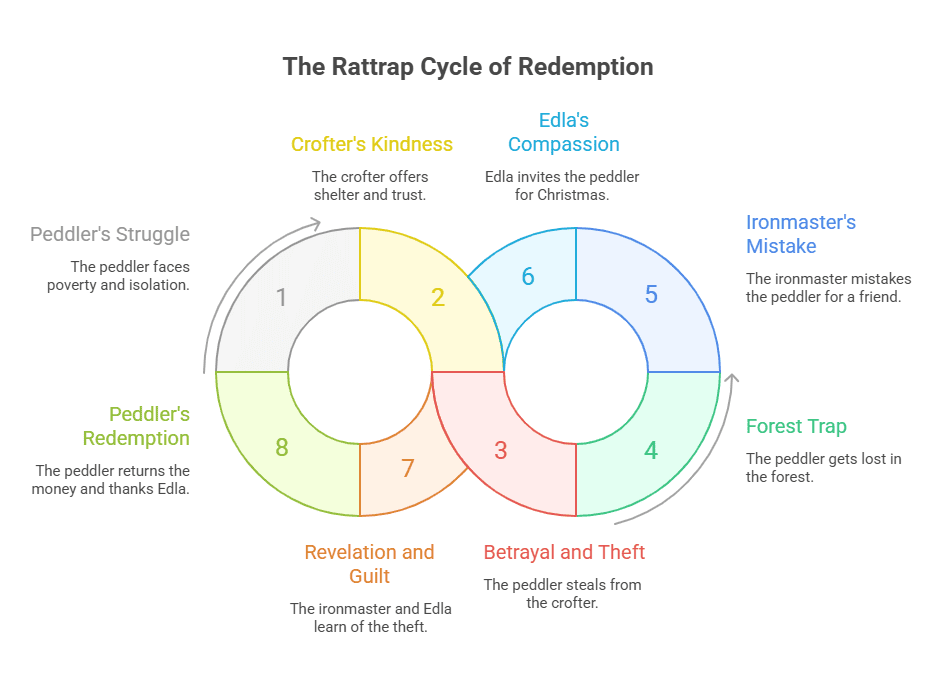
The Rattrap Summary Mind Map
Finish your entire Class 12 English prep in 24 hrs & ace your CBSE Boards 2026! – Concise chapter summaries (key events & ideas), lesson themes, Visual character sketches using mind maps Click here
Top
Question: In the class 12 lesson The Rattrap, elaborate on the journey of positive transformation in the rattrap seller.
Ans. The rattrap seller leads a very poor life as his earnings are very low. He has to resort to thievery and begging to make both ends meet. He is alone in this whole world and leads a miserable life. He sees the world with a cynical philosophy, viewing the riches and luxuries as cheese inside the rattrap to trap people. He comforts himself by mocking the rich people for being trapped in the rattrap.
He comes across a small cottage where a lonely, old crofter resides. His loneliness lowers his guard, and he welcomes the rattrap seller inside with an air of transparency and generosity. The rattrap seller is enticed by the temptations the old man provides and steals the money in the leather pouch. He runs to the woods to avoid the public areas but gets lost. Scared and lost, he feels frustrated that he fell for the temptation of riches and is now trapped in the rattrap. He regrets his actions.
Fortunately, he reaches Ramsjo Ironworks, and sits in front of the fire. The owner or ironmaster mistakes the rattrap seller to be Captain von Stahle and invites him to a warm Christmas celebration at his house. The rattrap seller again gets tempted and trapped inside the rattrap. The ironmaster takes care of the rattrap seller and gets him cleaned up. However, when he realises the true identity of his guest, he threatens to call the sherrif. The ironmaster’s daughter, Edla was the one who doubted the rattrap seller’s integrity and identity. However, she can see the regret and guilt in the peddler. She takes pity on him and his cynical philosophy and asks her father to let him stay for one Christmas. Edla’s kindness despite his past actions and critical thinking shatters the rattrap seller’s cynical philosophy.
Most people are either indifferent and harsh to him, especially after they get to know everything about him. However, Edla turns out to be completely different, which invokes a profound sense of gratitude and duty in the vagabond. He returns the stolen money and writes a heartwarming letter to convey his gratitude. He signs off as Captain von Stahle to showcase his appreciation for a chance to be a dignified man. His transformation from a vagabond to a dignified captain is the journey of positive transformation in the rattrap seller.
Questions based on the themes of The Rattrap
Question: What quality is common between Edla and the master smith in the lesson The Rattrap?
Ans. Edla and the master smith were both aware of the peddler’s true nature. The master blacksmith knew that the rattrap seller was a vagabond with petty tendencies because of his poor nature. Edla could tell that the rattrap seller was a thief who was guilty of his actions. However, despite observing these things, the master smith allowed him to stay in the Ramsjo Ironworks and did not tell the ironmaster that the man was not Captain von Stahle. Similarly, Edla still showed kindness to him and fulfilled the promise of giving him a comfortable Christmas. Therefore, both showed compassion and hospitality to a vagabond and thief.
Top

Question: In The Rattrap, how does the peddler interpret the acts of kindness and hospitality shown by Edla?
Ans. The cynic softens at the unconditional kindness displayed by Edla. The cynic in question is the protagonist, the rattrap seller, who sees the world as a rattrap. He sees rich people as rats who are trapped in a rattrap due to the temptation of riches and luxuries. However, because of his vagabond lifestyle and poverty, he himself fell into the rattrap many times in the chapter. Edla is the daughter of the owner of the Ramsjo Ironworks. When she finds out his true intentions and cynical viewpoint, she feels sympathy for the peddler and convinces her father to let him stay at their mansion. Seeing someone give him a chance even after knowing his identity and past actions surprises the peddler. He is amazed by her invitation for him to celebrate Christmas with them next year as well. The gentle treatment softens the cynic and encourages him to not only return the stolen money but to redeem himself as a dignified, honourable man.
Top
Question: How does the story “The Rattrap” portray the concept of gratitude and redemption in the rattrap seller? How does it show the redemptive power of love and compassion?
Ans. “Gratitude can be a driving force for redemption for a criminal.” The statement portrays that gratitude is a powerful emotion that can motivate a criminal to redeem themself and become a more respectable individual. In the chapter “The Rattrap”, we see that Edla’s kindness, despite the peddler’s actions, invokes gratitude in the peddler. He is so amazed by the comfortable stay and the invitation to come back next year makes the peddler thankful to Edla. He shows his gratitude through his redemption. He returns the stolen money, does not steal anything from the ironmaster, and signs off as “Captain von Stahle” to show his reformation.
Top
Question: How does “The Rattrap” highlight the power of kindness and human transformation?
Ans. The Rattrap highlights the power of kindness and human transformation through Edla’s kindness and the rattrap seller’s redemption. The rattrap seller has never been shown unconditional kindness. When people get to know the truth about him, they become harsh and indifferent, similar to the ironmaster. However, Edla allows him to stay at their manor house and requests her father to fulfill the promise he made to the peddler to give him a warm and comfortable stay for Christmas. Edla expresses her desire to give the peddler a peaceful rest, where he does not have to fear being arrested or cross-examined. Edla ensures that the peddler gets ample amount of food, rest, and even provides a suit for him. The kindness, generosity, and faith in him is a powerful force that makes him grateful. This gratitude leads him to try to be a respectable and honourable man, by returning the stolen money and leaving a rattrap as a Christmas present for her.
Top
Question: In what way in the Class 12 story The Rattrap does the character of the Ironmaster differ from that of his daughter?
Ans. The ironmaster and his daughter, Edla Willmansson play a pivotal role in the lesson. However, both differ greatly in terms of personality and attitude. We see that they both were doubtful of the peddler’s integrity, but at two different times. Edla was doubtful before she knew the truth, but the ironmaster had complete faith in him then. In complete contrast, the ironmaster became distrustful after he became aware of the peddler’s true identity and intentions, but Edla showed kindness and decided to give him a chance to redeem himself. Therefore, we see that the ironmaster is compassionate to those he knew and trusted, whereas Edla is compassionate regardless of a person’s past actions.
Top
Question: In the class 12 lesson “The Rattrap”, what was the philosophy of the peddler about his life?
Ans. The peddler has a cynical philosophy about his life. He views the world as a giant rattrap containing riches and luxuries as baits that lure people into it. He has seen that every person in the world is enticed by money, comforts and happiness. Once they get tempted, people get caught in the trap from which they cannot escape. The cynical philosophy is comforting to the peddler who is poverty-stricken and feels bitter about his vagabond lifestyle.
Top
Question: How is the concept of ‘bait’ illustrated through the character of the peddler in the story “The Rattrap”? Explain with the help of instances given in the story.
Ans. The character of the peddler in the story “The Rattrap” believes that the world to be a giant rattrap in which money and comforts are baits to lure people in. This concept of bait is illustrated in the story when the peddler himself falls into his own metaphorical rattrap. The peddler takes advantage of the crofter’s confidence in him and steals his thirty kronor. Therefore, by getting tempted and stealing the money, the peddler does not have a choice but to run into the woods. He cannot go out in public because he might get caught. As he runs through the woods, he gets lost. He walks for hours and hours, trying to find a place to stay. The night falls and the woods become colder. He hasn’t eaten, drunk water, or rested for a long time. He then realises that he himself has fallen into the rattrap by stealing the crofter’s money. He then regrets stealing money and faces the consequences of his actions, making him feel guilty. Therefore, it shows that people get lured by bait not just out of greed but also out of poverty-driven desperation.
Top
Question: Compare and contrast the crofter and Edla.
Ans. The crofter and Edla are good samaritans but with contrasting attitudes. The crofter is gullible and foolishly confided his secrets to a stranger and his kindness was taken advantage of. Edla is a good samaritan but also cautious. She welcomes the peddler only when she knows the complete truth about his life and intentions. Compared to the crofter, she was smart and wise but compassionate and understanding.
Top
Question: What is the theme of the story “The Rattrap”?
Ans. “The Rattrap” is centered around the power of unconditional kindness to the needy. The chapter is centered around the changes brought by unconditional kindness and generosity of the crofter and Edla to the needy and lonely people. Even though the ironmaster’s daughter, Edla Willmansson, is doubtful of the peddler’s integrity before, she wishes to give the poor man a comfortable and safe place and she requests her father to let him stay. This invokes the emotion of amazement and gratitude in the peddler. Gratitude is the driving force for motivation, transformation, and redemption. Edla’s kindness despite the peddler’s actions invokes gratitude in the peddler. The peddler is given unconditional kindness which shatters his cynical and pessimistic point of view. He feels the need to redeem himself in the eyes of the ironmaster and the crofter and take accountability for his past actions. This leads to a positive transformation in the peddler, from a ruthless vagabond to a dignified man. We can see his redemption when he returns the stolen money and signs off the note he left behind as “Captain von Stahle”.
Are you looking for the Summary and Explanation Video of The Rattrap Class 12?
Watch the video-
The Rattrap Previous Year Questions with Model Answers PDF
Download the previous year questions of the Lesson The Rattrap of class 12 English for free. With the help of this, you can prepare for the exam.
To Download The Rattrap Previous Year Questions with Model Answers- Click Here
The Rattrap Explanation
Question: In the class 12 chapter “The Rattrap”, how was the life of the peddler? Describe the appearance of the peddler in The Rattrap.
Passage: Once upon a time there was a man who went around selling small rattraps of wire. He made them himself at odd moments, from the material he got by begging in the stores or at the big farms. But even so, the business was not especially profitable, so he had to resort to both begging and petty thievery to keep body and soul together. Even so, his clothes were in rags, his cheeks were sunken, and hunger gleamed in his eyes.
No one can imagine how sad and monotonous life can appear to such a vagabond, who plods along the road, left to his own meditations. But one day this man had fallen into a line of thought, which really seemed to him entertaining.
Word Meanings
Odd Moments: A short period of free time.
Sunken: lowered
Gleamed: Shone
Monotonous: boring
Vagabond: wanderer
Plods: walks heavily
Explanation / Answer: Once there was a man who used to sell small rattraps made of wire. These rattraps were made by him in his free time. He used to collect the material required by begging from stores or big farms. Still his business was not earning him any profits. Therefore, he had to beg or steal in order to survive. His clothes were old and torn. His cheeks were lowered inside due to malnutrition and one could easily see the hunger in his eyes.
The life of the rattrap seller was very sad and boring. He was homeless and slowly, with heavy feet, he walked along the road, lost in his own thoughts. But one day he got lost in a series of thoughts which he found very interesting.
Question: What was the peddler’s philosophy about the rattrap?
Passage: He had naturally been thinking of his rattraps when suddenly he was struck by the idea that the whole world about him — the whole world with its lands and seas, its cities and villages — was nothing but a big rattrap. It had never existed for any other purpose than to set baits for people. It offered riches and joys, shelter and food, heat and clothing, exactly as the rattrap offered cheese and pork, and as soon as anyone let himself be tempted to touch the bait, it closed in on him, and then everything came to an end.
Word Meanings
Bait: Food placed on a hook to trap a rat, here it is referred to the comforts of life, which is offered to trap someone
Tempted: convinced
Explanation / Answer: The man was thinking about the rattrap and suddenly, a thought came to his mind that the whole world which includes land, sea, cities and villages was similar to a rattrap. He thought that there was no meaning of the existence of this world. It was nothing but a temptation, just like cheese and pork which we offer as bait to catch the rat. So according to him, as soon as someone tries to comfort himself with joy, food and shelter he at once gets trapped into this rattrap which is known as ‘world’.
Top
Question: Why did the peddler derive pleasure from his idea of the world?
Passage: The world had, of course, never been very kind to him, so it gave him unusual joy to think ill of it in this way. It became a cherished pastime of his, during many dreary ploddings, to think of people he knew who had let themselves be caught in the dangerous snare, and of others who were still circling around the bait.
Word Meanings
Cherished: to love, protect
Dreary: dull
Ploddings: walk heavily
Snare: trap
Explanation / Answer: No one in the world had ever been kind to the rattrap seller. So, he started thinking ill of others. It became a favorite pastime for him. During dull moments, these thoughts made him happy. So, he continued with thinking ill of those who were known to him. He would imagine those people who were already trapped in the rattrap of worldly things and also those who were about to get trapped in it.
Question: What is the theme of loneliness that runs through the class 12 lesson “The Rattrap”?
Passage: One dark evening as he was trudging along the road he caught sight of a little gray cottage by the roadside, and he knocked on the door to ask shelter for the night. Nor was he refused. Instead of the sour faces which ordinarily met him, the owner, who was an old man without wife or child, was happy to get someone to talk to in his loneliness.
Immediately he put the porridge pot on the fire and gave him supper; then he carved off such a big slice from his tobacco roll that it was enough both for the stranger’s pipe and his own. Finally he got out an old pack of cards and played ‘mjolis’ with his guest until bedtime.
Word Meanings
Trudging: walking slowly
Carved off: to divide something into parts
mjolis: a game played with playing cards
Explanation / Answer: One evening the rattrap seller was walking very slowly. He saw a little gray cottage which stood by the road. He went up to the cottage and knocked at the door so as to get shelter for the night. Generally he was not helped by anyone but this time he was welcomed by the old man into his cottage. He was a lonely old man without wife and kids. The old man was happy to get company that night. So, the old man gave him some porridge to eat and then shared his tobacco with the guest. After this, both played cards till bedtime.
Top
Question: In the class 12 story “The Rattrap”, what is the role of the cow in the old crofter’s life?
Passage: The old man was just as generous with his confidences as with his porridge and tobacco. The guest was informed at once that in his days of prosperity his host had been a crofter at Ramsjo Ironworks and had worked on the land. Now that he was no longer able to do day labour, it was his cow which supported him. Yes, that bossy was extraordinary. She could give milk for the creamery every day, and last month he had received all of thirty kronor in payment.
Word Meanings
Generous: liberal
Confidences: Secrets
Prosperity: riches
Crofter: A person who works on a rented farm
Bossy: Latin word ‘bos’ used for a cow
Creamery: A factory that produces cheese and cream
Kronor: Currency of Sweden
Explanation / Answer: The rattrap seller felt that the old man was not only liberal in sharing his porridge but also his secrets. He tells him that he was a rich man when he used to work on the rented farm. As he was old now and couldn’t work, so, he had to depend upon his cow for his living. The cow gave enough milk everyday to be sold in the factory that produced cheese and cream. The old man said that he was able to earn thirty kronors last month because of the cow’s milk.
Top
Question: Describe how the crofter’s loneliness and pride led to his own downfall in “The Rattrap”.
Passage: The stranger must have seemed incredulous, for the old man got up and went to the window, took down a leather pouch which hung on a nail in the very window frame, and picked out three wrinkled ten-kronor bills. These he held up before the eyes of his guest, nodding knowingly, and then stuffed them back into the pouch.
The next day both men got up in good season. The crofter was in a hurry to milk his cow, and the other man probably thought he should not stay in bed when the head of the house had gotten up. They left the cottage at the same time. The crofter locked the door and put the key in his pocket. The man with the rattraps said goodbye and thank you, and thereupon each went his own way.
But half an hour later the rattrap peddler stood again before the door. He did not try to get in, however. He only went up to the window, smashed a pane, stuck in his hand, and got hold of the pouch with the thirty kronor. He took the money and thrust it into his own pocket. Then he hung the leather pouch very carefully back in its place and went away.
Word Meanings
Incredulous: unbelieving
Stuffed: to fill up with something
In a good season: early enough
Peddler: seller
Smashed: badly broken
Explanation / Answer: The rattrap seller did not believe the old man’s words that a cow could earn him so much. Therefore, the old man took a leather pouch which hung on a window and took out three notes of ten kronor each which were old and crushed. He showed those currency notes to make him believe his words and then kept them back in the pouch.
Next morning, both the rattrap seller and the crofter woke up early as the crofter was in a hurry to milk his cow. Even the rattrap seller felt that as the owner of the house had awakened, so he should also leave the bed. They both came out of the cottage at the same time. The old man locked the door and went to his work. The rattrap seller also thanked him and went his own way.
After about half an hour the rattrap seller returned to the cottage and he broke down the window pane where the pouch hung. He took away the money, kept it in his pocket, put the pouch back at its place and walked off.
Top
Question: What happened with the rattrap seller in the woods? Why did the peddler recall his thoughts about the world and the rattrap when he was lost in the big and confusing forest?
Passage: As he walked along with the money in his pocket he felt quite pleased with his smartness. He realised, of course, that at first he dared not continue on the public highway, but must turn off the road, into the woods. During the first hours this caused him no difficulty. Later in the day it became worse, for it was a big and confusing forest which he had gotten into. He tried, to be sure, to walk in a definite direction, but the paths twisted back and forth so strangely! He walked and walked without coming to the end of the wood, and finally he realised that he had only been walking around in the same part of the forest. All at once he recalled his thoughts about the world and the rattrap. Now his own turn had come. He had let himself be fooled by a bait and had been caught. The whole forest, with its trunks and branches, its thickets and fallen logs, closed in upon him like an impenetrable prison from which he could never escape.
Word Meanings
Thickets: A dense group of bushes
Impenetrable: impassable
Explanation / Answer: The peddler was quite happy as he had money in his pocket. He then thought of walking through the forest as it was unsafe to walk on the highway because he feared being caught. So, initially it was not difficult to walk through the forest but later on it got confusing for him as he forgot his way. He tried hard to walk in the right direction but in vain as he found himself at the same place again and again. At this point of time he started thinking that now he himself was caught in the trap of the world just like other people. He was fooled by the bait of money which he had stolen from the old man’s house. The forest seemed like a prison full of trunks and branches. It was like an impassable prison.
Passage: It was late in December. Darkness was already descending over the forest. This increased the danger, and increased also his gloom and despair. Finally he saw no way out, and he sank down on the ground, tired to death, thinking that his last moment had come. But just as he laid his head on the ground, he heard a sound—a hard regular thumping. There was no doubt as to what that was. He raised himself. ‘‘Those are the hammer strokes from an iron mill’’, he thought. ‘‘There must be people nearby’’. He summoned all his strength, got up, and staggered in the direction of the sound.
Word Meanings
Gloom: dark
Despair: hopelessness
Thumping: the sound of some heavy object beating
Summoned: gathered
Stagger: To walk with difficulty
Explanation of the above Passage: As it was the month of December, it got dark early. As it got dark, his hope of escaping the forest reduced. The danger to his life increased and so did his feeling of being hopeless. There was no way left for him. So, he sat on the ground and was so tired and terrified that he thought this was his last moment and soon he would die. As he laid his head on the ground, he heard a very strong regular sound. It was a hard sound that was coming at the regular intervals. He soon realized that these sounds were the sounds of hammer strokes from an iron mill. He thought that he could find some people nearby. With this thought, he gathered some strength and started walking with great difficulty, towards the direction of the sound.
Top
Question: In the lesson “The Rattrap”, what happened at the Ramsjo iron works in summer and in winter?
Passage: The Ramsjo Ironworks, which are now closed down, were, not so long ago, a large plant, with smelter, rolling mill, and forge. In the summertime long lines of heavily loaded barges and scows slid down the canal, which led to a large inland lake, and in the wintertime the roads near the mill were black from all the coal dust which sifted down from the big charcoal crates.
Word Meanings
Forge: A shop where metal is heated
Barge: a long flat-bottomed boat for carrying freight on canals and rivers.
Scow: a flat-bottomed boat used for transporting cargo to and from ships in harbor.
sifted: descended lightly or sparsely as if sprinkled from a sieve
Smelter: A machine in which metal is melted to form into a shape
Rolling mill: machine to roll metal into sheets
Explanation / Answer: The Ramsjo Ironworks was a large plant that had shut down a few years ago. It had a smelter, rolling mill, and a forge. In summers, long, flat bottomed boats carrying the material would come down the canal which led to a large inland lake for supplying material to the mill, and in winters, the roads turned black because of the coal dust that came along due to the transportation of the charcoal crates.
Top
Question: Describe the scene at the ironmill in the story “The Rattrap”.
Passage: During one of the long dark evenings just before Christmas, the master smith and his helper sat in the dark forge near the furnace waiting for the crude iron, which had been put in the fire, to be ready to put on the anvil. Every now and then one of them got up to stir the glowing mass with a long iron bar, returning in a few moments, dripping with perspiration, though, as was the custom, he wore nothing but a long shirt and a pair of wooden shoes.
All the time there were many sounds to be heard in the forge. The big bellows groaned and the burning coal cracked. The fire boy shoveled charcoal into the maw of the furnace with a great deal of clatter. Outside roared the waterfall, and a sharp north wind whipped the rain against the brick-tiled roof.
It was probably on account of all this noise that the blacksmith did not notice that a man had opened the gate and entered the forge, until he stood close up to the furnace.
Word Meanings
Anvil: a heavy iron block with a flat top and concave sides
Perspiration: sweat
Bellows: air bag that emits a stream of air used for blowing air into a fire.
Shoveled: move
Maw: jaws
Clatter: bang
Whipped: beaten with a whip, here to hit something
Explanation / Answer: On one long, dark evening near Christmas time, the master smith and his helper were sitting in the dark forge, which was built near the furnace. He was wearing a long shirt and a pair of wooden shoes. Both of them were waiting for the pig iron which was put inside the furnace fire to be ready to put onto the anvil. (Anvil is a heavy block with a flat top which is used to shape the metals.) They took turns to stir the liquid which was very hot. As they could bear the heat for a few minutes, each of them would return, sweating profusely.
One could hear different types of sounds in the forge. There was a big bellow which was blowing air in the fire with great sound. Also, there was the sound of cracking coal. One could also hear the bang of the charcoal which was being shoveled by the fire boy. The sounds were coming from outside the mill. These were of the waterfall, the high-speed north wind which hit the raindrops against the brick tiled roof.
It was due to these different types of sounds that the blacksmith didn’t realize that a man had opened the gate of the forge and had entered, till he came and stood near the furnace.
Top
Question: Why did vagabonds get attracted to the furnace in the class 12 lesson “The Rattrap”?
Passage: Surely it was nothing unusual for poor vagabonds without any better shelter for the night to be attracted to the forge by the glow of light which escaped through the sooty panes and to come in to warm themselves in front of the fire. The blacksmiths glanced only casually and indifferently at the intruder. He looked the way people of his type usually did, with a long beard, dirty, ragged, and with a bunch of rattraps dangling on his chest.
He asked permission to stay, and the master blacksmith nodded a haughty consent without honoring him with a single word.
Word Meanings
Sooty panes: windowpanes covered in soot ( black powder produced when coal, wood etc is burned.
Haughty: arrogant
Explanation / Answer: Many homeless people used to get attracted to the lights of the forge which peeked through the window panes which were covered with the black powder of burnt coal. They would seek shelter there. They would warm themselves with the help of the burning fire. As the blacksmiths were accustomed to visitors, they were indifferent to the man. They just looked at him. The rattrap seller’s appearance was similar to that of other wanderers. He had a long beard, was dirty, wore old worn out clothes and had a bunch of rattraps hanging from his chest.
The peddler tried to seek permission from the blacksmith so that he could stay in the forge for a night. He allowed the peddler with an arrogant consent by just nodding and didn’t say a single word to him.
Top
Question: In the lesson “The Rattrap”, why did the Iron master visit the mill that night?
Passage: The tramp did not say anything, either. He had not come there to talk but only to warm himself and sleep. In those days the Ramsjo iron mill was owned by a very prominent ironmaster, whose greatest ambition was to ship out good iron to the market. He watched both night and day to see that the work was done as well as possible, and at this very moment he came into the forge on one of his nightly rounds of inspection.
Naturally the first thing he saw was the tall ragamuffin who had eased his way so close to the furnace that steam rose from his wet rags. The ironmaster did not follow the example of the blacksmiths, who had hardly deigned to look at the stranger. He walked close up to him, looked him over very carefully, and then tore off his slouch hat to get a better view of his face.
Word Meanings
Prominent: Important
Tramp: vagabond, wanderer
Ragamuffin: A person in rags
Deigned: do something that one considers to be beneath one’s dignity
Slouch hat: hat bend on one side of the head.
Explanation / Answer: The peddler also said nothing because his main aim was to warm himself and sleep. The owner of the Ramsjo iron mill in those days was a very ambitious person whose aim was to sell only the finest iron into the market. Therefore, he used to keep a check on the workers both during the night and the day. The owner was on a night inspection visit when the peddler entered the forge.
Unlike the blacksmiths, the ironmaster at once noticed the peddler who was sitting so close to the furnace that steam was coming out of his torn clothes. He not only went near him but also removed the wanderer’s hat that was bent to one side so that he could see the man’s face clearly.
Top
Question: In the class 12 lesson, “The Rattrap”, why did the Ironmaster talk kindly to the peddler and invite him home?
Passage: ‘‘But of course it is you, Nils Olof!’’ he said. “How you do look!” The man with the rattraps had never before seen the ironmaster at Ramsjo and did not even know what his name was. But it occurred to him that if the fine gentleman thought he was an old acquaintance, he might perhaps throw him a couple of kronor. Therefore he did not want to undeceive him all at once.
‘‘Yes, God knows things have gone downhill with me’’, he said.
‘‘You should not have resigned from the regiment’’, said the ironmaster. ‘‘That was the mistake. If only I had still been in the service at the time, it never would have happened.
Well, now of course you will come home with me.’’
Word Meanings
Acquaintance: associate
Undeceive: to tell someone that his belief is mistaken
Downhill: worst
Regiment: unit in the army or defence forces
Explanation / Answer: When the iron master took off the peddler’s hat, he mistook him as an old acquaintance- Nils Olof. The peddler didn’t know him nor had he seen this man before. But he thought that if this man mistook him as his old companion and gave him some money out of pity, then it would be a good thing. Therefore, he didn’t let him know that he had mistaken him as Nils Olof.
So, the peddler started a conversation with the iron master by saying that things didn’t went well with him. To this, the iron master replied that he had made a big mistake by leaving the regiment. He also added that if he would have been working in the regiment when he resigned, he wouldn’t have let him do so. Later on he invited him to his home.
Top
Question: Why was the vagabond not ready to go with the ironmaster to his house?
Passage: To go along up to the manor house and be received by the owner like an old regimental comrade — that, however, did not please the tramp. ‘No, I couldn’t think of it!’’ he said, looking quite alarmed. He thought of the thirty kronor. To go up to the manor house would be like throwing himself voluntarily into the lion’s den. He only wanted a chance to sleep here in the forge and then sneak away as inconspicuously as possible.
The ironmaster assumed that he felt embarrassed because of his miserable clothing.
‘‘Please don’t think that I have such a fine home that you cannot show yourself there’’, He said… ‘‘Elizabeth is dead, as you may already have heard. My boys are abroad, and there is no one at home except my oldest daughter and myself. We were just saying that it was too bad we didn’t have any company for Christmas. Now come along with me and help us make the Christmas food disappear a little faster.”
Word Meanings
Manor house: A large country house
Comrade: A fellow soldier
Alarmed: Frighten
Inconspicuously: invisible or which is not noticeable
Explanation / Answer: The rattrap seller didn’t find it to be a good idea to visit the iron master’s place. He was frightened with the idea of visiting to the large house of an old soldier which according to him was not safe. After all he had the stolen money with him. He didn’t want to put himself in danger. His intentions were to sleep in the forge and then go away from there without even being noticed.
The iron master was aware of his friend’s miserable condition. So he tried to make him comfortable by saying that he should feel free to come his home as his home was an ordinary one. He told him that his wife was no more and added that he must be aware of this. Then he let him know that both his sons were settled abroad. Only he and his daughter were left at home. He invited him to celebrate Christmas with his family. So, that he and his daughter may have some good company at the Christmas feast.
Top
Question: In the class 12 chapter “The Rattrap”, who did the ironmaster mistake the peddler for?
Passage: But the stranger said no, and no, and again no, and the ironmaster saw that he must give in.
‘‘It looks as though Captain von Stahle preferred to stay with you tonight, Stjernstrom’’, he said to the master blacksmith, and turned on his heel.
But he laughed to himself as he went away, and the blacksmith, who knew him, understood very well that he had not said his last word.
Explanation / Answer: Though the ironmaster made many attempts to invite him, the peddler didn’t accept his invitation. So, at last he says to the blacksmith, Stjernstrom that it seemed that Captain Von Stahle (the army comrade whom he mistook to be the peddler) wanted to stay with him in the forge.
Then he laughed and went away. But the blacksmith knew that he was hiding something.
Top
Question: Who sent Edla to the mill? Why?
Passage: It was not more than half an hour before they heard the sound of carriage wheels outside the forge, and a new guest came in, but this time it was not the ironmaster. He had sent his daughter, apparently hoping that she would have better powers of persuasion than he himself.
Explanation / Answer: After a gap of half an hour, the ironmaster sent his daughter Edla to the Iron mill. He hoped that his daughter might be successful and bring his army comrade friend home, as he believed that she was better at persuading others.
Passage: She entered, followed by a valet, carrying on his arm a big fur coat. She was not at all pretty, but seemed modest and quite shy. In the forge everything was just as it had been earlier in the evening. The master blacksmith and his apprentice still sat on their bench, and iron and charcoal still glowed in the furnace. The stranger had stretched himself out on the floor and lay with a piece of pig iron under his head and his hat pulled down over his eyes. As soon as the young girl caught sight of him, she went up and lifted his hat. The man was evidently used to sleeping with one eye open. He jumped up abruptly and seemed to be quite frightened.
‘‘My name is Edla Willmansson,’’ said the young girl. ‘‘My father came home and said that you wanted to sleep here in the forge tonight, and then I asked permission to come and bring you home to us. I am so sorry, Captain, that you are having such a hard time.’’
She looked at him compassionately, with her heavy eyes, and then she noticed that the man was afraid. ‘‘Either he has stolen something or else he has escaped from, jail’’, she thought, and added quickly, “You may be sure, Captain, that you will be allowed to leave us just as freely as you came. Only please stay with us over Christmas Eve.’’
Word Meanings
Valet: personal attendant
Modest: humble
Apprentice: learner
Compassionately: showing sympathy for others
Explanation / Answer: The iron master’s daughter entered the mill with her attendant who was carrying a big fur coat. She was a humble girl who was very shy. When she entered, everyone was busy the same way as they had been earlier. The blacksmith was still sitting on the bench with his trainees and was working on the iron. She went up to the peddler and lifted his hat. The peddler slept with one eye open and as soos as he saw her, he got shocked and jumped up.
She introduced herself as Edla Williamson and was sorry to hear about the hard times that he was facing. She explained to him that she had come to take him home with her father’s permission.
Edla had sympathy for the peddler. But then she noticed that the reason behind his fear could be that either he had committed robbery or jailbreak. So, she said that he was free to leave their house at any time but she wanted him to stay with the family just for Christmas Eve.
Top
Question: In the class 12 lesson “The Rattrap” why did the peddler accept the invitation extended by Edla?
Passage: She said this in such a friendly manner that the rattrap peddler must have felt confidence in her. ‘‘It would never have occurred to me that you would bother with me yourself, miss,’’ he said. ‘’I will come at once.’’
He accepted the fur coat, which the valet handed him with a deep bow, threw it over his rags, and followed the young lady out to the carriage, without granting the astonished blacksmiths so much as a glance. But while he was riding up to the manor house he had evil forebodings.
‘‘Why the devil did I take that fellow’s money?’’ he thought. ‘‘Now I am sitting in the trap and will never get out of it.’
Word Meanings
Astonished: greatly surprised
Forebodings: a foretelling
Explanation / Answer: Edla was talking to peddler in a very nice way which made him believe her and he got ready to go with her.
The peddler wore the fur coat offered by the valet and started following the lady. He didn’t even bother to notice the other people in the room. On the way to the house, the peddler felt that as he had committed a crime, he would be punished for it.
He started cursing himself that if he had not stolen the money, he would not have got trapped like this. The money was a bait which had led him into a trap.
Top
Question: How did the Ironmaster and Edla differ in recognizing strangers?
Passage: The next day was Christmas Eve, and when the ironmaster came into the dining room for breakfast he probably thought with satisfaction of his old regimental comrade whom he had run across so unexpectedly.
“First of all we must see to it that he gets a little flesh on his bones,” he said to his daughter, who was busy at the table. “And then we must see that he gets something else to do than to run around the country selling rattraps.”
“It is queer that things have gone downhill with him as badly as that,” said the daughter. “Last night I did not think there was anything about him to show that he had once been an educated man.”
“You must have patience, my little girl,” said the father. “As soon as he gets clean and dressed up, you will see something different. Last night he was naturally embarrassed. The tramp manners will fall away from him with the tramp clothes.”
Word Meanings
Flesh on his bones: here it means that the seller should eat good food to gain some flesh on his body
Queer: strange
Embarrassed: awkward, shy
Explanation / Answer: The next day was Christmas Eve, both the ironmaster and his daughter were at the dining table. The ironmaster said to his daughter that they had to do something good for the peddler and should try to find some better job for him.
The iron master’s daughter said that it was strange to see that the peddler had been in such hard times and was doubtful whether the man had been educated. Hearing this, the ironmaster clarified that it was due to his bad condition. He also added that the man would behave differently after getting clean and dressed up.
Top
Question: In the story The Rattrap, when did the Ironmaster realize his mistake? How did the Ironmaster react on realizing his mistake?
Passage: Just as he said this the door opened and the stranger entered. Yes, now he was truly clean and well dressed. The valet had bathed him, cut his hair, and shaved him.
Moreover he was dressed in a good-looking suit of clothes which belonged to the ironmaster. He wore a white shirt and a starched collar and whole shoes.
But although his guest was now so well groomed, the ironmaster did not seem pleased. He looked at him with puckered brow, and it was easy to understand that when he had seen the strange fellow in the uncertain reflection from the furnace he might have made a mistake, but that now, when he stood there in broad daylight, it was impossible to mistake him for an old acquaintance. “What does this mean?” he thundered. The stranger made no attempt to dissimulate. He saw at once that the splendor had come to an end.
“It is not my fault, sir,” he said. “I never pretended to be anything but a poor trader, and I pleaded and begged to be allowed to stay in the forge. But no harm has been done. At worst I can put on my rags again and go away”. “Well,” said the ironmaster, hesitating a little, “it was not quite honest, either. You must admit that, and I should not be surprised if the sheriff would like to have something to say in the matter.”
Word Meanings
Starched collar: Starch is the stuff that makes your shirt collar look crisp and fresh.
Whole shoes: Proper fitted shoes
Groomed: ready
Puckered: wrinkle
Dissimulate: pretend
Splendor: luxury
Thundered: make a loud noise
Hesitating: to be reluctant
Sheriff: chief executive officer of crown (in England)
Explanation / Answer: While both father – daughter were discussing about the peddler, he entered the room with the valet. He was looking clean as he had bathed and his hair had been cut by the valet. He was wearing the ironmaster’s clothes and shoes – a shirt with a starched collar and shoes which covered the entire feet.
The ironmaster seemed very angry to see his well groomed guest as now he could make out his appearance well and realized that he was not his comrade. He understood that he mistook some stranger as his old friend. He screamed at him and asked him to explain. The peddler knew that the iron master could make out that he was not his old friend. As he already knew this, he was ready for the consequences and felt that the luxurious treatment was about to end.
The peddler tried to explain that he should not be blamed. He said that he was just begging for a stay in the forge. He also said that he had not harmed anyone and was ready to wear his rags again. To this, the ironmaster hesitated and said that the peddler had not been quite honest and so, he wanted to call the sheriff.
Top
Question: In “The Rattrap”, what did the peddler say when the ironmaster threatened to call the sheriff?
Passage: The tramp took a step forward and struck the table with his fist. “Now I am going to tell you, Mr. Ironmaster, how things are,” he said. “This whole world is nothing but a big rattrap. All the good things that are offered to you are nothing but cheese rinds and bits of pork, set out to drag a poor fellow into trouble. And if the sheriff comes now and locks me up for this, then you, Mr. Ironmaster, must remember that a day may come when you yourself may want to get a big piece of pork, and then you will get caught in the trap.”
The ironmaster began to laugh. “That was not so badly said, my good fellow. Perhaps we should let the sheriff alone on Christmas Eve. But now get out of here as fast as you can.”
Word Meanings
Fist: A person’s hand bent
Explanation / Answer: The rattrap seller gets so enraged upon hearing about the sheriff, that he struck the table very hard with his fist. He said that this world is a rattrap and all the good things are a bait just like the rinds of cheese and the small pieces of pork are a bait for the rat which are offered to trap it. Not only this, he also pointed out to the ironmaster that he may today be imprisoned by the sheriff but one day, the ironmaster will also get trapped like this.
The iron master didn’t like the peddler’s words and decided not to call the sheriff. He asked the peddler to leave at once.
Top
Question: Why did Edla Willmansson insist on keeping the peddler home despite knowing his real identity?
Passage: But just as the man was opening the door, the daughter said, “I think he ought to stay with us today. I don’t want him to go.” And with that she went and closed the door. “What in the world are you doing?” said the father. The daughter stood there quite embarrassed and hardly knew what to answer. That morning she had felt so happy when she thought how homelike and Christmassy she was going to make things for the poor hungry wretch. She could not get away from the idea all at once, and that was why she had interceded for the vagabond.
“I am thinking of this stranger here,” said the young girl. “He walks and walks the whole year long, and there is probably not a single place in the whole country where he is welcome and can feel at home. Wherever he turns he is chased away. Always he is afraid of being arrested and cross-examined. I should like to have him enjoy a day of peace with us here — just one in the whole year.” The ironmaster mumbled something in his beard. He could not bring himself to oppose her. “It was all a mistake, of course,” she continued. “But anyway I don’t think we ought to chase away a human being whom we have asked to come here, and to whom we have promised Christmas cheer.”
Word Meanings
Wretch: miserable person
Interceded: intervened
Explanation / Answer: The iron master’s daughter stopped the peddler. She wanted to help the poor fellow. Since morning, she was planning how she could make the peddler’s day happy on the occasion of Christmas. Therefore, she went against her father’s will and stopped him by closing the door.
She tried to explain the difficulties faced by the peddler. She said that he didn’t have any house. He was turned out from wherever he went and he always kept on running in order to safeguard himself from being arrested. She said that she wanted him to enjoy Christmas with peace as they had promised him. They should not send away a man on Christmas, the man whom they had promised happiness on the day. The iron master was not able to find an answer to go against his daughter.
Top
Question: What is the meaning of “You do preach worse than a parson”? In the class 12 story The Rattrap, why did the ironmaster compare Edla to a parson?
Passage: “You do preach worse than a parson,” said the ironmaster. “I only hope you won’t have to regret this.” The young girl took the stranger by the hand and led him up to the table.
“Now sit down and eat,” she said, for she could see that her father had given in.
Word Meanings
Preach: advice
Parson: Churchman
Explanation / Answer: The only thing he could say to his daughter was that she was trying good at convincing others – better than the priest at the church. But he also warned her that hopefully, her decision would not bring any adverse effect on them. The girl took the peddler to the table and offered him food. She saw that her father had consented to her wish.
Passage: The man with the rattraps said not a word; he only sat down and helped himself to the food. Time after time he looked at the young girl who had interceded for him. Why had she done it? What could the crazy idea be?
After that, Christmas Eve at Ramsjo passed just as it always had. The stranger did not cause any trouble because he did nothing but sleep. The whole forenoon he lay on the sofa in one of the guest rooms and slept at one stretch. At noon they woke him up so that he could have his share of the good Christmas fare, but after that he slept again. It seemed as though for many years he had not been able to sleep as quietly and safely as here at Ramsjo.
In the evening, when the Christmas tree was lighted, they woke him up again, and he stood for a while in the drawing room, blinking as though the candlelight hurt him, but after that he disappeared again. Two hours later he was aroused once more. He then had to go down into the dining room and eat the Christmas fish and porridge.
As soon as they got up from the table he went around to each one present and said thank you and good night, but when he came to the young girl she gave him to understand that it was her father’s intention that the suit which he wore was to be a Christmas present — he did not have to return it; and if he wanted to spend next Christmas Eve in a place where he could rest in peace, and be sure that no evil would befall him, he would be welcomed back again.
The man with the rattraps did not answer anything to this. He only stared at the young girl in boundless amazement. The next morning the ironmaster and his daughter got up in good season to go to the early Christmas service. Their guest was still asleep, and they did not disturb him.
Word Meanings
Boundless: limitless
Amazement: wonder
Explanation / Answer: The peddler didn’t say a word and started eating. Though he was doubtful about her intentions and was wondering why she stopped him.
The peddler went to sleep after having food. He did not cause harm to anyone and lay down on the sofa in the guest house. He was once woken up in the afternoon but after having his lunch he again went to sleep. It was like as if he had never got the chance to sleep so peacefully as he had got at this place.
In the evening, the family woke him as they had to light up the Christmas tree. He stood there blinking as if he was getting hurt by the bright light of the candles. He again went to sleep. Finally they called him again for the dinner of Christmas fish and porridge.
After the dinner was over, the peddler thanked everyone present. The ironmaster’s daughter said that the clothes which were given to him were a Christmas present from her father. So, he could carry them with him. She even invited the peddler to be with her family for the next Christmas Eve and promised that nothing bad would happen to him.
The peddler did not have an answer for this and stared at the girl with wonder. Next day both ironmaster and his daughter went for the Christmas service early in the morning. They didn’t disturb their guest as he was asleep.
Top
Question: Why was Edla sad while returning from the church?
Passage: When, at about ten o’clock, they drove back from the church, the young girl sat and hung her head even more dejectedly than usual. At church she had learned that one of the old crofters of the ironworks had been robbed by a man who went around selling rattraps. “Yes, that was a fine fellow you let into the house,” said her father. “I only wonder how many silver spoons are left in the cupboard by this time.”
Word Meanings
Dejected: sad
Explanation / Answer: Both iron master and his daughter had come to know that a rattrap seller had stolen money from the old crofter. They realized that he was the same man whom they had over as a guest. The ironmaster said that it was his daughter who insisted to give shelter to a thief and was wondering that how many silver spoons had been stolen by him.
Passage: The wagon had hardly stopped at the front steps when the ironmaster asked the valet whether the stranger was still there. He added that he had heard at church that the man was a thief. The valet answered that the fellow had gone and that he had not taken anything with him at all. On the contrary, he had left behind a little package which Miss Willmansson was to be kind enough to accept as a Christmas present.
Explanation of the above Passage:The ironmaster, on reaching home enquired about the peddler from the valet. He also told him that he was a thief. To his surprise, the valet told him that the peddler, instead of taking something had left a small Christmas gift for Miss Willmansson.
Top
Question: In The Rattrap, what gift did the peddler leave for Edla and why was she happy to see it?
Passage: The young girl opened the package, which was so badly done up that the contents came into view at once. She gave a little cry of joy. She found a small rattrap, and in it lay three wrinkled ten kronor notes. But that was not all. In the rattrap lay also a letter written in large, jagged characters —
“Honoured and noble Miss, “Since you have been so nice to me all day long, as if I was a captain, I want to be nice to you, in return, as if I was a real captain — for I do not want you to be embarrassed at this Christmas season by a thief; but you can give back the money to the old man on the roadside, who has the money pouch hanging on the window frame as a bait for poor wanderers. “The rattrap is a Christmas present from a rat who would have been caught in this world’s rattrap if he had not been raised to captain, because in that way he got power to clear himself. “Written with friendship and high regard,
“Captain von Stahle.”
Explanation / Answer: The ironmaster’s daughter opened the gift. It was so roughly packed that she could easily guess what was inside the pack. Apart from a rattrap and three kronor notes, there was a letter. The peddler had thanked his host who had taken care of him as if he was a real captain. In return, he gifted her a rattrap and also requested her to return the stolen money to the old man. He said that it was she who let him free from the rattrap by raising his status from that of a mere peddler to that of a Captain. At last, he undersigned as Captain Von Stahle.
Top
The Rattrap Class 12 Part 1 Video Explanation
Click Here to Watch The Rattrap Important Question Answers Video
Click Here For The Rattrap Important Question Answers
The Rattrap Class 12 Part 2 Video Explanation
The Rattrap Class 12 Part 3 Video Explanation
The Rattrap FAQs
Question: Who is the narrator of The Rattrap?
Ans. The story The Rattrap is narrated by the author, Selma Lagerlof.
Question: What is the theme of the class 12 story The Rattrap?
Ans. The central message of the story The Rattrap is the redemptive power of selfless kindness, love and compassion. We see the transformation in the main character, the Rattrap peddler due to the compassion and kindness shown by Edla.
Question: Who is Edla in the story The Rattrap?
Ans. Edla is the daughter of the owner of the Ironmill, the Ironmaster. She is very kind-hearted and compassionate. Her selfless concern for the vagabond and her desire to share Christmas cheer with him is the turning point in the vagabond’s life. Edla is more mature than her father and can better judge strangers than him. She is patient and tolerant.
Question: Why does the peddler feel happy to think ill of the world?
Ans. The peddler is a homeless poverty-ridden man who resorts to beggary and thievery to keep himself going. The world had never been kind to him and so, he got immense joy by thinking ill of it. Thus, he developed the philosophy that the worldy riches, joy, shelter and food were baits and all people were trapped in it.
Question: What is the story The Rattrap about?
Ans. The story ‘The Rattrap’’ is about a rattrap peddler who is a homeless wanderer and resorts to beggary and thievery to survive. He thinks ill of the world and even steals money from the crofter who gave him shelter and food. However, the compassion and kindness of Edla transforms him.
Question: Why did the peddler leave a rattrap as a Christmas gift for Edla?
Ans. The rattrap was a symbolic gift. The peddler had once believed the world was a giant rattrap that traps people with the bait of riches, and he himself had fallen into it by stealing the crofter’s money. By gifting Edla a rattrap along with the stolen money and a note signed “Captain von Stahle,” he showed that her kindness had freed him from that trap — raising him from a common thief to the status of a dignified man, capable of clearing his own name.
The Rattrap Summary in Hindi
द रैट्रैप एक चूहेदानी विक्रेता की कहानी है जो बहुत गरीब जीवन व्यतीत करता है क्योंकि उसकी कमाई बहुत कम है। दोनों सिरों को पूरा करने के लिए उसे चोरी का सहारा लेना पड़ता है और भीख मांगनी पड़ती है। वह इस पूरी दुनिया में अकेला है और दुखी जीवन जीता है। तो वह तरह-तरह के विचार बुनने लगता है। इन्हीं में से एक विचार पूरी दुनिया को एक बड़े चूहेदानी के रूप में मानने का है। उनका मत है कि संसार हमें जीवन की सुख-सुविधाओं के रूप में तरह-तरह के लालच देता है। यह बदले में हमें दुनिया के जाल में फँसाता है और हमें विभिन्न प्रकार के दुखों की ओर ले जाता है।
हर रात, पेडलर को आश्रय की तलाश करनी पड़ती थी क्योंकि उसके पास कोई घर नहीं था। एक शाम उसने एक बूढ़े क्रॉफ्टर के घर पे दस्तक दे आश्रय की मांग की । अगली सुबह उसने क्रॉफ्टर के पैसे चुरा लिए जो उसने अपनी गाय के दूध को बेचकर कमाए थे। अपने आप को बचाने के लिए, पेडलर ने जंगल के रास्ते को चुना जो एकांत था, लेकिन जल्द ही खुद को जंगल में फंसा पाया क्योंकि वह घने जंगल से बाहर निकलने का रास्ता नहीं खोज पा रहा था। बाद में, वह एक फोर्ज का रास्ता खोजता है और वहां शरण लेता है। वहाँ कुछ असामान्य होता है। आयरनमास्टर उसे अपना पुराना मित्र समझ लेता है और उसे अपने घर आमंत्रित करता है। बेचारा पेडलर पकड़े जाने के डर से प्रस्ताव को अस्वीकार कर देता है। जल्द ही उसे आयरनमास्टर की बेटी द्वारा आमंत्रित किया जाता है और विवश होकर उसे जाना पड़ता है । अगली सुबह जब वह नाहा कर नए कपडे पहनता है तो िरोंमास्टर को पता चल जाता है कि वह एक पेडलर है और कैप्टन स्टाल्हे नहीं। फिर भी उसे क्रिसमस की पूर्व संध्या के लिए आयरनमास्टर की बेटी द्वारा घर पर रोका जाता है ।
क्रिसमस के अगले दिन, जब आयरनमास्टर और उनकी बेटी चर्च जाते हैं, तो उन्हें पता चलता है कि वह आदमी चोर है जिसने पुराने क्रॉफ्टर से पैसे चुराए । लोहे की मिल का मालिक और उसकी बेटी एक चोर को पनाह देने के लिए पछताते हैं और आश्चर्य करते हैं कि उस समय तक उसने क्या-क्या चीजें चुरा ली होंगी। यहाँ एक मोड़ आता है क्योंकि चोरी करने के बजाय, पेडलर आयरनमास्टर की बेटी को एक चूहा दान उपहार में देता है। चूहेदानी के अंदर धन्यवाद पत्र और चुराए गए पैसे मिलते हैं। पेडलर एडला को उसकी दया के लिए धन्यवाद देता है और उससे चोरी के पैसे क्रॉफ्टर को वापस करने का अनुरोध करता है।
यह कहानी हमें संदेश देती है कि दुसरे इंसान में अच्छाई को कभी भी अपने अच्छे कर्मों से जगाया जा सकता है।
Top
Class 12 Important Videos Links
| Class 12 English Important Questions Videos |
| Class 12 English Flamingo and Vistas book MCQs Videos |
| Class 12 Flamingo Book Chapter wise Video Explanation |
Also See :
- CBSE Class 12 English Notes, Lesson Explanation
- CBSE Class 12 English MCQ Question Answers
- Class 12 English Flamingo Book Chapter wise word meanings
- Class 12 English Flamingo Poems Word meanings
- Class 12 English Vistas Book Word meanings
- CBSE Class 12 English Important Question Answers
- Character Sketch of Class 12 English
- Class 12 English Core Previous Year Question Answers (2019-2024) Chapterwise
- Class 12 English Core Previous Year Question Paper with Solutions 2019-2024
Class 12 English Chapter-wise Explanation