
CBSE Class 12 English Lesson 1 The Last Lesson Summary, Line by Line Explanation along with Difficult Word Meanings from Flamingo Book
Updated for the CBSE 2026-27 session as per the rationalised syllabus.
In the class 12 chapter 1 “The Last Lesson” from the Flamingo book, Alphonse Daudet presents the story of a young boy Franz who undergoes a transformation. From a careless, immature lad, Franz becomes a sensitive, sincere boy. The teacher M Hamel is dedicated and disciplined and shows his love for his country. The story’s background is the Franco-Prussian War, wherein Prussia occupied the French Districts of Alsace and Lorraine. Prussia ordered that German language be taught in the schools there instead of French. The Last Lesson gives a message of patriotism, discipline and love for one’s mother tongue.
To understand the Class 12 Board Exam Pattern and Marking Scheme, Click here
Question: What are the important keywords / value points of The Last Lesson for class 12 English?
Ans. Here is a list of the keywords of The Last Lesson-

- Linguistic chauvinism: As a result of the Franco-Prussian war, the Prussians impose the teaching of German language instead of French in schools of the French districts of Alsace and Lorraine. So, they try to impose their language on the French public which is a way to snatch their nationality.
- Procrastination: The character Franz represents the French men who are not serious towards study and think – “Bah! I’ve plenty of time. I’ll learn it tomorrow.” This habit of putting of the task has costed them their freedom because now the enemy has imposed its language on them.
- Nationality and language: M Hamel, the French teacher at school asserts the link between one’s nationality and language. He says that the mother tongue is a key to freedom from slavery.
- War: The Franco-Prussian war is the background of the story. The people of Alsace gather around the bulletin board in the Town Hall because “For the last two years all our bad news had come from there- the lost battles, the draft, the orders of the commanding officer…”
- Role of parents and teachers in education: The French teacher M Hamel tells Franz not to feel guilty for putting off studies. He asserts that even the parents and teachers are to be blamed. “Your parents were not anxious enough to have you learn. They preferred to put you to work on a farm or at the mills, so as to have a little more money. And I? I’ve been to blame also. Have I not often sent you to water my flowers instead of learning your lessons? And when I wanted to go fishing, did I not just give you a holiday?”
- Patriotism: M Hamel shows his love for his country and his mother tongue. He says that French is the most beautiful and logical language. As it is the last day in school, he gets new notebooks for the students. On the top cover, it is written France, Alsace, France, Alsace in beautiful handwriting. After the class, he gets so emotional that he writes “Vive la France!” on the board.
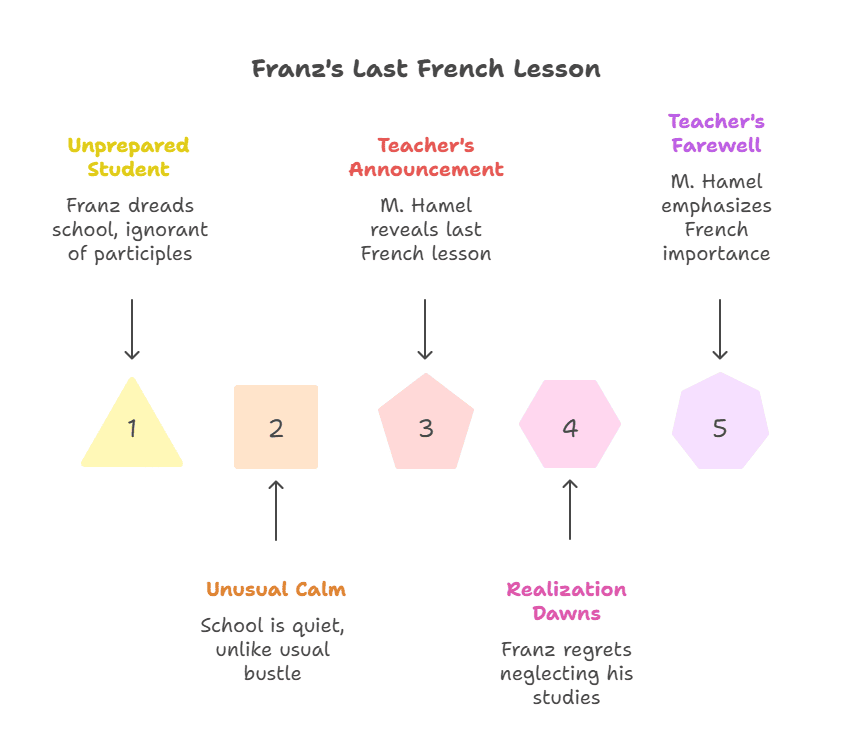
- Realization and regret: The young boy Franz is shocked by the announcement that he can no longer study French language. Through M Hamel’s announcement, he realizes the importance of the mother tongue. He develops a sudden interest in studies and regrets that he wasn’t serious towards academics earlier.
The Last Lesson Quick overview
| Detail | Information |
| Story Title | The Last Lesson |
| Author | Alphonse Daudet |
| Book | Flamingo (CBSE Class 12 English) |
| Chapter | 1 |
| Narrator | Franz |
| Setting | Alsace, France after Franco-Prussian war |
| Theme | Importance of mother tongue; cultural identity |
- The Last Lesson Summary Mind Map
- Describe the transformation in Franz as the story ‘The Last Lesson’ proceeds as asked in CBSE class 12 board exam.
- The Last Lesson Summary in Hindi Video Explanation
- How does Franz show resistance to the theme of linguistic chauvinism in the story?
- How does the Last lesson show a connection between identity and language?
- M Hamel displays patriotism. Discuss.
- M Hamel is a different person on his last day in school. Why? Identify the trigger and discuss the incidents that show this change.
- The character of Franz undergoes realization and regret. Discuss.
- Do you think that Franz was solely responsible for his careless attitude towards studies? Discuss the role of parents and teachers as is highlighted through The Last Lesson.
- How does the story justify the title “The Last Lesson”?
- What is the background of the story “The Last Lesson”? Describe the setting
- Describe the writing style used by Alphonse Daudet in The Last Lesson
- What is significant about the pigeons cooing on the roof during the last lesson, and how does this detail add to the story’s meaning?
- The Last Lesson Video Explanation Part 1
- The Last Lesson Explanation
- In the class 12 chapter, The Last Lesson, why was Franz in dread of his teacher?
- In The Last Lesson, Franz resisted temptations. What were they?
- In the story The Last Lesson, why had a crowd gathered outside the bulletin board?
- Who is Watcher in the story “The Last Lesson”? Why did he call Franz?
- In The Last Lesson, what were the usual morning noises in the school?
- How had Franz planned to use the commotion in his favour?
- In the class 12 story The Last Lesson, what was strange in M Hamel’s behaviour that day?
- Describe the dress that M Hamel wore on the last day of school.
- In The Last Lesson, who all attended the class on the last day?
- What terrifying news did M Hamel disclose in the story The Last Lesson?
- In the story “The Last Lesson”, what news had been put up on the bulletin board that day?
- In the story The Last Lesson what incident causes regret in Franz?
- In The Last Lesson, why did Franz feel sympathetic towards his teacher M Hamel?
- In The Last lesson, why had the village elders gathered in the class that day?
- In the class 12 story The Last Lesson, how do we see Franz regretting for putting off study to the next day?
- According to M Hamel, in The Last Lesson, what was the problem with the people of France?
- How does M Hamel highlight the role of parents and teachers in children’s education?
- In The Last Lesson, M Hamel connects language with nationality. Elaborate.
- In the Last lesson, what change was seen in Franz in relation to academics, on the last day of French class?
- How does M Hamel display patriotism in the story The Last lesson?
- In The Last Lesson how did the Prussians impose linguistic chauvanism on the French?
- How can we say that the village elders were emotional in the story The Last Lesson?
- The Last Lesson Video Explanation Part 2
- The Last Lesson Summary in Hindi
Related:
- The Last Lesson Important Question Answers
- The Last Lesson Summary Class 12 English Explanation Notes
- The Last Lesson Character Sketch
- The Last Lesson Previous Years Question with Answers
Finish your entire Class 12 English prep in 24 hrs & ace your CBSE Boards 2026! – Concise chapter summaries (key events & ideas), lesson themes, Visual character sketches using mind maps Click here
Question. Describe the transformation in Franz as the story ‘The Last Lesson’ proceeds as asked in CBSE class 12 board exam.
Answer.
In the story, The Last Lesson, we see that the character of Franz undergoes a transformation from a carefree lad to a responsible boy. The story opens with the ten year old Franz who is least interested in attending school, fears his teacher M Hamel, does not know the topic of Participles and wishes to play in the open fields instead. The sudden announcement of Prussian annexation of the two French districts of Alsace and Lorraine and the resultant changes in the education rules is a thunderclap for Franz. Prussian government announces the discontinuation of French classes in the schools. Instead, German would be taught there.
So, that day is the last day of the French teacher who has devoted forty years in the school, teaching French. He highlights how the French have been lazy in learning their mother tongue which has led to the annexation by Prussia. The presence of the village elders who procrastinated studies earlier, is a lesson for all to avoid procrastinating work. Hamel’s words induce repentance in Franz who undergoes a change. Franz develops a liking and respect for his teacher, he understands the lesson that he teaches and he does not want him to leave. Franz’s thought that would the Prussians teach the pigeons also to coo in German language marks the peak of his remorse.
Thus, the story shows a clear transformation in Franz from a carefree fun-loving chap to a serious and devoted boy.

Do you want a summary of The Last Lesson in Hindi?
Check out this video-
Questions based on the themes / central idea of The Last Lesson
Question. How does Franz show resistance to the theme of linguistic chauvinism in the story?
Ans. Franz is in deep shock and is unable to process the announcement that they will no longer study French. He questions that will they even teach the pigeons to coo in German. This shows his resistance and disappointment at the Prussian order. Franz does not want to get detached from his mother tongue because it is an intrinsic part of his identity.
Question. How does the Last lesson show a connection between identity and language?
Ans. The story The Last Lesson highlights the fact that one’s native language or the mother tongue is a part of one’s identity. In fact, there are so many regional variations in the dialect of a language that it becomes very typical to a local area. Natives of the same area feel a sense of belonging and oneness. The mother tongue is an essential component of this feeling. Thus, language is closely connected to one’s identity.
Top
Question. M Hamel displays patriotism. Discuss.
Ans. M Hamel shows his love for his country and his mother tongue. He is a dedicated teacher and has been teaching French in the school for the last forty years. He says that French is the most beautiful, clearest and logical language. As it is the last day in school, he gets new notebooks for the students. On the top cover, it is written France, Alsace, France, Alsace in beautiful handwriting. After the class, he gets so emotional that he writes “Vive la France!” on the board.
Top
Question. M Hamel is a different person on his last day in school. Why? Identify the trigger and discuss the incidents that show this change.
Ans. M Hamel is dressed in his formal outfit – “green coat, frilled shirt, and the little black silk cap, all embroidered, that he never wore except on inspection and prize days.” He was unusually kind to Franz. He didn’t scold Franz for not being able to recite Participles.
All these changes were because of the announcement that the Prussians had order discontinuation of teaching French language. They had imposed the teaching of German language instead. So, now M Hamel knew that Franz would himself feel repentance and regret for procrastinating studies. Therefore, he is gentle and kind with him.
Top
Question. The character of Franz undergoes realization and regret. Discuss.
Ans. In the story The Last Lesson from class 12, we see a change in Franz who regrets for not studying.
The young boy Franz is shocked by the announcement that he can no longer study French language because Prussia has imposed German language classes in the schools of French districts- Alsace and Lorraine. Through M Hamel’s announcement, he realizes the importance of the mother tongue. He develops a sudden interest in studies and regrets that he wasn’t serious towards academics earlier.
Question. Do you think that Franz was solely responsible for his careless attitude towards studies? Discuss the role of parents and teachers as is highlighted through The Last Lesson.
Ans. The French teacher M Hamel tells Franz not to feel guilty for putting off studies. He asserts that even the parents and teachers of Alsace are to be blamed. “Your parents were not anxious enough to have you learn. They preferred to put you to work on a farm or at the mills, so as to have a little more money. And I? I’ve been to blame also. Have I not often sent you to water my flowers instead of learning your lessons? And when I wanted to go fishing, did I not just give you a holiday?” Even the village elders who are pretty old attend the class that day because they hadn’t studied all their lives.
Top
Question. How does the story justify the title “The Last Lesson”?
In The Last Lesson, we see that procrastination is an evil that corrodes golden opportunities sent in our way as delaying our work is an inherent flaw in our outlook towards life.
The story revolves around the last lesson taught by M. Hamel as now French would no longer be taught in the schools of Alsace and Lorraine. If we take our life for granted and fail to be grateful for it, chances are that we will lose it in the times to come. This is exactly what happened with the people of Alsace and Lorraine. They lost their chance to be close to their mother tongue as they had never bothered to learn their language and it was a matter of shame that being Frenchmen, they were unable to read or write French. Hence, the title ‘The Last Lesson’ is apt as it teaches the people of Alsace and Lorraine and the readers as well that lessons of life must be learnt well in time lest life should take away the opportunity.
Question. What is the background of the story “The Last Lesson”? Describe the setting.
The story is set in a French village in Alsace district of France, with the backdrop of the Franco-Prussian war in which France was defeated by Prussia (then consisting of Germany, Poland and parts of Austria). The Prussian rulers order that French will no longer be taught in the schools of Alsace and Lorraine. The story tells how M.Hamel, a school teacher in Alsace, his students and the elders of the village react to this news. There is an atmosphere of hopelessness and regret in the classroom. For the first time the defeated French people in the village realize their mistake in not learning their own language. The setting is appropriate, as the story relates to a bygone era of French defeat in the hands of the Prussians.
Question. Describe the writing style used by Alphonse Daudet in The Last Lesson.
The story ‘The Last Lesson’ has a first person narrative. The speaker is a little boy named Franz, a resident of Alsace-Lorraine district of France that has been occupied by the Prussians.
The tone is serious and biased. The author feels biased about the government and the war compelling everyone to speak German. The oppressors and conquerors become heartless and enforce their own views on the defeated. This is clear from the story when the order from Berlin comes that French will no longer by taught in Alsace and Lorraine.
The author has used many literary devices of irony, metaphors, similes and symbols to make the narration and them clear and effective. He uses irony, to highlight the human tendency that there is a plenty of time to do things. Hence, we keep on postponing the lessons of life, forgetting that life is subject to change. Learning of French by the people has never been a serious affair with them. But the sudden order to stop teaching French comes as a sudden blow and sad realization to the people.
The author has also used other devices like metaphors, similes and symbols. ‘What a thunderclap’ is a metaphor for the sudden order from Berlin. Mother tongue ‘as if a key to their prison’ is a simile, the key to regain freedom from their prison.
Top
Question. What is significant about the pigeons cooing on the roof during the last lesson, and how does this detail add to the story’s meaning?
Ans. The cooing pigeons on the roof serve as a quiet but powerful symbol in the story. Just as the pigeons instinctively coo in their own natural sound regardless of who rules the land, language and identity are shown to be something organic that cannot simply be legislated away by an occupying power. Franz’s fleeting thought — wondering if the Prussians would force even the pigeons to sing in German — reflects his dawning understanding that his own mother tongue is just as natural and inseparable a part of him. The detail quietly reinforces the story’s larger message that identity, once awakened, resists suppression.
The Last Lesson Video Explanation Part 1
The Last Lesson Explanation and text-based Questions
Question. In the class 12 chapter, The Last Lesson, why was Franz in dread of his teacher?
Passage: I started for school very late that morning and was in great dread of a scolding, especially because M. Hamel had said that he would question us on participles, and I did not know the first word about them.
Word Meanings:
in great dread of: fear of
Explanation/Answer: The narrator of the story is a young school-going boy named Franz. That morning, he was scared as he was late for school. Also, as their teacher M. Hamel had announced the previous day that he would test them on the topic of ‘Participles’ and Franz did not know anything at all, he was more scared of being scolded.
Top
Question. In The Last Lesson, Franz resisted temptations. What were they?
Passage: For a moment I thought of running away and spending the day out of doors. It was so warm, so bright! The birds were chirping at the edge of the woods; and in the open field back of the sawmill the Prussian soldiers were drilling.
It was all much more tempting than the rule for participles, but I had the strength to resist, and hurried off to school.
Word Meanings:
Sawmill: a factory for cutting wood
Drilling: exercising
Tempting: attracting
Resist: to stay away
Explanation / Answer: Franz had another option in his mind – to miss school and enjoy the day out in the warm and bright weather. He describes the scene – there were birds chirping on the trees and the noise of the Prussian soldiers doing the drill behind the sawmill could also be heard.
The scene outside was more attractive than the school but Franz controlled the temptation and chose to attend school.
Top
Question. In the story The Last Lesson, why had a crowd gathered outside the bulletin board?
Passage: When I passed the town hall there was a crowd in front of the bulletin board. For the last two years all our bad news had come from there — the lost battles, the draft, the orders of the commanding officer — and I thought to myself, without stopping, “What can be the matter now?”
Word Meanings:
bulletin-board: a notice board for putting up the latest news and communication
Explanation / Answer: As Franz walked past the town hall, he noticed a huge crowd at the notice board. The war with Prussia had begun two and a half years ago and since then all the bad news like losing the war, occupation of Alsace and Lorraine by the enemy i.e. Prussia, etc had been communicated to the people through this bulletin board. Franz kept on walking towards the school and thought in his mind that what news could have been put up at the board now.
Top
Question. Who is Watcher in the story “The Last Lesson”? Why did he call Franz?
Passage: Then, as I hurried by as fast as I could go, the blacksmith, Wachter, who was there, with his apprentice, reading the bulletin, called after me, “Don’t go so fast, bub; you’ll get to your school in plenty of time!”
I thought he was making fun of me, and reached M. Hamel’s little garden all out of breath.
Word Meanings:
Apprentice: trainee
Explanation / Answer: As he walked hurriedly towards the school, the blacksmith who was also reading the news and had come along with his trainee called out to Franz from behind and said that he needn’t go in such a hurry as there was plenty of time for him to reach school.
Franz thought that the blacksmith was making fun of him as he was already late for school. When Franz reached the garden outside the school, he was out of breath as he had walked very fast.
Top
Question. In The Last Lesson, what were the usual morning noises in the school?
Passage:
Usually, when school began, there was a great bustle, which could be heard out in the street, the opening and closing of desks, lessons repeated in unison, very loud, with our hands over our ears to understand better, and the teacher’s great ruler rapping on the table.
Word Meanings:
a great bustle: a lot of noise created by many people
in unison: at the same time
rapping: striking
Explanation / Answer: Franz describes the usual scene at the school in the mornings – a lot of noise created by the moving of desks, children repeating their lessons and teachers striking the tables with the rulers could be heard.
Top
Question. How had Franz planned to use the commotion in his favour?
Passage: But now it was all so still! I had counted on the commotion to get to my desk without being seen; but, of course, that day everything had to be as quiet as Sunday morning. Through the window, I saw my classmates, already in their places, and M. Hamel walking up and down with his terrible iron ruler under his arm. I had to open the door and go in before everybody. You can imagine how I blushed and how frightened I was.
Word Meanings:
counted on: depended upon
commotion: noise and confusion
Blushed: face turned red in colour due to shame
Explanation / Answer: That day was unusual as there was no such sound coming out of the school and it seemed that the school was closed as it used to be on a Sunday morning. Franz had planned that he would take cover under the commotion and reach the class without being noticed but that did not seem possible. Franz peeped inside his class and saw his classmates seated and M. Hamel, their teacher walking in the class with the ruler made of iron placed under his arm. Franz feared a beating. Franz was ashamed of being late and feared a scolding as he had to enter the classroom in front of everyone.
Top
Question. In the class 12 story The Last Lesson, what was strange in M Hamel’s behaviour that day?
Passage: But nothing happened. M. Hamel saw me and said very kindly, “Go to your place quickly, little Franz. We were beginning without you.”
Explanation / Answer: Franz found it strange as M. Hamel did not say anything and on the contrary, politely asked him to get to his seat,as the class was about to begin without him.
Top
Question. Describe the dress that M Hamel wore on the last day of school.
Passage: I jumped over the bench and sat down at my desk. Not till then, when I had got a little over my fright, did I see that our teacher had on his beautiful green coat, his frilled shirt, and the little black silk cap, all embroidered, that he never wore except on inspection and prize days.
Explanation / Answer: Franz hurried to his seat. After some time when he overcame the scare and became comfortable, he noticed that their teacher had worn his best embroidered that day. The teacher normally wore it on occasions like inspection and prize distribution days. Franz wondered if that day was a normal day, then what could be the reason for M. Hamel to wear his special dress.
Top
Question. In The Last Lesson, who all attended the class on the last day?
Passage: Besides, the whole school seemed so strange and solemn. But the thing that surprised me most was to see, on the back benches that were always empty, the village people sitting quietly like ourselves; old Hauser, with his three-cornered hat, the former mayor, the former postmaster, and several others besides. Everybody looked sad; and Hauser had brought an old primer, thumbed at the edges, and he held it open on his knees with his great spectacles lying across the pages.
Word Meanings:
Solemn: serious.
Primer: basic reader of any language
Thumbed: torn and damaged
Explanation/ Answer: Franz felt that the atmosphere in the school was unusual and serious. To add to it, the last benches of the classroom were occupied by the senior village men – Hauser, who was wearing his three-cornered hat, the retired mayor, postmaster, etc. They all looked sad. Hauser had brought his reader which was old and torn. He had opened it, kept it on his knees and had placed his spectacles on it.
Top
Question. What terrifying news did M Hamel disclose in the story The Last Lesson?
Passage: While I was wondering about it all, M. Hamel mounted his chair, and, in the same grave and gentle tone which he had used to me, said, “My children, this is the last lesson I shall give you. The order has come from Berlin to teach only German in the schools of Alsace and Lorraine. The new master comes tomorrow. This is your last French lesson. I want you to be very attentive.”
Word Meanings:
Grave: serious
Explanation / Answer: Franz was confused and could not figure out what was happening that day. Just then M. Hamel told them that it was their last lesson in French as the Prussians in Berlin had ordered that French language would no longer be taught in the schools of Alsace and Lorraine and that German language be taught instead. The German teacher would arrive the next day and as this was the last lesson in French, he wanted them to pay attention.
Top
Question. In the story “The Last Lesson”, what news had been put up on the bulletin board that day?
Passage: What a thunderclap these words were to me! Oh, the wretches; that was what they had put up at the town-hall!
Word Meanings:
Thunderclap: used in comparison to refer to something startling or unexpected
Wretches: here, it refers to an unfortunate happening
Explanation / Answer: Franz was shocked to know that he could not learn French any longer and now he knew the latest news that had been put up at the bulletin board of the town hall.
Top
Question. In the story The Last Lesson what incident causes regret in Franz?
Passage: My last French lesson! Why, I hardly knew how to write! I should never learn any more! I must stop there, then! Oh, how sorry I was for not learning my lessons, for seeking birds’ eggs, or going sliding on the Saar!
My books, that had seemed such a nuisance a while ago, so heavy to carry, my grammar, and my history of the saints, were old friends now that I couldn’t give up.
Word Meanings:
Saar: a river which passes through France
Nuisance: problem, burden
couldn’t give up: cannot leave
Explanation / Answer: Franz regretted for not being serious towards studies and for wasting his time in hunting bird’s eggs and playing in the Saar river. Till now Franz considered his books to be an unwanted burden but suddenly, he starts considering them to be his best friends whom he could never leave. The writer wants to show the change in Franz’s attitude towards study after hearing the news that he could not learn French any longer.
Top
Question. In The Last Lesson, why did Franz feel sympathetic towards his teacher M Hamel?
Passage: And M. Hamel, too; the idea that he was going away, that I should never see him again, made me forget all about his ruler and how cranky he was.
Poor man! It was in honour of this last lesson that he had put on his fine Sunday clothes, and now I understood why the old men of the village were sitting there in the back of the room.
Word Meanings:
Cranky: strange, short – tempered
Sunday clothes: the best dress that a person has.
Explanation / Answer: The news that their teacher M Hamel was leaving also had a similar impact on him. Franz did not want him to go away. He no longer thought the teacher to be short–tempered and strict.
Now Franz knew that M Hamel was wearing his best dress in honour of this last lesson. He also realized that the village men had come to pay respect and thank M Hamel for his service of forty years in that school.
Top
Question: In The Last lesson, why had the village elders gathered in the class that day?
Passage: It was because they were sorry, too, that they had not gone to school more. It was their way of thanking our master for his forty years of faithful service and of showing their respect for the country that was theirs no more.
Explanation / Answer: The village men had come to the class as they were also repenting for not have studied well in their childhood. They had come to thank their teacher for his forty years of service as a teacher of French. Also, they wanted to show respect to their country and were sad as their mother tongue – French would no longer be taught to them.
Passage: While I was thinking of all this, I heard my name called. It was my turn to recite. What would I not have given to be able to say that dreadful rule for the participle all through, very loud and clear, and without one mistake? But I got mixed upon the first words and stood there, holding on to my desk, my heart beating, and not daring to look up.
Word Meanings:
Dreadful: frightening
mixed up: confused
Explanation of the above passage: The teacher calls out to Franz as it his turn to recite the topic of participles. As the news had impacted Franz, he was eager to study and so, he was desperate to show his eagerness. He wanted to be able to recite the topic in one go and without any mistake and please his teacher. His desperation is reflected in his willingness to give away all that he had in return for reciting the lesson well. As Franz did not know the lesson, he got confused and stood quietly. His heart was beating fast as he was ashamed of himself and did not have the courage to face his teacher.
Top
Question: In the class 12 story The Last Lesson, how do we see Franz regretting for putting off study to the next day?
Passage: I heard M. Hamel say to me, “I won’t scold you, little Franz; you must feel bad enough. See how it is! Every day we have said to ourselves, ‘Bah! I’ve plenty of time. I’ll learn it tomorrow.’ And now you see where we’ve come out.
Word Meanings:
where we’ve come out: result
Explanation / Answer: M. Hamel said to Franz that he would not scold him as now he had realized his mistake. Everyday Franz told himself that he would study the next day and now the opportunity to study had ended and he knew nothing.
Top
Question: According to M Hamel, in The Last Lesson, what was the problem with the people of France?
Passage: Ah, that’s the great trouble with Alsace; she puts off learning till tomorrow. Now those fellows out there will have the right to say to you, ‘How is it; you pretend to be Frenchmen, and yet you can neither speak nor write your own language?’ But you are not the worst, poor little Franz. We’ve all a great deal to reproach ourselves with.”
Word Meanings:
Pretend: show
to reproach: blame
Explanation / Answer: M Hamel says that all the people of Alsace were to be blamed as no one was serious towards learning. He tells the class that the enemies (Prussians) would laugh at them and say that they only show to be Frenchmen as they can neither speak nor write their own language. He says that Franz should not feel guilty as everyone is at fault.
Top
Question. How does M Hamel highlight the role of parents and teachers in children’s education?
Passage: “Your parents were not anxious enough to have you learn. They preferred to put you to work on a farm or at the mills, so as to have a little more money. And I? I’ve been to blame also. Have I not often sent you to water my flowers instead of learning your lessons? And when I wanted to go fishing, did I not just give you a holiday?”
Explanation / Answer: M. Hamel says that Franz’s parents were not interested in getting him educated. They wanted him to work at a farm or a mill and earn some money. He says that as a teacher, he was also not interested in teaching them. He would send them to his home to water the plants. Sometimes, he would declare a holiday and go for fishing.
Top
Question. In The Last Lesson, M Hamel connects language with nationality. Elaborate.
Passage: Then, from one thing to another, M. Hamel went on to talk of the French language, saying that it was the most beautiful language in the world — the clearest, the most logical; that we must guard it among us and never forget it, because when a people are enslaved, as long as they hold fast to their language it is as if they had the key to their prison.
Explanation / Answer: M. Hamel praises their mother tongue – French language as being the most beautiful, clearest and most logical language in the world. He tells the class to guard their language as it is the only way to free oneself from the prison of slavery. If a person knows his mother tongue well, no one can enslave him. Knowing the mother tongue well as a language is a tool to fight domination.
Top
Question. In the Last lesson, what change was seen in Franz in relation to academics, on the last day of French class?
Passage: Then he opened a grammar and read us our lesson. I was amazed to see how well I understood it. All he said seemed so easy, so easy! I think, too, that I had never listened so carefully, and that he had never explained everything with so much patience.
It seemed almost as if the poor man wanted to give us all he knew before going away, and to put it all into our heads at one stroke.
Word Meanings:
at one stroke: at once, in one go.
Explanation / Answer: The teacher took a lesson in grammar. That day Franz was surprised that he understood the lesson with ease. He felt that he had been attentive and that M. Hamel also explained the lesson with a lot of patience. Franz felt that the teacher wanted to give them all the knowledge he had before leaving.
Top
Question. How does M Hamel display patriotism in the story The Last lesson?
Passage: After the grammar, we had a lesson in writing. That day M. Hamel had new copies for us, written in a beautiful round hand — France, Alsace, France, Alsace. They looked like little flags floating everywhere in the school-room, hung from the rod at the top of our desks. You ought to have seen how everyone set to work, and how quiet it was! The only sound was the scratching of the pens over the paper.
Explanation / Answer: After Grammar, they had a lesson in writing. M. Hamel gave the class new notebooks with “France, Alsace, France, Alsace” beautifully written on them. Franz felt that here was an air of patriotism in the class. The notebooks were like flags of France that were floating all around. The entire class was busy writing and the only sound that could be heard was that of the pen writing on the paper.
Passage: Once some beetles flew in; but nobody paid any attention to them, not even the littlest ones, who worked right on tracing their fish-hooks, as if that was French, too.
Word Meanings:
beetles: a large-sized insect
not even the littlest ones: refers to the pigeons
who worked right on tracing their fish-hooks: scratching with their claws.
Explanation of the above passage: Once some mosquitoes flew into the class, but no one panicked as everyone was busy writing. The writer considers the pigeons sitting on the roof of the class to be students as well and says that even the pigeons were busy scratching the roof with their claws and it seemed that they were also busy writing the task of French language.
Top
Question. In The Last Lesson how did the Prussians impose linguistic chauvanism on the French?
Passage: On the roof the pigeons cooed very low, and I thought to myself, “Will they make them sing in German , even the pigeons?”
Word Meanings:
Cooed: the sound made by the pigeons
Explanation / Answer: The ‘coo’ sound of the pigeons could be heard in the class and Franz wondered that would the Prussians force the pigeons also to change their language and coo in German. The writer wants to say that language comes naturally to a being and it cannot be forced upon anyone – be it the pigeons or the French men.
Passage: Whenever I looked up from my writing I saw M. Hamel sitting motionless in his chair and gazing first at one thing, then at another, as if he wanted to fix in his mind just how everything looked in that little school-room.
Word Meanings:
Gazing: looking intently
fix in his mind: store or keep forever
Explanation of the above passage: In between writing, Franz looked at M. Hamel who sat still and stared at the different things in the classroom in succession as if he wanted to memorize the appearance of everything before leaving.
Passage: Fancy! For forty years he had been there in the same place, with his garden outside the window and his class in front of him, just like that. Only the desks and benches had been worn smooth; the walnut-trees in the garden were taller, and the hopvine that he had planted himself twined about the windows to the roof.
Word Meanings:
worn smooth: had worn out and became smooth due to overuse
twined: twisted
Explanation of the above passage: M. Hamel had been teaching at that same place for the last forty years. The only changes were that the desks in the classroom had worn out due to use over the years, the walnut trees in the garden outside had grown taller, the hopvine on the outer wall of the school building had climbed up to the roof.
Passage: How it must have broken his heart to leave it all, poor man; to hear his sister moving about in the room above, packing their trunks! For they must leave the country next day.
Explanation of the above passage: Franz feels that the teacher must be heartbroken to be sent away from a place where he had spent forty years of his life. The noises of his sister packing and moving their luggage could be heard from the room upstairs as they had to leave the next day.
Passage: But he had the courage to hear every lesson to the very last. After the writing, we had a lesson in history, and then the babies chanted their ba, be bi, bo, bu.
Explanation of the above passage: M. Hamel remained composed and heard the lesson from the entire class. After the writing task, there was a lesson of history followed by phonetics where they recited the sounds of alphabets. Franz referred to the class as “babies” because although they were grown up, they were reciting the lesson of phonetics which is usually done by younger children. So, he calls himself and his class to be ‘babies’.
Top
Question. How can we say that the village elders were emotional in the story The Last Lesson?
Passage: Down there at the back of the room old Hauser had put on his spectacles and, holding his primer in both hands, spelled the letters with them.
You could see that he, too, was crying; his voice trembled with emotion, and it was so funny to hear him that we all wanted to laugh and cry. Ah, how well I remember it, that last lesson!
Explanation / Answer: Hauser had put on his spectacles and holding the primer in both his hands, recited the letters with the class. He was crying, his voice trembled as he spoke. Franz had mixed feelings – he found it funny to see how an old man like Hauser was crying and trembling and on the other hand, he also felt emotional like Hauser did. Franz could never forget this last lesson.
Passage: All at once the church-clock struck twelve. Then the Angelus. At the same moment the trumpets of the Prussians, returning from drill, sounded under our windows. M. Hamel stood up, very pale, in his chair. I never saw him look so tall.
Word Meanings:
Angelus: prayer song in the church, the start is marked by the ringing of the bell.
Trumpets: a musical instrument.
Pale: used to describe a person’s face or skin if it has less colour than usual
Explanation of the above passage: Just then the clock at the church struck twelve and the prayer song begun. At the same moment, the sound of the trumpets played by the Prussian soldiers who were returning from the drill was heard. M. Hamel’s face became dull and colourless as the time had come for the class to get over. He stood straight and motionless and Franz says that he had never appeared to be so tall.
Passage: “My friends,” said he, “I—I—” But something choked him. He could not go on. Then he turned to the blackboard, took a piece of chalk, and, bearing on with all his might, he wrote as large as he could — “Vive La France!”
Word Meanings:
Choked: became unable to speak due to strong emotions
Explanation of the above passage: M. Hamel began to speak but could not continue as he was overpowered by his emotions. He took a piece of chalk and wrote the words “Vive La France” meaning ‘Long Live France’ on the blackboard as large as he could.
Passage: Then he stopped and leaned his head against the wall, and, without a word, he made a gesture to us with his hand — “School is dismissed — you may go.”
Word Meanings:
Gesture: a signal
Explanation of the above passage: Then he stopped writing, bent towards the wall and without speaking anything signaled the class to leave as the class was over.
The Last Lesson Video Explanation Part 2
The Last Lesson FAQs
Question: Who is the narrator of The Last Lesson?
Ans. The story The Last Lesson is narrated by a young school boy named Franz.
Question: What is the theme of the class 12 story The last Lesson?
Ans. The central message of the story The Last Lesson is the connection between nationality, language and identity.
Question: Who is M Hamel in the story The Last Lesson?
Ans. M Hamel is a school teacher at a school in Alsace, France. He has been teaching in the school for the last forty years and is a strict disciplinarian.
Question: Why is Franz unwilling to attend school that day?
Ans. Franz has not prepared the topic of Participles for the test that day. Also, he is late for school. Thus, he is scared of his teacher M Hamel.
Question: What does M Hamel write on the board? What does it signify?
Ans. M Hamel writes “Vive la France” which means ‘Long Live France’. This shows his love and patriotism.
The Last Lesson Summary in Hindi
कहानी का मुख्य पात्र फ्रांसीसी लड़का फ्रांज है। कहानी एक फ्रांसीसी लड़के फ्रांज द्वारा सुनाई गई है। वह आलसी लेकिन संवेदनशील है और खेलना पसंद करता है। उसे फ्रेंच पढ़ना पसंद नहीं है और वह अपने शिक्षक एम. हैमेल से नफरत करता है।
फ्रांस राज्य के जिलों अलसैस और लोरेन पर अधिकार करने के बाद, बर्लिन ने आदेश दिया है कि वहां के स्कूलों में फ्रेंच के बजाय जर्मन भाषा सिखाई जाए।
यह उनके फ्रांसीसी शिक्षक एम. हैमेल का अंतिम दिन है, जो वहां चालीस वर्षों से पढ़ा रहे है। वे शोक, विषाद और देशभक्ति से भरे है । उनकी कड़ी मेहनत के सम्मान में, गांव के लोग भी उनके ‘अंतिम पाठ’ में शामिल होते हैं। वे दुखी हैं क्योंकि उन्होंने बचपन में अपनी मातृभाषा, फ्रेंच नहीं सीखी थी।
फ्रांज यह जानकर हैरान है कि यह उसका आखिरी पाठ है, क्योंकि वह फ्रेंच नहीं जानता है। अब, अचानक, वह इसे सीखने में दिलचस्पी लेता है और उस दिन पढ़ाया जाने वाला सब कुछ समझता है!
वह शिक्षक एम. हैमेल को अचानक से पसंद करने लग जाता है और उनकी ईमानदारी और कड़ी मेहनत के लिए उनका सम्मान करता है।
वह उनके विदा होने पर दुखी होता है और पार्टिसिपलस को याद ना कर पाने के लिए शर्मिंदा होता है।
एम. हैमेल उन्हें बताता है कि सीखने के लिए पर्याप्त उत्सुक नहीं होने, इसे अगले दिन के लिए टालने के लिए वे सभी दोषी हैं। वह उन्हें ईमानदारी से नहीं सिखाने के लिए खुद को दोषी ठहराता है।
एम. हैमेल फ्रेंच भाषा कि प्रशंसा करते हुए कहते है कि वह विश्व कि सबसे सुन्दर और तर्कपूर्ण भाषा है। इस से उनकी देशभक्ति झलकती है। वह कक्षा को अपनी भाषा की रक्षा करने के लिए कहता है क्योंकि गुलामी की जेल से बचने के लिए अपनी भाषा के करीब होना महत्वपूर्ण है। यह उन्हें जर्मनों से मुक्त होने में मदद करेगा।
वे अपनी मातृभाषा सीखने के महत्व को महसूस करते हैं और जर्मनों द्वारा उनकी निरक्षरता के कारण उन्हें पराजित किया गया है।
फ्रांज को लगता है कि किसी व्यक्ति से किसी की भाषा को छीनना संभव नहीं है क्योंकि यह प्रत्येक प्राणी के लिए स्वाभाविक है। जिस तरह कबूतरों के लिए “कू” कि आवाज स्वाभाविक है उसी तरह फ्रांसीसीयो के लिए उनकी मातृभाषा फ्रेंच भी स्वाभाविक है। या फ्रांसीसी के लिए “फ्रांसीसी” हो सकता है।
Top
Also See :
- CBSE Class 12 English Notes, Lesson Explanation
- CBSE Class 12 English MCQ Question Answers
- Class 12 English Flamingo Book Chapter wise word meanings
- Class 12 English Flamingo Poems Word meanings
- Class 12 English Vistas Book Word meanings
- CBSE Class 12 English Important Question Answers
- Character Sketch of Class 12 English
- Class 12 English Core Previous Year Question Answers (2019-2024) Chapterwise
- Class 12 English Core Previous Year Question Paper with Solutions 2019-2024
Class 12 Important Videos Links