
CBSE Class 12 English Poem 4 A Roadside Stand Summary, Line by Line Explanation along with Difficult Word Meanings and Literary Devices from Flamingo Book
Updated for the CBSE 2026-27 session as per the rationalised syllabus.
In the class 12 Poem 4 “A Roadside Stand”, Robert Frost highlights the plight of the rural poor who seek money from the city people. They display the farm produce in sheds and wait, hoping for the cars passing by to stop and buy something. These innocent people are cheated by politicians who make false promises and grab their houses. Frost suggests that rather than giving pain for all their lives, they be struck and killed in a single blow.
To understand the Class 12 Board Exam Pattern and Marking Scheme, Click here
Question: What are the key points of “A Roadside Stand”?
Ans. The key points of “A Roadside Stand” are as follows:

- Harsh lives of the rural people: The poet highlights the plight of the rural poor who seek some money from the city people. These rural folk are innocent and they are deceived by politicians who take away their homes in the garb of false promises.
- Dreams and expectations: We see the expectations of the poor people. The poor people who have set up the roadside stand wish to earn a livelihood without resorting to begging. As they watch the cars of the rich people drive by the shack, they expect the rich to help them by buying their goods. These poor people are farmers who dream of having the beautiful life they see illustrated in movies. They do not want to be famous or as big as the rich people. They simply want to experience a life supplied with sufficient money instead of poverty. They want only a small portion of the city money to flow into their homes. So, they expect the rich to support such small businesses and to allow the city money to flow elsewhere. Every time they hear the brakes of a car, they are filled with hope that a rich person is there to pay for the wild berries, golden squash, and pleasant rest that the roadside shack humbly provides.
- Deceit: The rich deceive the poor. They keep the money flowing in the city only, not giving the poor access to it by not visiting the shack. They pretend to be beneficial and good doers, but they are actually greedy beasts who like to maintain the economic disparity between the wealthy and the unwealthy. The rich have unfair power and they use it to show colorful movies that support the childish longing in the unfortunate. They silence the poor with false promises and make them feel relaxed and safe. They manipulate them to become satisfied with just movies and a few stores, and so the poor sleep all day long without working and fighting for their share of money and glamorous life.
- Misery: Misery is the main emotion reflected in the poem. The poor are in misery because the rich do not wish to support their roadside business. They are farmers who bring fresh berries, squashes, and a nice rest accompanied by a scenic view through their roadside shack. However, no car stops by to appreciate their efforts. This indifference and unfair treatment is the main source of poverty and misery in their lives. They are unable to rise in power and wealth because the “party in power” suffocates all their attempts at achieving something more. Not only the poor’s misery, but the poet, Robert Frost’s misery, is also displayed in the poem. Seeing the pitiful cycle in which the poor are trapped in, Robert Frost feels immense grief. He wonders if death would be a more merciful option for the poor and for those who empathise with the poor. The poet’s misery and profound pain highlight his empathetic nature.
A Roadside Stand Quick Overview
| Detail | Information |
| Poem Title | A Roadside Stand |
| Author | Robert Frost |
| Book | Flamingo (CBSE Class 12 English) |
| Chapter | 4 |
| Narrator | Poet |
| Setting | Rural countryside |
| Theme | Rural people’s life, desire for some money inflow, cheating by politicians |
- A Roadside Stand Summary
- A Roadside Stand Summary in Hindi Video Explanation
- Theme-based Questions on A Roadside Stand
- A Roadside Stand Previous Year Questions with Model Answers PDF
- A Roadside Stand Lesson Explanation
- A Roadside Stand Video Explanation
- A Roadside Stand- Literary Devices
- A Roadside Stand Summary in Hindi
Related:
- A Roadside Stand MCQs
- A Roadside Stand Question Answers
- A Roadside Stand Previous Years Question with Answers
A Roadside Stand Summary Mind Map
Finish your entire Class 12 English prep in 24 hrs & ace your CBSE Boards 2026! – Concise chapter summaries (key events & ideas), lesson themes, Visual character sketches using mind maps Click here
Question: What is the summary of A Roadside Stand class 12 English?
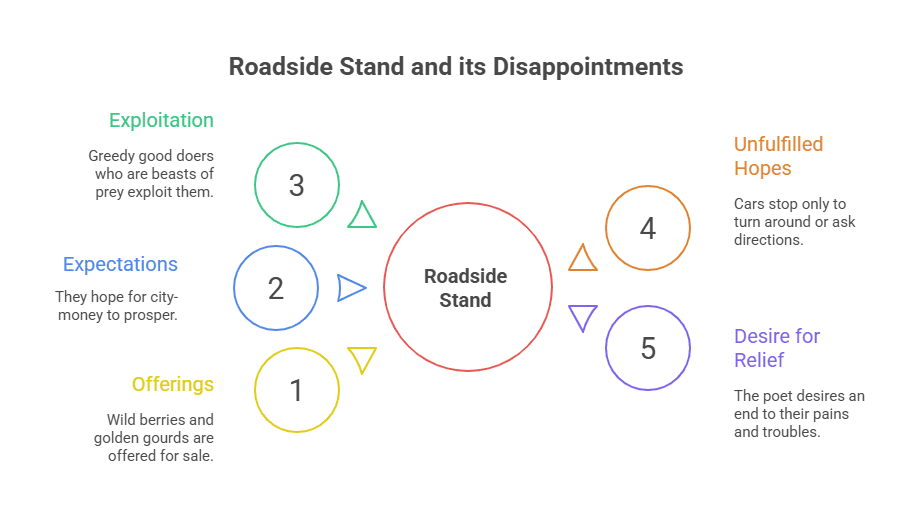
Ans.There is a roadside stand at the edge of the road. Those who established it certainly did so to earn money. They expected their prospective customers to stop there and buy things. But the rich and the refined people drive past without stopping there. The roadside stand offers ordinary things for sale like wild berries and golden gourds.
The people who run this stand hope for city-money so that they may also prosper. There is a news that their land will be bought by the government. The so called good doers and greedy people exploit them. Some people who pretend to be generous are even worse than flesh-eating wild animals. These greedy people want to mint money by befooling the innocent rural people.
The people who run this roadside stand hope that some car will stop there. They keep their windows open so that some customer may oblige them. But some come only to back or turn around the car or to ask the way where it is bound.
The poet will feel greatly relieved if all their pains and troubles are removed at one stroke. Death is far better than their miserable living.
A Roadside Stand Summary in Hindi Video Explanation
Theme-based Questions on A Roadside Stand
Questions: What were the expectations of the people who had set up the roadside stand?
Ans. We see the expectations of the poor people in the poem “A Roadside Stand”. The poor people who have set up the roadside stand wish to earn a livelihood without resorting to begging. As they watch the cars of the rich people drive by the shack, they expect the rich to help them by buying their goods. The people, who come from the countryside, are filled with childish longing. They want to escape poverty and experience the glamorous life shown in movies in the cinema. They want only a small portion of the city money to flow into their homes. Every time they hear the brakes of a car, they are filled with hope that a rich person is there to pay for the wild berries, golden squash, and pleasant rest that the roadside shack humbly provides. When the cars stop only to plow up grass, to take a u-turn, and to ask for a gallon of gas. The indifference shown by the rich makes the people in the roadside stand disheartened and frustrated, shattering their hopes and dreams.

Questions: How do the greedy good doers deceive the poor people?
Ans. In the poem “A Roadside Stand”, we read about a shack opened near the road by the poor with the hopes of having a livelihood from a small business than begging for bread. However, the cars passing by ignore the shack. The rich deceive the poor by not supporting the work of the rural people. They keep the money flowing in the city only, not giving the poor access to it by not visiting the shack. They pretend to be beneficial, kind-hearted, and good doers, but they are actually greedy beasts who like to maintain the economic disparity between the wealthy and the unwealthy. The party in power makes false promises to the poor to gain their loyalty and obedience, but their aim is to support the childish longing in the unfortunate and make people like them richer. They silence and soothe them by opening a theatre and store near their homes. The theatres show a life that they cannot have, the moving pictures showcasing a glamorous story. The stores maintain a cycle of convenience and laziness, making the poor less capable and more reliant on the resources the rich provide. The party in power manipulates the rural people and change even their biological sleep cycle. The poor relaxedly sleep at daytime, and enjoy the small convenient resources at night. This enables the beneficient beasts of prey to exploit the lands and abilities of the poor even more by putting them in more financial strain.
Questions: What does the poet feel about the roadside stand?
Ans. The poem “A Roadside Stand”, written by Robert Frost, is a poem concentrating on misery. We see the misery of the poor rural population, who have been manipulated by the party in power. Those who attempt to break out of the vicious cycle of manipulative convenience and relaxation are shown indifference and are pushed aside. Seeing all of this, Robert Frost feels immense misery. Robert Frost is an empathetic person who feels sorrow from watching the trusting sorrow of the people who set up the roadside stand. Robert Frost is miserable with agony as he observes how the rural people are taken advantage of by those who are fortunate enough to be a part of the urban population. He admires the efforts of the people in the shabby shack and expresses anger towards the rich for being indifferent and selfish. The poet wonders if it would be kinder to put the poor out of their misery, meaning death. When they are dead, they will be at peace with no one taking advantage of them. The poet then asks the reader to put him out of his misery as well. By feeling the pain of the poor, Robert Frost is too devastated and hopeless and feels like he too can find peace when dead.
Questions: How does Robert Frost present the plight of the poor people in his poem “A Roadside Stand”?
Ans. Robert Frost’s poem “A Roadside Stand” presents the plight of poor people perpetuated by the rich. The disparity between the rural and urban parts of the world is highlighted, with emphasis on how the rich manipulate the poor and keep them trapped in a vicious cycle of false promises, financial strain, and indifference. The poem talks about the poor people who choose to set up a small business instead of begging. The shack or roadside stand is built on the hopes that one of the car in the fast-paced traffic will stop by and purchase berries, golden squash, or simply enjoy the scenic view. They do not want charity. They want the rich to support their business by being an active customer. However, the polished traffic continues, the rich thinking of their goals and ambitions more than the roadside stand. To them, the roadside stand is ruining the view because of how shabby it looks. They are indifferent to their efforts because they do not want the city money to go to the countryside. The people who set up the shack hope that the money which funds the city of flowers will help their homes to flourish as well. They watch stories of a glamorous life in movies, which is something they have never experienced. They are full of childish longing and trusting sorrow. They want the rich to stop by the stand and fulfill their promises of being good doers and beneficent to the needy. However, they are secretly greedy beasts and the poor are their prey. The party in power make grand statements, making the poor reassured with false words and promises. They open theatres and stores near their homes, luring them with entertainment and convenience. When they become successfully trapped, the poor stop working and their brains become too relaxed. They sleep during the day and enjoy the small things the party in power provides them. They do not realise that while they become compliant and slow, the greedy beasts of prey exploit them and their lands. Additionally, those who do try to break out of this cycle are shown indifference and cruelty. For instance, when cars do stop by the stand, it is not to support the small business but to satisfy their own selfish needs. Seeing the plight of the poor, Robert Frost is overcome with anger and misery, suggesting that the poor and himself should be put out of their sorrow in order to escape the exploitation and manipulation of the rich.
A Roadside Stand Previous Year Questions with Model Answers PDF
Download the previous year questions of the Poem A Roadside Stand of class 12 English for free. With the help of this, you can prepare for the exam.
To Download A Roadside Stand Previous Year Questions with Model Answers- Click Here
A Roadside Stand Explanation
POEM :
The little old house was out with a little new shed
In front at the edge of the road where the traffic sped,
A roadside stand that too pathetically pled,
It would not be fair to say for a dole of bread,
But for some of the money, the cash, whose flow supports
The flower of cities from sinking and withering faint.
The polished traffic passed with a mind ahead,
Or if ever aside a moment, then out of sorts
At having the landscape marred with the artless paint
Word Meaning:
Pathetically: In a way that arouses pity, especially by displaying sadness
Dole of Bread: a tiny portion of bread
Marred: Spoilt
Explanation of the poem passage above: There was a small house with a new shed outside it. The road was busy with cars and other vehicles moving here and there. The shed was built to display items on sale and the owner expected the passing vehicles to stop by and buy the things or at least have a look at them. The condition of the shed aroused one’s pity because it displayed the sad feelings of the owner who was desperate to earn some money. They did not seek any favour or piece of bread from the city people but wanted some money because the flow of money helps everyone to use it and benefit from it. Just like the money with the city people helps them lead a better life, similarly, if it will flow from their pockets into the pockets of the shed owner, it will benefit his life too. The cars that pass by are sparkling but they never notice the shed. They are thinking of their destination only. If by chance they do stop at the shed, they just complain that the shabby paint of the huts and sheds there has spoiled the beauty of the landscape.
Questions based on the stanza above-
Question: Where was the roadside stand located?
Ans. The roadside stand was located at the edge of the road. The cars of rich people passed by the roadside stand.
Question: What did the roadside stand plead for?
Ans. The roadside stand pleads for money that flows in the urban city.
Question: Why do country people ask for money in the poem “The Roadside Stand”?
Ans. Country people ask for money in the poem “The Roadside Stand” so that their poverty-stricken homes can flourish like the flower of cities.
Question: What do you mean by “the flower of cities from sinking and withering faint”?
Ans. The line “the flower of cities from sinking and withering faint” means that the city money helps the flourishing city from collapsing, poverty, and sickness.
Question: Which poetic device was used in the phrase “pathetically pled” in the poem “A Roadside Stand”?
Ans. Two poetic device were used in the phrase “pathetically pled” in the poem “A Roadside Stand”. We see personification because the roadside stand is given a human trait, which is to be able to plead. We see alliteration because the sound of the consonant ‘p’ is repeated.
Question: Why is it unfair to say that these people are begging for a dole of bread?
Ans. It is unfair to say that the people who set up the roadside stand are begging for a dole of bread. The people from the countryside are setting up a small business instead of begging. They want the rich people to come buy something from them instead of giving money to them in the name of charity and kind generosity.
Question: Why does the poet call the traffic “polished”?
Ans. The poet Robert Frost calls the traffic polished because of how clean and well-maintained the cars are compared to the roadside stand. This adjective reflects the wealth of the rich.
Question: What does “the polished traffic passed with a mind ahead” mean?
Ans. The line “the polished traffic passed with a mind ahead” from the poem “A Roadside Stand” means that the rich drove past the roadside stand without looking or caring for the roadside stand. The line reflects the indifference shown by the wealthy to the efforts of the poor.
Question: How do the expressions “polished traffic” and “a stand that pathetically pled” depict the contrasting worlds that co-exist in the poem “A Roadside Stand”?
Ans. The expressions “polished traffic” and “a stand that pathetically pled” show economic disparity in one single. The traffic, full of cars owned and maintained by the rich, pass the roadside stand with indifference and focused on their own selfish desires. On the other hand, the roadside stand is stagnant and stuck in one place or the vicious cycle of poverty. It please pathetically for the city money that the rich are too selfish to give. It shows how the contrasting sides of one society and huge economic gap that is co-existing in an unfair manner.
Question: What attitude does the ‘polished traffic’ show?
Ans. The polished traffic shows an indifferent and uncaring attitude towards the roadside stand.
POEM :
Of signs that with N turned wrong and S turned wrong
Offered for sale wild berries in wooden quarts,
Or crook-necked golden squash with silver warts,
Or beauty rest in a beautiful mountain scene,
You have the money, but if you want to be mean,
Why keep your money (this crossly) and go along.
The hurt to the scenery wouldn’t be my complaint
Word Meaning:
Squash: here, a fruit
Warts: A small growth on the outer surface
Crossly: In an annoyed or angry way
Explanation of the poem passage above: Here the poet says that as the people living in these sheds are poor their surroundings are not well-maintained. The signboards indicating directions of north and south are pointing towards the wrong directions. The sheds have farm produce on sale – wild berries, golden squash fruit with silver coloured marks on it, kept in wooden baskets. The place is beautiful and people should stop here and enjoy the mountain scenery. If they have money then they should buy some things but if they are selfish then they should keep their money with themselves and not stop there. The poet says that he does not complain that the sheds have spoiled the scenery of the place.
Questions based on the stanza above-
Question: Name some of the things that the roadside stand offered for sale.
Ans. The roadside stand offered wild berries in wooden quarts and golden squash with silver coloured undesirable features for sale.
Question: How are the roadside stand and the moving cars a contrast?
Ans. The roadside stand is stationary while the cars are moving. The roadside stand is a symbol of the poor attempting to improve their living conditions, while the moving cars symbolise indifference to others’ struggles and efforts. The contrast also reflects how the rich are fast and enjoying their well-to-do lives, but the poor are stuck in the vicious cycle of poverty.
Question: What does “the hurt to the scenery wouldn’t be my complaint” mean?
Ans. The line “the hurt to the scenery wouldn’t be my complaint” means that Robert Frost believes that the roadside stand does not ruin the beautiful mountain scenery. The poet critises the complaint of the rich people who drive by the shack. They only care for their own desires and pleasure, and when they see a crooked shed at the edge of the road in front of a serene scenery, they are upset by it. Robert Frost highlights that if the rich uplifted the poor and lessened the economic disparity prevalent in society, the roadside stand would not exist in the first place. Therefore, the rich are the reason why the shack is there. Moreover, the hurt to the scenery is less significant than the hurt to the unfortunate. He reflects on how the wealthy lack humanity and place the importance of scenery over the efforts of the rural population.
POEM :
So much as the trusting sorrow of what is unsaid:
Here far from the city we make our roadside stand
And ask for some city money to feel in hand
To try if it will not make our being expand,
And give us the life of the moving-pictures’ promise
That the party in power is said to be keeping from us.
Explanation of the poem passage above: The poet says that these people who have opened the shed are keeping faith in a promise which was never done to them. Here, the promise is their expectation that the cars passing by will stop at the shed and buy some stuff from them. They have built this shed far from the city and they expect that the city people will flow some money out of their pockets into the hands of the shed owner. The shed owner wants to feel the money on his hands. Just like they see in pictures that the one who works hard achieves quick success and money, they have laid their trust on these ideas and expect to get some money. Frost adds that the political party in power has stopped the flow of cash from the city dwellers to the rural people.
Questions based on the stanza above-
Question: What does the phrase “trusting sorrow of what is unsaid” represent?
Ans. The phrase “trusting sorrow of what is unsaid” represents how the poor trust the false promises of the rich but are constantly being deceived by them, hence causing sorrow.
Question: What is the moving pictures’ promise in roadside stand?
Ans. The moving pictures showcase the high class, glamorous life that the poor have never experienced. The movies show how the cities and city money offers opportunities and can elevate anyone’s living conditions. Therefore, the moving pictures promise a better life in the urban area.
Question: What is the party in power keeping from the rural poor in a roadside stand?
Ans. The party in power keeps the rural power in a roadside stand from having a glamorous life depicted in movies.
POEM :
It is in the news that all these pitiful kin
Are to be bought out and mercifully gathered in
To live in villages, next to the theatre and the store,
Where they won’t have to think for themselves anymore,
While greedy good-doers, beneficent beasts of prey,
Swarm over their lives enforcing benefits
That are calculated to soothe them out of their wits,
And by teaching them how to sleep they sleep all day,
Destroy their sleeping at night the ancient way.
Word Meaning:
Kin: one’s family and relations
Beneficent: generous or doing good
Beasts of Prey: an animal killing other animal
Out of their wits: their perplexed or terrified state
Explanation of the poem passage above: It is in news that soon all these sheds and huts will be bought by the government and these people will be relocated to the villages. Near their houses there will be movie theatre and grocery store. They will be so happy there that they will not worry about their future. The poet says greedy good-doers and beneficient beasts i.e. such people who show to be doing good deeds but are actually greedy and are animals of prey who show that they are benefitting the other persons but in reality, they destroy them. The rich people and politicians are described as greedy good-doers and beneficient beasts because they show that they are helping the poor shed owners but in reality nothing like that is done. Actually, they are encircling their lives and forcefully giving them such benefits which have been well planned and will put these poor people in a confusion. These people cannot decide what is good for them and what is harmful. These selfish people tell to the poor that now they can relax but in reality, they themselves sleep all day long. Also, they destroy their sleep at night too as has been happening since the past.
Questions based on the stanza above-
Question: Who are the pitiful kin?
Ans. The pitiful kin refers to the poor and their families.
Question: What opinion does the poet express about the relocation of the poor in villages next to the theatre and store?
Ans. The poet expresses anger and concern at the relocation of the poor in villages next to the theatre and store. He is angry towards the rich at their manipulative and exploitative nature. He cares for the well-being of the poor, which is genuine unlike the false promises of the party in power.
Question: What figure of speech is greedy good-doers?
Ans. There are two figures of speech in ‘greedy good-doers’: oxymoron and alliteration. There is oxymoron because two opposites are used to describe the rich. There is alliteration because the consonant sound ‘g’ is repeated consecutively.
Question: What does the poet mean by greedy good-doers?’
Ans. The poet calls the rich ‘greedy good-doers’ because they only pretend to be good doers but they are actually greedy and selfish and care for their own needs and desires.
Question: What is the irony in the expression beneficent beasts of prey?
Ans. The irony in the expression ‘beneficent beasts of prey’ is that beneficent people are supposed to be selfless, kind, and generous. However, they are beasts of prey because they look at the group of economical weaker people and prey on them and their resources. It is ironical that the people who act kind and generous are actually beasts who prey on the needy.
Question: Who will soothe the rural poor out of their wits and how?
Ans. The rich soothe the rural poor out of the wits by enforcing calculated benefits like putting them in homes and trapping them to a neighbourhood of relaxation and convenience with theatres and stores.
Question: What do you understand by “teaching them how to sleep” and “ancient way of sleeping”?
Ans. The lines “teaching them how to sleep” and “ancient way of sleeping” show how the rich make the poor completely reliant on them. The poor trust and rely on the resources the rich give them, and in turn, the rich destroy their natural way of sleeping. The poor usually worked hard during the day and slept at night. But the rich teach them to sleep during the day and enjoy the theatre and store during the day under the guise of elevating their lives. The poor follow those rules with hope and trust, and end up destroying themselves and letting the rich exploit them further.
POEM :
Sometimes I feel myself I can hardly bear
The thought of so much childish longing in vain,
The sadness that lurks near the open window there,
That waits all day in almost open prayer
For the squeal of brakes, the sound of a stopping car,
Of all the thousand selfish cars that pass,
Just one to inquire what a farmer’s prices are.
And one did stop, but only to plow up grass
In using the yard to back and turn around;
And another to ask the way to where it was bound;
And another to ask could they sell it a gallon of gas
They couldn’t (this crossly); they had none, didn’t it see?
Word Meaning:
In vain: without success or a result
Lurk: be or remain hidden so as to wait in ambush for someone or something
Plow : move in a fast and uncontrolled manner
Explanation of the poem passage above: The poet says that this kiddish desire in the hearts of these shed owners is useless. He cannot tolerate their sadness which they go through when they open the window of the shed, waiting for a car to stop and buy something. They wait there the whole day and it seems that they are doing a prayer seeking a buyer for their goods. They pray for the vehicles to step on the brakes and want to hear a car stop by. There are many cars carrying selfish people but hopefully, some may stop by just to ask the prices of the produce grown by the farmers there. One car did stop there but just to disturb the grass when they back their car and turn around. Some stop by to ask directions of their destination. Some cars stop by to buy fuel for their cars. Poet gets annoyed and says that do they not have any idea that these poor people cannot afford to sell fuel.
Questions based on the stanza above-
Question: What does the poet hardly bear?
Ans. The poet Robert Frost can hardly bear how the farmers wait with naive hope for a rich person to pay for their goods. However, they watch the cars pass by with sadness through the open window, their childish longing producing no results.
Question: What does “childish longing in vain” mean?
Ans. The phrase “childish longing in vain” means that the poor long for someone to boost their small business. Their longing and hope is naive because they do not know that the rich do not care for them. Their longing goes in vain, meaning that it is useless and produces no results.
Question: What is “the sadness that lurks near the open window”?
Ans. The line “the sadness that lurks near the open window” highlights the farmer’s emotions as they watch the cars speed by their shack without caring for their small business. They keep hoping for a car to stop at their shed and help with their livelihood, but that never happens, causing them to feel disheartened.
Question: What literary device is “the sadness that lurks in the open window”?
Ans. The literary or poetic device in “the sadness that lurks in the open window” is personification as it gives the open window the ability to feel sadness, which is a human quality.
Question: What does the person waiting near the open window pray for?
Ans. The person waiting near the open window prays for the sound of brakes and a wealthy man who will uplift their business by buying something from the roadside stand.
Question: For what purpose do cars stop at the roadside stand?
Ans. The cars stop at the roadside stand to ask for the prices of the berries and squash, to ask for a gallon of gas, to simply admire the scenery, to make a U-turn, or to trim the grass at the edge of the road.
Question: Why are the cars called selfish in the poem “A Roadside Stand”?
Ans. The cars are called selfish in the poem “A Roadside Stand” because the occupants care only about fulfilling their own desires and needs. When they stop at the roadside stand, they stop to ask for gas or ask for the prices of their goods or use their backyard to make a U-turn or to ask for directions. However, they do not support the small business of the roadside stand.
POEM :
No, in country money, the country scale of gain,
The requisite lift of spirit has never been found,
Or so the voice of the country seems to complain,
I can’t help owning the great relief it would be
To put these people at one stroke out of their pain.
And then next day as I come back into the sane,
I wonder how I should like you to come to me
And offer to put me gently out of my pain.
Word Meaning:
Requisite: required / needed
Sane: sensible / realistic
Explanation of the poem passage above: Some stop by to ask directions of their destination. Some cars stop by to buy fuel for their cars. Poet gets annoyed and says that do they not have any idea that these poor people cannot afford to sell fuel. He adds that the kind of work these villagers do and the kind of things they sell, it cannot lead to the required upliftment. The resources are too less to help them get rid of their problem. Their situation demands such a solution which would be a relief to put them out of their problems in one go. The next day, the poet thinks that when he is realistic then he expects the rich to visit and help them get rid of their problem in one go, perhaps with death.
Questions based on the stanza above-
Question: What is the meaning of requisite lift?
Ans. The phrase ‘requisite lift’ in the class 12 poem “A Roadside Stand” signifies how the farmers do not experience satisfaction or happiness or the required lift of spirit to continue putting up their own businesses. This is because the rich want the city money to circulate in the city only and to not go to the countryside.
Question: What will be a great relief to the poet?
Ans. The poet believes that putting the poor out of their pain and misery will give him great relief. He wishes that the farmers would finally get the blissful peace they deserve when they’ll be put out of their misery in one stroke. However, even though it would be a great relief, he acknowledges that it is not a sane or humane way to take care of this matter.
Question: What does the poet wish at the end of the poem “A Roadside Stand”?
Ans. At the end of the poem “A Roadside Stand”, the poet wishes to gently release the pain he carries within him from observing the cruelty of the rich. He knows that it is not sane and feasible to put every poor rural person out of their misery. So he requests the reader to put him out of his misery instead so he won’t have to observe such exploitation anymore.
A Roadside Stand Video Explanation
A Roadside Stand- Literary Devices
Personification- the attribution of a personal nature or human characteristics to something non-human, or the representation of an abstract quality in human form
- A roadside stand that too pathetically pled
- The sadness that lurks near the open window there,
Transferred Epithet– It is a figure of speech where a modifier (usually an adjective) qualifies a noun other than the thing or the person it is describing
- The polished traffic passed with a mind ahead
- Of all the thousand selfish cars that pass,
Metaphor- a figure of speech in which a word or phrase is applied to an object or action to which it is not literally applicable
- So much as the trusting sorrow of what is unsaid
Alliteration- the occurrence of the same letter or sound at the beginning of adjacent or closely connected words.
- While greedy good-doers, beneficent beasts of prey
A Roadside Stand FAQs
Question: Who is the narrator of A Roadside Stand?
Ans. The poem A Roadside Stand is narrated by the poet Robert Frost.
Question: What is the theme of the class 12 poem A Roadside Stand?
Ans. The central message of the poem A Roadside Stand is the poor rural people who innocently put up sheds to sell farm produce hoping that the city cars would buy something and then they would also get some cash that would improve their lives. These innocent people are deceived by the politicians who rob their lands by making false promises.
Question: What type of poem is ‘A Roadside Stand’?
Ans. It is a social poem that highlights the plight of the rural poor.
Question: What does the poet convey?
Ans. The poet conveys that the rural poor lead miserable lives. They don’t have money and they are fooled by false promises. Their pain should be ended by killing them in a single stroke rather than making them live such painful lives.
Question: What is the poem A Roadside Stand about?
Ans. The poem is about the lives of the rural poor people. They fix sheds outside their homes to sell the farm produce to the city people who pass by the road in shining cars. However, no one buys anything. These innocent people are cheated by the politicians who make false promises and rob their properties. The poet sympathizes with these innocent people and feels helpless. He suggests that their lives be ended in a single stroke rather than inflicting endless pain.
Question: Why does the poet compare the rich people’s treatment of the poor to “beasts of prey”?
Ans. Robert Frost uses this comparison to expose the hidden cruelty behind the rich and the politicians’ apparent generosity. On the surface, the “party in power” and city folk appear to be helping the rural poor by promising resettlement, theatres, and stores near their homes. But like a predator that stalks its prey while seeming harmless, these so-called benefactors are actually exploiting the poor for their own gain — taking their land and independence while offering hollow comforts in return. The comparison highlights how the poor are systematically weakened and made dependent, just as a predator might tire out its prey before the final strike. This animal imagery deepens the poem’s central irony: those who claim to “do good” are, in truth, the ones causing the most harm.
Summary of the Poem A Roadside Stand in Hindi
सड़क के किनारे स्टैंड है। जिन्होंने इसे स्थापित किया, उन्होंने निश्चित रूप से पैसा कमाने के लिए ऐसा किया। उन्हें उम्मीद थी कि उनके संभावित ग्राहक वहीं रुकेंगे और चीजें खरीदेंगे। लेकिन अमीर और परिष्कृत लोग बिना रुके अतीत उस शेड् को पार कर जाते हैं। सड़क के किनारे का स्टैंड बिक्री के लिए साधारण चीजें पेश करता है। वहां खेतो मे उगाई गयी जंगली जामुन और सुनहरी लौकी बेची जाती है। जो लोग इसे चलाते हैं, वे नगर-धन की आशा रखते हैं, कि वे भी समृद्ध हों। समाचार है कि उनके घर और जमीन को खरीदा जाएगा।
तथाकथित अच्छे कर्ता और लालची लोग उनका शोषण करेंगे। कुछ लोग जो उदार होने का दिखावा करते हैं, वे मांस खाने वाले जंगली जानवरों से भी बदतर हैं। ये लालची लोग बेगुनाह ग्रामीण जनता को बेवकूफ बनाकर पैसे की ढलाई करना चाहते हैं। इस सड़क के किनारे दौड़ने वाले लोग उम्मीद करते हैं कि कोई गाड़ी वहीं रुकेगी। वे अपनी खिड़कियां खुली रखते हैं ताकि कुछ ग्राहक उन्हें उपकृत कर सकें। लेकिन कुछ तो केवल पीछे आने के लिए आते हैं या कार को घुमाते हैं या यह पूछने के लिए कि उनकी मंजिल को कौन सा रास्ता जाता है यह कहाँ से बंधी है।
कवि को बहुत राहत महसूस होगी यदि एक ही झटके में उनके सारे कष्ट दूर हो जाएं। उनके दयनीय जीवन से मृत्यु कहीं बेहतर है।
Class 12 Important Videos Links
Class 12 English Poem Summary and Explanation
| My Mother at Sixty-Six | Keeping Quiet |
| A Thing of Beauty | A Roadside Stand |
| Aunt Jennifer’s Tigers |
Also See :
- CBSE Class 12 English Notes, Lesson Explanation
- CBSE Class 12 English MCQ Question Answers
- Class 12 English Flamingo Book Chapter wise word meanings
- Class 12 English Flamingo Poems Word meanings
- Class 12 English Vistas Book Word meanings
- CBSE Class 12 English Important Question Answers
- Character Sketch of Class 12 English
- Class 12 English Core Previous Year Question Answers (2019-2025) Chapterwise
- Class 12 English Core Previous Year Question Paper with Solutions 2019-2025
Excellent!!!