
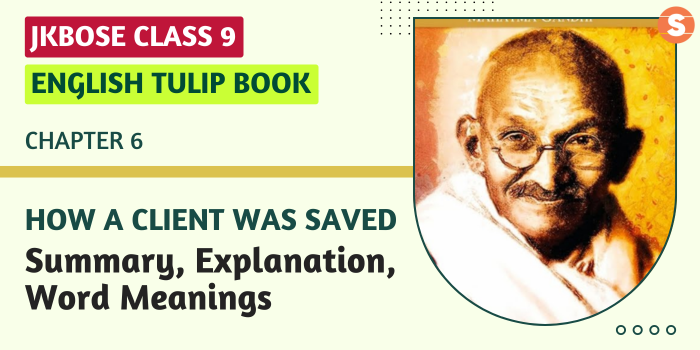
How a Client was Save Summary and Explanation
Jammu and Kashmir Board Class 9 English Chapter 6 How a Client was Save Summary, Explanation along with Difficult Word Meanings from English Tulip Book
How a Client was Save Summary – Are you looking for the summary, theme and Lesson explanation for Jammu and Kashmir Board of Secondary Education (JKBOSE) Class 9 English Chapter 6 – How a Client was Save from Tulip Book. Get Lesson summary, theme, explanation along with difficult word meanings.
PSEB Class 9 English Main Course Book Chapter 6 – How a Client was Save
Mohandas Karamchand Gandhi
This extract from My Experiments with Truth highlights Mahatma Gandhi’s belief in honesty and moral courage. Set in South Africa, it recounts how Gandhi guides his friend and client Parsi Rustomji to confess his wrongdoing openly. The incident shows that truth and repentance are more powerful than legal tricks or deception.
Related:
How a Client was Saved Summary
Parsi Rustomji was Gandhi’s client and close friend who trusted him completely. However, Rustomji concealed that he was smuggling imported goods, exploiting his good relations with customs officials. When his smuggling was discovered, he came to Gandhi in tears, confessing his guilt and fearing jail and ruin.
Gandhi calmly advised Rustomji to confess his guilt to the government, not merely to him personally. He explained that Rustomji had wronged the government and not him, and therefore a confession before him alone was not sufficient. Gandhi proposed that they should meet the Customs Officer and Attorney General and offer to pay whatever penalty they decided. He also emphasized that the real shame lay not in going to jail as in committing the offence, and that imprisonment should be accepted as a form of penance.
Gandhi then met both officials with complete honesty, revealing all the facts and promising full access to Rustomji’s account books. His frankness deeply impressed them, and the Attorney General remarked that Gandhi was someone who never accepted refusal easily. Finally, the case was settled through a compromise, and Rustomji was required to pay a penalty equal to twice the amount that he had smuggled.
Rustomji framed a written account of the incident and hung it in his office as a permanent reminder to himself, his heirs, and fellow merchants about the importance of honesty.
Summary of the Lesson How a Client was Saved in Hindi
पारसी रुस्तमजी गांधीजी के मुवक्किल और घनिष्ठ मित्र थे जो उन पर पूरा भरोसा करते थे। परंतु रुस्तमजी ने यह बात छुपाई कि वे आयातित सामान की तस्करी करते थे और सीमा शुल्क अधिकारियों के साथ अच्छे संबंधों का फायदा उठाते थे। जब उनकी तस्करी पकड़ी गई, तो वे रोते हुए गांधीजी के पास आए, अपना अपराध स्वीकार किया और जेल और बर्बादी के डर से घबरा गए।
गांधीजी ने शांतिपूर्वक रुस्तमजी को सलाह दी कि वे केवल उनके सामने नहीं, बल्कि सरकार के सामने अपना अपराध स्वीकार करें। उन्होंने समझाया कि रुस्तमजी ने उन्हें नहीं, बल्कि सरकार को नुकसान पहुँचाया है, इसलिए केवल उनके सामने की गई स्वीकारोक्ति पर्याप्त नहीं है। गांधीजी ने प्रस्ताव रखा कि वे कस्टम अधिकारी और अटॉर्नी जनरल से मिलेंगे और जो भी दंड वे निर्धारित करें, उसे चुकाने की पेशकश करेंगे। उन्होंने यह भी स्पष्ट किया कि असली लज्जा जेल जाने में नहीं, बल्कि अपराध करने में है, और कारावास को प्रायश्चित के रूप में स्वीकार किया जाना चाहिए।
इसके बाद गांधीजी ने दोनों अधिकारियों से पूरी ईमानदारी के साथ मुलाकात की और मामले से जुड़े सभी तथ्य स्पष्ट रूप से रखे तथा रुस्तमजी की लेखा-पुस्तकें दिखाने का वचन दिया। उनकी सत्यनिष्ठा से अधिकारी प्रभावित हुए और अटॉर्नी जनरल ने टिप्पणी की कि गांधीजी ऐसे व्यक्ति हैं जो आसानी से हार नहीं मानते। अंततः मामला समझौते से सुलझ गया और रुस्तमजी को तस्करी की गई राशि से दुगुना जुर्माना भरना पड़ा।
रुस्तमजी ने पूरी घटना का लिखित विवरण तैयार करवाया, उसे फ्रेम करवाया और अपने कार्यालय में टांग दिया ताकि यह उन्हें, उनके उत्तराधिकारियों और साथी व्यापारियों को ईमानदारी के महत्व की स्थायी याद दिलाता रहे। मामला समझौते से निपटाया गया, रुस्तमजी ने स्वीकार की गई तस्करी की राशि के दोगुने के बराबर जुर्माना चुकाया। रुस्तमजी ने पूरे मामले के तथ्यों को लिखा, कागज को फ्रेम करवाया, और इसे अपने कार्यालय में “अपने उत्तराधिकारियों और साथी व्यापारियों के लिए स्थायी अनुस्मारक” के रूप में लटका दिया।
जब रुस्तमजी के दोस्तों ने गांधी को चेतावनी दी कि इस “क्षणिक पश्चाताप” में न आएं, तो गांधी ने रुस्तमजी को बताया, जिन्होंने जवाब दिया, “अगर मैं आपको धोखा दूं तो मेरा क्या हाल होगा?”, जो उनके सच्चे पश्चाताप और यह मान्यता दर्शाता है कि गांधी का विश्वास कीमती है और फिर से धोखा नहीं दिया जाना चाहिए।
Theme of the Lesson How a Client was Save
Honesty and Truth as Fundamental Virtues: The central theme emphasizes that honesty is not merely the best policy but the best principle and most valued virtue. Gandhi demonstrates that complete truthfulness, even when revealing wrongdoing, is the foundation of moral life. His insistence that Rustomji confess to the government rather than just to him shows that honesty must extend beyond personal relationships to civic duty.
Confession and Repentance: The narrative explores the power of sincere confession to transform situations. Gandhi believes that acknowledging wrongdoing publicly is the first step toward redemption. Rustomji’s willingness to confess, pay penalties, and publicly display his mistake as a warning to others demonstrates genuine repentance rather than mere avoidance of punishment.
Moral Courage vs. Social Shame: Gandhi distinguishes between real and false shame. Society considers imprisonment shameful, but Gandhi argues the real shame lies in committing the offense. He teaches that accepting punishment for wrongdoing with dignity is actually an act of courage, not disgrace. This challenges conventional views about honor and reputation.
Trust and Friendship: The relationship between Gandhi and Rustomji exemplifies deep trust. Despite their different lifestyles and backgrounds, Rustomji trusts Gandhi even with personal domestic matters and accepts his “quack treatment” during illness. This trust becomes crucial when Rustomji needs guidance in his crisis, showing how genuine friendship transcends social and cultural differences.
Legal Ethics and Justice: The story contrasts two approaches to justice, the conventional lawyer’s approach (relying on jury prejudices, technical defenses) versus Gandhi’s approach (complete transparency, confession, and appeal to officials’ sense of fairness). Gandhi demonstrates that justice is better served through honesty than through legal maneuvering.
The Power of Transparency: Gandhi’s complete frankness with both the Customs Officer and Attorney General wins their respect and cooperation. His willingness to place all books at their disposal and hide nothing transforms adversaries into allies. This shows that transparency can be more powerful than concealment.
Practical Wisdom and Moral Principle: Gandhi combines idealistic moral principles with practical wisdom. He doesn’t simply demand confession but carefully navigates the legal system, meeting with officials, negotiating penalties, and achieving a compromise that serves both justice and mercy. This demonstrates that moral living requires both principles and practical intelligence.
Personal Responsibility: Rustomji’s decision to frame and display the written facts of his case in his office serves as a “perpetual reminder” to himself, his heirs, and fellow merchants. This theme emphasizes taking personal responsibility for mistakes and using them as lessons for oneself and others.
How a Client was Save Lesson Explanation
Passage: The reader, by now, will be quite familiar with Parsi Rustomji’s name. He was one who became at once my client and co-worker, or perhaps it would be truer to say that he first became co-worker and then client. I won his confidence to such an extent that he sought and followed my advice also in private domestic matters.
Even when he was ill he would seek my aid, and though there was much difference between our ways of living, he did not hesitate to accept my quack treatment.
Word Meanings
Parsi: a member of a small community in India following the Zoroastrian religion
co-worker: a person who works together with another
confidence: trust or faith in someone
domestic: related to home or family life
aid: help or assistance
quack: a person who pretends to have medical knowledge without proper training
Explanation: Gandhi tells about his close relationship with Parsi Rustomji. Rustomji first became his associate in work and later also his client. The bond between them grew so strong that Rustomji trusted the writer not only in professional matters but also in personal family issues. Even during illness Rustomji depended on him for help and accepted his medical advice, although their lifestyles were very different and the quack treatment by Gandhiji was not professionally trained. This shows the deep trust and confidence Rustomji had in the writer.
Passage: This friend once got into a very bad scrape. Though he kept me informed of most of his affairs, he had studiously kept back one thing that he was a large importer of goods from Bombay and Calcutta, and not infrequently he resorted to smuggling. But as he was on the best terms with the customs officials, no one was inclined to suspect him. In charging duty they used to take his invoices on trust. Some might even have connived at the smuggling.
Word Meanings
scrape: a difficult or dangerous situation
studiously: deliberately and carefully
importer: a person who brings goods into a country for sale
resorted: turned to as a habit or practice
smuggling: the illegal movement of goods to avoid customs duty
inclined: likely or willing
customs officials: government officers who check goods entering or leaving a country
invoices: written lists showing goods supplied and their prices
connived: secretly allowed or ignored something wrong
Explanation: The writer describes how his friend once got into serious trouble. Although the friend usually shared details of his business, he deliberately hid the fact that he was a major importer and often smuggled goods from Bombay and Calcutta. Because he had friendly relations with customs officials, he was rarely suspected. The officials trusted his invoices while charging duty, and some of them may have knowingly ignored his illegal activities. This shows how misuse of trust and corruption helped the friend escape scrutiny for a long time.
Passage: But to use the telling simile of the Gujarati poet, Akho, theft like quicksilver won’t be suppressed, and Parsi Rustomji’s proved no exception. The good friend ran posthaste to me, the tears rolling down his cheeks as he said. ‘Bhai. I have deceived you. My guilt has been discovered today. I have smuggled and I am doomed. I must go to jail and be ruined. You alone may be able to save me from this predicament. I have kept back nothing else from you, but I thought I ought not to bother you with such tricks of the trade, and so I never told you about this smuggling. But now, how much I repent it!’
Word Meanings
simile: a comparison using “like” or “as”
quicksilver: mercury; something that slips away easily
suppressed: stopped or controlled
posthaste: very quickly
deceived: cheated or misled
guilt: responsibility for a wrongdoing
doomed: facing unavoidable punishment or failure
predicament: a difficult or unpleasant situation
repent: feel deep regret for a wrong action
Explanation: Mahatma Gandhi explains that wrongdoing cannot remain hidden forever, comparing theft to quicksilver that slips out no matter how one tries to hold it. Parsi Rustomji’s illegal activities were finally exposed. Overcome with fear and remorse, he rushed to the writer, confessed his deception, and admitted that he had been involved in smuggling. He believed he was destined for jail and ruin and pleaded for help, explaining that he had earlier hidden this truth thinking it was merely a business trick. Now filled with regret, he realized his mistake and sought guidance in his desperate situation.
Passage: I calmed him and said, ‘To save or not to save you is in His hands. As to me you know my way. I can but try to save you by means of confession.’
The good Parsi felt deeply mortified. ‘But is not my confession before you enough?’ he said. ‘You have wronged not me but the government. How will the confession made before me avail you!’ I replied gently.
‘Of course I will do just as you advise, but will you not consult with my old counsel Mr_ He is a friend too,’ said Parsi Rustomji.
Inquiry revealed that the smuggling had been going on for a long time, but the actual offence detected involved a trifling sum. We went to his counsel. He perused the papers, and said, ‘The case will be tried by a jury, and a Natal jury will be the last to acquit an Indian. But I will not give up hope.’
Word Meanings
calmed: made someone less anxious or upset
means: method or way
confession: an admission of wrongdoing
mortified: deeply ashamed or embarrassed
avail: help or benefit
consult: seek advice from someone
inquiry: careful investigation
trifling: very small or insignificant
perused: read carefully
acquit: declare someone not guilty
Natal: relating to Natal, a province in South Africa ( now part of KwaZulu-Natal)
Explanation: The narrator tries to reassure Parsi Rustomji and tells him that his fate ultimately lies in God’s hands, while he himself can only help through honest confession. Parsi Rustomji feels embarrassed and questions whether confessing to the narrator alone is not enough. The narrator explains that the wrongdoing was against the government, not against him personally, so a proper confession in front of the authorities was necessary. Though reluctant, Parsi Rustomji agrees to follow the advice and asks that his old lawyer be consulted. An investigation shows that smuggling had been happening for a long time, though the specific offence discovered involved only a small amount. The lawyer studies the case papers and warns that a local jury would be unlikely to acquit an Indian, but still expresses some hope for a favourable outcome.
Passage: I did not know this counsel intimately. Parsi Rustomji intercepted: ‘I thank you, but I should like to be guided by Mr Gandhi’s advice in this case. He knows me intimately. Of course you will advise him whenever necessary.’
Having thus shelved the counsel’s question, we went to Parsi Rustomji’s shop.
And now explaining my view I said to him, ‘I don’t think this case should be taken to court at all. It rests with the Customs Officer to prosecute you or to let you go, and he in turn will have to be guided by the Attorney General. I am prepared to meet both. I propose that you should offer to pay the penalty they fix, and the odds are that they will be agreeable. But if they are not, you must be prepared to go to jail. I am of opinion that the shame lies not so much in going to jail as in committing the offence. The deed of shame has already been done. Imprisonment you should regard as a penance. The real penance lies in resolving never to smuggle again.’
Word Meanings
intimately: closely or personally
intercepted: interrupted or stopped someone from speaking
guided: directed or advised
shelved: set aside or postponed
prosecute: bring a legal case against someone
penalty: punishment, usually a fine or legal consequence
odds: chances or likelihood
agreeable: willing or acceptable
offence: a crime or wrongdoing
penance: punishment or suffering accepted to show repentance
Explanation: Parsi Rustomji expresses his trust in Mr Gandhi by choosing to follow his advice rather than relying fully on the lawyer, whom Gandhi did not know well. The lawyer’s question is thus set aside, and they go to Rustomji’s shop. Gandhi then explains his moral and practical approach to the situation. He advises that the matter should not go to court and suggests approaching the Customs Officer and the Attorney General directly. Gandhi believes that offering to pay the penalty honestly may resolve the issue. However, if imprisonment becomes unavoidable, Rustomji should accept it without fear or shame. Gandhi emphasizes that true shame lies in committing the crime, not in accepting punishment. He presents imprisonment as a form of penance and stresses that the most important repentance is a firm resolve never to repeat the wrongdoing of smuggling.
Passage: I cannot say that Parsi Rustomji took all this quite well. He was a brave man, but his courage failed him for the moment. His name and fame were at stake, and where would he be if the edifice he had reared with such care and labour should go to pieces?
‘Well, I have told you,’ he said, ‘that I am entirely in your hands. You may do just as you like.’ I brought to bear on this case all my powers of persuasion. I met the Customs Officer and fearlessly apprised him of the whole affair. I also promised to place all the books at his disposal and told him how penitent Parsi Rustomji was feeling.
Word Meanings
quite well: in a satisfactory manner
courage failed him: he lost his confidence
at stake: in danger of being lost
edifice: something carefully built, here meaning reputation or life’s work
reared: built or created
go to pieces: be destroyed or ruined
entirely: completely
brought to bear: used effectively
persuasion: ability to convince others
fearlessly: without fear
apprised: informed
disposal: availability for use
penitent: feeling sorry and repentant
Explanation: Parsi Rustomji is shown struggling emotionally with Gandhi’s advice. Though naturally brave, he momentarily loses courage because his reputation and lifelong work are in danger. The thought of everything he had carefully built being ruined deeply disturbs him. Still, he places complete trust in Gandhi and leaves the decision entirely to him. Gandhi then acts with honesty and moral strength by using all his persuasive ability to approach the Customs Officer directly. He openly informs him of the entire truth, offers full cooperation by making all records available, and emphasizes Rustomji’s genuine repentance. This highlights Gandhi’s belief in confession, transparency, and moral courage as being the right paths to save oneself from the sin done.
Passage: The Customs Officer said, ‘I like the Old Parsi. I am sorry he has made a fool of himself. You know where my duty lies. I must be guided by the Attorney General and so I would advise you to use all your persuasion with him.’
‘I shall be thankful,’ said I, ‘if you do not insist on dragging him into court.’
Having got him to promise this, I entered into correspondence with the Attorney-General and also met him. I am glad to say that he appreciated my complete frankness and was convinced that I had kept back nothing.
Word Meanings
Customs Officer: government official who checks goods and collects duty
made a fool of himself: behaved foolishly and irresponsibly
duty lies: official responsibility rests
guided by: act according to the advice or authority of
Attorney General: chief legal officer of the government
persuasion: effort to convince someone
insist: demand firmly
dragging into court: forcing someone to face a legal trial
correspondence: exchange of letters
appreciated: understood and valued
complete frankness: total honesty
kept back nothing: concealed no facts
Explanation: The Customs Officer shows personal sympathy for Parsi Rustomji but makes it clear that he cannot ignore his official responsibility. He explains that the final decision depends on the Attorney General and advises Gandhi to use his influence there. Gandhi politely requests that Rustomji should not be taken to court, and the officer agrees to this request. Encouraged by this assurance, Gandhi writes to and personally meets the Attorney General. His honest and transparent approach wins appreciation, and the Attorney General becomes convinced that Gandhi has concealed nothing. This episode highlights the power of truth, sincerity, and moral courage in dealing with legal and ethical problems.
Passage: I now forget whether it was in connection with this or with some other case that my persistence and frankness extorted from him the remark: ‘I see you will never take a no for an answer. ‘
The case against Parsi Rustomji was settled by a compromise. He was to pay a penalty equal to twice the amount he had confessed to having smuggled. Rustomji reduced to writing the facts of the whole case, got the paper framed and hung it up in his office to serve as a perpetual reminder to his heirs and fellow merchants.
These friends of Rustomji warned me not to be taken in by this transitory contrition. When I told Rustomji about this warning he said: ‘What would be my fate if I deceived you?’
Word Meanings
persistence: firm determination to continue
frankness: openness and honesty
extorted: forced to obtain
remark: comment or statement
settled: resolved
compromise: agreement by mutual concession
penalty: punishment or fine
confessed: admitted openly
smuggled: illegally imported goods
reduced to writing: written down formally
framed: placed in a frame
perpetual: lasting forever
heirs: those who inherit property
transitory: temporary, short-lived
contrition: deep remorse or repentance
deceived: cheated or misled
Explanation: The writer recalls that his honesty and persistence impressed the Attorney General, who remarked that he never accepted refusal easily. The case against Parsi Rustomji ended in a compromise, under which Rustomji had to pay a fine double the amount than what he had smuggled. To ensure he never repeated the mistake, Rustomji wrote down the full account of the incident, framed it, and displayed it in his office as a lasting moral lesson for his heirs and fellow traders. Although some friends doubted the sincerity of Rustomji’s repentance, he firmly expressed his deep respect and fear of betraying the writer’s trust, showing that his remorse was genuine.
Conclusion
This post covers the summary, explanation and word meanings of the lesson “How a Client was saved” from the JKBOSE Class 9 English Tulip book. Students can get a revision of the lesson with the help of this text.