

The Discovery of Moon Summary and Explanation
PSEB Class 9 English Chapter 5 The Discovery of Moon Summary, Explanation along with Difficult Word Meanings from English Main Course Book
The Discovery of Moon Summary – Are you looking for the summary, theme and Lesson explanation for Punjab School Education Board (PSEB) Class 9 English Chapter 5 – The Discovery of Moon from English Main Course Book. Get Lesson summary, theme, explanation along with difficult word meanings
PSEB Class 9 English Main Course Book Chapter 5 – The Discovery of Moon
This chapter is based on The Discovery of Moon from the book World Famous Discoveries Published by Pustak Mahal. It discusses important spacecrafts namely, Apollo-11, Eagle-2, and Luna-16.
- The Discovery of Moon Summary
- The Discovery of Moon Summary in Hindi
- The Discovery of Moon Theme
- The Discovery of Moon Explanation
Related:
The Discovery of Moon Summary
Apollo-11 and Eagle-2 were launched into outer space on a moon exploration mission. Apollo-11 carried Armstrong and Edwin while Eagle-2 carried Michael Collins. Eagle-2 flew around the moon while Apollo-11 landed on the moon on July 20, 1969. Armstrong and Edwin became the first men to set foot on the moon. They set up equipment and machines for the observatories back on Earth. They collected samples of lunar soil for research, and they went back to Earth. The USSR and the USA noticed how the observations were breaking misconceptions about the moon and giving invaluable knowledge. The USSR sent spaceships and the USA sent their astronauts. The USSR then sent a robot to the moon. A robot was inexpensive, less endangering human life, and could do the same tasks as a human being. We get to know fourteen important facts about the moon: it is the Earth’s only natural satellite, it is a large satellite in relation to the size of its parent planet, as compared to the satellites of other planets, the diameter of the moon is one-fourth of the earth’s diameter, it is 384,405 km away from the earth, it orbits the earth entirely in a month, the surface of the moon has craters caused by meteorites, the moon is the same age as the earth, the moon does not shine on its own, the earth and the moon travel around a common centre of gravity in space, the moon has different phases, the average daily delay in the moon-rise and the moon-set is about 50 minutes, it has no air or water, cosmic dust rains on the moon, and the rocks can reach a temperature of 110°C more than the boiling point of water in the sunlight and the temperature goes down to less than -100 °C in the shadows. The moon was declared to be desolate and uninhabitable. Poets and artists still compare their beloved to the moon, despite knowing that the moon is not as beautiful as it is said to be.
Summary of the Lesson The Discovery of Moon in Hindi
अपोलो-11 और ईगल-2 को चंद्रमा अन्वेषण मिशन पर अंतरिक्ष में भेजा गया था। अपोलो-11 में आर्मस्ट्रांग और एडविन सवार थे, जबकि ईगल-2 में माइकल कॉलिन्स सवार थे। ईगल-2 ने चंद्रमा की परिक्रमा की, जबकि अपोलो-11 20 जुलाई, 1969 को चंद्रमा पर उतरा। आर्मस्ट्रांग और एडविन चंद्रमा पर कदम रखने वाले पहले व्यक्ति बने। उन्होंने पृथ्वी पर स्थित वेधशालाओं के लिए उपकरण और मशीनें स्थापित कीं। उन्होंने शोध के लिए चंद्र मिट्टी के नमूने एकत्र किए और पृथ्वी पर लौट आए। सोवियत संघ और अमेरिका ने देखा कि कैसे अवलोकन चंद्रमा के बारे में गलत धारणाओं को दूर कर रहे थे और अमूल्य ज्ञान प्रदान कर रहे थे। सोवियत संघ ने अंतरिक्ष यान भेजे और अमेरिका ने अपने अंतरिक्ष यात्रियों को भेजा। इसके बाद सोवियत संघ ने चंद्रमा पर एक रोबोट भेजा। रोबोट सस्ता था, मानव जीवन के लिए कम खतरनाक था, और मनुष्य के समान कार्य कर सकता था। हम चंद्रमा के बारे में चौदह महत्वपूर्ण तथ्य जानते हैं: यह पृथ्वी का एकमात्र प्राकृतिक उपग्रह है, यह अन्य ग्रहों के अन्य उपग्रहों की तुलना में एक बड़ा उपग्रह है, चंद्रमा का व्यास पृथ्वी के व्यास का एक चौथाई है, यह पृथ्वी से 384,405 किमी दूर है, यह एक महीने में पृथ्वी की पूरी परिक्रमा करता है, चंद्रमा की सतह पर उल्कापिंडों के कारण गड्ढे हैं, चंद्रमा की आयु पृथ्वी के समान है, चंद्रमा स्वयं नहीं चमकता है, पृथ्वी और चंद्रमा अंतरिक्ष में एक सामान्य गुरुत्वाकर्षण केंद्र के चारों ओर यात्रा करते हैं, चंद्रमा के विभिन्न चरण होते हैं, चंद्रमा के उदय और अस्त होने में औसत दैनिक विलंब लगभग 50 मिनट है, चंद्रमा पर न तो हवा है और न ही पानी, इस पर ब्रह्मांडीय धूल की वर्षा होती है, और इसकी चट्टानें सूर्य के प्रकाश में पानी के क्वथनांक से 110 डिग्री सेल्सियस अधिक तापमान तक पहुँच सकती हैं, जबकि छाया में तापमान -100 डिग्री सेल्सियस से भी नीचे चला जाता है। चंद्रमा को निर्जन और रहने योग्य नहीं घोषित किया गया था। कवि और कलाकार आज भी अपने प्रियजनों की तुलना चंद्रमा से करते हैं, यह जानते हुए भी कि चंद्रमा उतना सुंदर नहीं है जितना कहा जाता है।
Theme of the Lesson The Discovery of Moon
The theme of this chapter is the progress of science and technology. It shows how science can break down conventional thinking and misconceptions. This chapter is based on the discovery of the moon and the event that developed research in the field of space and moon exploration rapidly. It discusses important spacecrafts like Apollo-11, Eagle-2, and Luna-16. It highlights the contributions of the USSR and the USA in research on the moon. The chapter showcases the summary of how the research on the moon progressed and what it yielded.
The Discovery of Moon Lesson Explanation
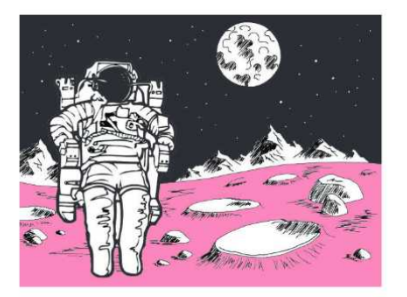
Passage: On July 20, 1969, two American astronauts, Armstrong and Edwin, emerging from the spacecraft Apollo-11, became the first men to set foot on the moon. This great event opened new avenues in the field of space and moon exploration. After collecting samples of the lunar soil, these two astronauts returned to their spacecraft Apollo-11. However, they left such instruments and machines on the moon which continued to send their observations about the moon to the observatories on the earth. Apollo-11 was locked with another spacecraft, Eagle-2. As Apollo-11 remained on the surface of the moon, Eagle-2 revolved round the moon. Aboard the Eagle-2 was a third astronaut Michael Collins, who waited for the return of his two companions.
Word-meanings:
astronaut: one who travels in a spacecraft, cosmonaut
avenues: means of access or attainment
exploration: examination, a close study
observatory: a room or building housing an astronomical telescope or other scientific equipment for the study of natural phenomena
Explanation: On July 20, 1969, the spacecraft Apollo-11 landed on the moon. Apollo-11 was locked with another spacecraft, Eagle-2. Apollo-11 was on the surface of the moon, while Eagle-2 orbited the moon. Two Americans, Armstrong and Edwin, were travelling in Apollo-11. Michael Collins was travelling in the Eagle-2. Armstrong and Edwin became the first men to set foot on the moon. This event opened a direct means to gather information about the moon for the field of space and moon exploration. The two astronauts collected samples of the moon soil. The instruments and machines were left on the moon so they could continue to get observations of the moon.
Passage: After this successful expedition, a series of Apollo spacecraft for making more manned space flights to moon was started. These flights made available extremely useful and wonderful information about the moon. This new information removed all kinds of misconceptions about the moon from the minds of the people the world over.
Word-meanings:
expedition: an excursion, journey or voyage made for some specific purpose
manned: having human crew
misconception: a wrong idea due to some false comprehension
Explanation: The moon excursion was successful. More Apollo spacecraft were made so that more human excursions could be made to the moon. The expeditions brought more useful information about the moon. The new knowledge removed false thoughts about the moon.
Passage: The discovery of the moon formed an important part of the space programme. Besides earth, it was the only heavenly mass where man landed and had a glimpse of it. Spacecraft have been landed on the other planets too but man has yet to set his foot on any of these heavenly bodies. The USSR and the USA had worked out programme for the exploration of moon. The USSR sent there its spaceships whereas the USA sent its astronauts. The exploration of the planets is still going on but there is no more any programme for further exploration of the moon.
Word-meanings:
heavenly: celestial
Explanation: The discovery of the moon became integrated with the space programme because the moon was the only celestial body other than Earth on which man had walked. The USSR, or the Union of Soviet Socialist Republics and the USA worked out various moon expeditions, in which the USSR sent out spaceships and the USA sent its astronauts.
Passage: The Soviet Union did not feel it necessary to land man on the moon. It thought it more appropriate to send spaceships and to carry on exploration with the help of scientific instruments only. The Soviet scientists sent a spacecraft called Luna-16 on the moon in September 1970. It carried a robot that was placed on the surface of the moon. A robot was found to be as good as a man to carry out experiments on moon’s surface. Moreover, it was also less expensive and above all, human life was not endangered.
Word-meanings:
appropriate: suitable
robot: a manufactured device capable of performing some human-like functions
endangered: someone or something at a risk or in danger of being harmed, damaged or destroyed
Explanation: The USSR preferred to send unmanned spaceships. On September 1970, the Luna-16 carried a robot to the moon, which carried out experiments with the same quality as a man. The robot was less expensive and avoided endangerment of human life.
Passage: Researches on moon for over three decades have shattered many traditional beliefs about it. The moon is an absolutely desolate place where there is no water and air. The Soviet scientists have declared it unfit for human inhabitation. Of course, some useful metals like aluminium, titanium and iron have been found on moon but man has not been tempted to exploit these metal resources of moon. However, some scientists still feel that moon can be made inhabitable for men by separating oxygen from elements which contain oxygen.
Word-meanings:
decade: a period of ten years
shattered: broke
desolate: feeling very sad and lonely
inhabitable: a worth living place or land
Explanation: Researchers have been working for three decades, which means thirty years. The research and the new knowledge brought in broke many old beliefs about the moon. The moon is unfit for living as it does not have water and air. Useful metals like aluminium, titanium and iron have been found on the moon but remain unused by man. Some scientists are working on making the moon a place worth living on by separating oxygen from other elements.
Passage: Today we know all the important facts about the moon. It is the Earth’s only natural satellite. Compared to satellites of other planets, it is very large in relation to its parent planet. It is a quarter of the earth’s diameter measuring 3476 km. Its distance from the earth is 384,405 km. It orbits the earth once a month, keeping the same face turned towards earth as it does so. Its surface is pitted with craters caused by meteorites. The moon is the same age as the earth about 4.600 million years. The moon is not a self-luminous body. The earth and the moon travel around a common centre of gravity in space. As the moon orbits the earth, different amount of its sunlit surface are visible from the earth. This produces the cycle known as Phases of the moon. We can see the full- moon and no moon once in a month and for rest of the days it appears in its phases. The average daily delay in the moon-rise and the moon-set is about 50 minutes. The moon is lacking water and it has no atmosphere. A very light ‘rain’ of cosmic dust continually falls here. In the glare of the sun, lunar rocks reach a temperature of 110°C – more than the boiling point of water. But in shadows the temperature goes down to less than -100 °C.
Word-meanings:
pitted: having marks, dents, or pits on the surface
self-luminous: something that shines on their own
Explanation: We know many important facts about the moon. First, it is the Earth’s only natural satellite i.e., it revolves around the earth. Second, it is a large satellite compared to other satellites of other planets. Third, the diameter of the moon is one-fourth of the earth’s diameter, measuring 3,476 km. Fourth, it is 384,405 km away from the earth. Five, it orbits the earth entirely in a month. Six, the surface of the moon has craters caused by meteorites. Seven, the moon is the same age as the earth, about 4,600 million years. Eight, the moon does not shine on its own. Nine, the earth and the moon travel around a common centre of gravity in space. Ten, the moon has different phases because of the different ways in which the sunlight can fall on the moon. We can see the full moon and no moon once a month and for the rest of the days, it appears in its phases where there is a gradual change in the size of the moon according to the changes in the amount of sunlight that falls on it. Eleven, the average daily delay in the moon-rise and the moon-set is about 50 minutes. Twelve, it has no air or water. Thirteen, cosmic dust rains on the moon. Fourteen, lunar rocks reach a temperature of 110°C – more than the boiling point of water in the sunlight and the temperature goes down to less than -100 °C in the shadows.
Passage: In spite of the knowledge of these ‘dull’ facts about the moon, poets and lovers continue to sing of the beauties of this heavenly body and compare the faces of their beloveds to this lovely satellite.
Passage Explanation: So we know that the moon is dull and desolate and full of craters which look like blemishes. However, poets and lovers still continue to sing about the moon’s beauty and compare the face of a beautiful girl to the moon.
Conclusion
This post covers the lesson “The Discovery of Moon” from PSEB Class 9 English Main Course book. Students can check out the summary, word meanings and explanation to understand the lesson better.