

PSEB Class 9 English Chapter 5 The Discovery of Moon Important Question Answers from English Main Course Book
PSEB Class 9 English The Discovery of Moon Question Answers – Looking for questions and answers for PSEB Class 9 English Main Course Book Chapter 5 The Discovery of Moon? Look no further! Our comprehensive compilation of important questions will help you brush up on your subject knowledge. Practising Class 9 English question answers can significantly improve your performance in the exam. Improve your chances of scoring high marks by exploring Chapter 5 The Discovery of Moon now. The questions listed below are based on the latest PSEB exam pattern. All the Questions Answers given at the back of the lesson have also been covered.
Related:
PSEB Class 9 English Chapter 5 The Discovery of Moon Textbook Questions
LANGUAGE EXERCISES
A. Comprehension Questions
Answer the following questions in your own words:
1. Name the two astronauts who landed on the moon.
Ans. Armstrong and Edwin are the two astronauts who landed on the moon.
2. What was the name of their spacecraft?
Ans. Apollo-11 was the name of their spacecraft.
3. Which two countries had worked out programme for the exploration of the moon?
Ans. The USSR and the USA were the two countries that had worked out a programme for the exploration of the moon.
4. How did the Soviet Union feel about carrying on this exploration?
Ans. The Soviet Union, or the USSR, thought about sending robots instead of men on moon expeditions. They felt that a robot is less expensive, sufficiently capable, and avoids putting human life in danger.
5. Why have the scientists declared the moon unfit for human habitation?
Ans. The moon has no air or water. It cannot support life, as it is completely desolate. Therefore, scientists have declared the moon unfit for human habitation.
6. According to the scientists, how can the moon be made habitable for man?
Ans. The moon can be made habitable for man by separating oxygen from the other elements.
7. Name the metals found on the moon.
Ans. The metals found on the moon are iron, titanium, and aluminium.
8. Have the traditional beliefs about the moon proved true?
Ans. No, the observations recorded on the moon proved the traditional beliefs false.
B Vocabulary Exercises
(i) Match the words in column A with their meanings in column B:
| A | B |
| astronaut | something that can be used to help in achieving an aim |
| spacecraft | to get attracted |
| misconception | chemical substance made of atoms of one type only |
| shatter | older methods and ideas |
| desolate | a person who travels and works in spacecraft |
| traditional | a place that is empty or without people |
| element | a vehicle that travels in space |
| tempted | a belief not based on correct information |
| resources | to destroy completely |
Ans.
| A | B |
| astronaut | a person who travels and works in spacecraft |
| spacecraft | a vehicle that travels in space |
| misconception | a belief not based on correct information |
| shatter | to destroy completely |
| desolate | a place that is empty or without people |
| traditional | older methods and ideas |
| element | chemical substance made of atoms of one type only |
| tempted | to get attracted |
| resources | something that can be used to help in achieving an aim |
(ii) Fill in the blanks with words given:
| planet | satellite | orbit | man-made | constant |
| face | rotate | phenomenon | heavenly |
The word satellite comes from the Latin word satellitis meaning attendant. The moon is Earth’……… It is our planet’…………companion in space. The moon takes exactly the same time ……………around its axis once as the earth takes to rotate on its axis once. That is why we see the same………… of the moon on earth. Scientists took an idea from this………. and developed artificial satellites. Satellites are………… bodies that revolve round a planet. They are also called the moons of the……….. Artificial satellites are…… objects which are put into………with the help of rockets.
Ans. The word satellite comes from the Latin word satellitis meaning attendant. The moon is Earth’s satellite. It is our planet’s constant companion in space. The moon takes exactly the same time to rotate around its axis once as the earth takes to rotate on its axis once. That is why we see the same face of the moon on earth. Scientists took an idea from this phenomenon and developed artificial satellites. Satellites are heavenly bodies that revolve round a planet. They are also called the moons of the planet. Artificial satellites are man-made objects which are put into orbit with the help of rockets.
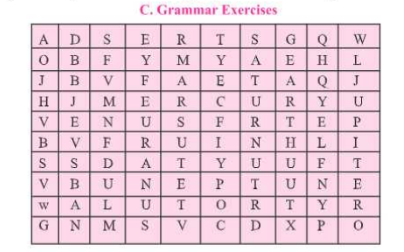
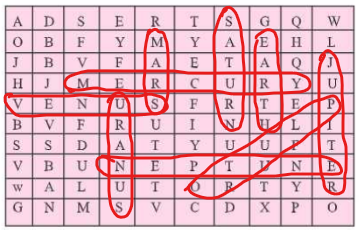
(iii). Can you identify the names of the eight planets of our solar system in the box:
(i) Rewrite the following paragraph in the past tense:
There is a function at our school. The whole school is decorated with balloons, strips of coloured paper, flowers and blinking lights. All the students are excited. They do their best. The performers wait for their turn backstage.
Ans. There was a function at our school. The whole school was decorated with balloons, strips of coloured paper, flowers and blinking lights. All the students were excited. They did their best. The performers waited for their turn backstage.
(ii) Fill in the blanks with the correct tense forms of the verbs given in brackets:
1. Two U.S. astronauts…….. (land) on the moon on July 20, 1969.
2. The astronauts………(bring) back samples of lunar rocks to earth.
3. These sample……..(analyse) by the scientists. (passive)
4. The astronauts……… (find) no evidence of life on the moon.
5. Some useful metal like aluminium and iron……. (find) on the moon. (passive)
Ans. 1. Two U.S. astronauts landed on the moon on July 20, 1969.
2. The astronauts brought back samples of lunar rocks to earth.
3. These samples were analysed by the scientists.
4. The astronauts found no evidence of life on the moon.
5. Some useful metal like aluminium and iron were found on the moon.
D. Pronunciation Practice
Say the following words aloud. Take care that you pronounce the cluster of consonants correctly.
| strike | scrap | spray | square |
| straight | screen | sprain | squint |
| strict | scream | spring | squeak |
| stream | screw | spright | squash |
| friends | belt | box | heads |
| trends | pelt | fox | wads |
| rends | hilt | tax | lads |
Ans.
| /strʌɪk/ | /skrap/ | /spreɪ/ | /skwɛː/ |
| /streɪt/ | /skriːn/ | /spreɪn/ | /skwɪnt/ |
| /strɪkt/ | /skriːm/ | /sprɪŋ/ | /skwiːk/ |
| /striːm/ | /skruː/ | /spaɪt/ | /skwɒʃ/ |
| /frɛnd/ | /bɛlt/ | /bɒks/ | /hɛd/ |
| /trɛnd/ | /pɛlt/ | /fɒks/ | /wɒd/ |
| /rɛnd/ | /hɪlt/ | /taks/ | /lad/ |
E. Creative Writing and Extended Reading
1. Read the chapter on Solar System in your General Science book. Write a brief note on it.
2. What do you know about India’s progress in the field of space travel? Name the satellites put into the orbit by India.
3. Read the story of Kalpana Chawla, the space heroine who lost her life during a space exploration mission in the USA. Write 10-12 lines on her achievements.
Ans.
2. India has evolved from launching its first satellite to being one of the leading countries in space exploration. It has launched numerous satellites into orbit, and some of the key satellites are Aryabhata, Bhaskara, Rohini, the IRS series, the INSAT series, Chandrayaan, Mangalyaan, and CMS-03.
3. Kalpana Chawla achieved groundbreaking milestones as an Indian-American astronaut. She conducted computational fluid dynamics research at NASA Ames on vertical take-off concepts and multi-computer fluid flow solutions. She was selected in 1994 as part of NASA’s 15th astronaut group. She trained as a mission specialist and operator of the robotic arm. On STS-87 in 1997 aboard Columbia, Chawla deployed the Spartan satellite over 252 orbits, logging 372 hours in space despite a malfunction requiring a spacewalk. She was involved in over 80 microgravity experiments on astroculture, combustion, and materials in 2003. She was posthumously awarded the Congressional Space Medal of Honour, NASA Space Flight Medal, and Distinguished Service Medal for her contributions.
Punjab Board Class 9 English Chapter 5 The Discovery of Moon Extra Question and Answers
Extract-Based questions
A. On July 20, 1969, two American astronauts, Armstrong and Edwin, emerging from the spacecraft Apollo-11, became the first men to set foot on the moon. This great event opened new avenues in the field of space and moon exploration. After collecting samples of the lunar soil, these two astronauts returned to their spacecraft Apollo-11. However, they left such instruments and machines on the moon which continued to send their observations about the moon to the observatories on the earth. Apollo-11 was locked with another spacecraft, Eagle-2. As Apollo-11 remained on the surface of the moon, Eagle-2 revolved round the moon. Aboard the Eagle-2 was a third astronaut Michael Collins, who waited for the return of his two companions.
Q1. The first men to set foot on the moon were from ______
Ans. USA
Q2. They were onboard the _________ spacecraft.
Ans. Apollo-11
Q3. Which aircraft accompanied Apollo 11?
Ans. Eagle-2
Q4. While Apollo 11 remained on the moon’s surface, ________ revolved around it.
Ans. Eagle-2
Q5. Apollo-11 left _____ on the moon.
Ans. instruments and machines
B. The Soviet Union did not feel it necessary to land man on the moon. It thought it more appropriate to send spaceships and to carry on exploration with the help of scientific instruments only. The Soviet scientists sent a spacecraft called Luna-16 on the moon in September 1970. It carried a robot that was placed on the surface of the moon. A robot was found to be as good as a man to carry out experiments on moon’s surface. Moreover, it was also less expensive and above all, human life was not endangered.
Q1. Which country did not find it necessary to land man on the moon?
Ans. USSR or the Soviet Union.
Q2. What was more appropriate for the Soviets?
Ans. They found it appropriate to send spaceships and do explorations with instruments.
Q3. Which country sent the Luna-16 to the moon?
Ans. USSR
Q4. When did the Luna 16 go to the moon and what did it carry?
Ans. It went in September 1970 and took a robot to the moon.
Q5. How was Luna-16 better than Apollo-11?
Ans. It was less expensive and did not put human life in danger.
C. Today we know all the important facts about the moon. It is the Earth’s only natural satellite. Compared to satellites of other planets, it is very large in relation to its parent planet. It is a quarter of the earth’s diameter measuring 3476 km. Its distance from the earth is 384,405 km. It orbits the earth once a month, keeping the same face turned towards earth as it does so. Its surface is pitted with craters caused by meteorites. The moon is the same age as the earth about 4.600 million years. The moon is not a self-luminous body. The earth and the moon travel around a common centre of gravity in space. As the moon orbits the earth, different amount of its sunlit surface are visible from the earth. This produces the cycle known as Phases of the moon. We can see the full- moon and no moon once in a month and for rest of the days it appears in its phases. The average daily delay in the moon-rise and the moon-set is about 50 minutes. The moon is lacking water and it has no atmosphere. A very light ‘rain’ of cosmic dust continually falls here. In the glare of the sun, lunar rocks reach a temperature of 110°C – more than the boiling point of water. But in shadows the temperature goes down to less than -100 °C.
Q1. __________ is the Earth’s only natural satellite.
Ans. Moon
Q2. The moon’s diameter is a _____ that of the Earth.
Ans. quarter
Q3. The moon is at a distance of 384,405 km from the _________. (Earth / Sun)
Ans. Earth
Q4. The ___________ age is the same as that of the Earth.
Ans. moon’s
Q5. What causes the phases of the moon?
Ans. As the moon orbits the earth, the amount of its sunlit surface visible from the earth varies. This causes the phases on the moon.
D. Researches on moon for over three decades have shattered many traditional beliefs about it. The moon is an absolutely desolate place where there is no water and air. The Soviet scientists have declared it unfit for human inhabitation. Of course, some useful metals like aluminium, titanium and iron have been found on moon but man has not been tempted to exploit these metal resources of moon. However, some scientists still feel that moon can be made inhabitable for men by separating oxygen from elements which contain oxygen.
Q1. How many decades has research on the moon been carried for?
Ans. Over three decades
Q2. Describe the conditions on the moon.
Ans. The moon is empty and lacks water and air.
Q3. Which country has declared the moon unfit for human inhabitation?
Ans. The Soviets.
Q4. Some useful ____ have been found on the moon.
Ans. metals
Q5. How can the moon be made inhabitable?
Ans. Moon can be made inhabitable for men by separating oxygen from elements which contain oxygen.
Multiple Choice Questions (MCQs)
Q1. Complete the analogy:
Lunar : moon : : Solar : _______
A. Earth
B. Sun
C. Universe
D. none of these
Ans. B. Sun
Q2. Which of the following has phases?
A. Moon
B. Earth
C. Apollo-11
D. Luna-16
Ans. A. Moon
Q3. Which was the first spacecraft to land men on the moon?
A. Eagle-2
B. Luna-16
C. Apollo-12
D. Apollo-11
Ans. D. Apollo-11
Q4. When did man land on the moon for the first time?
A. July 21, 1969
B. July 22, 1969
C. July 20, 1968
D. July 20, 1969
Ans. D. July 20, 1969
Q5. Which of the following two aircrafts were locked together?
A. Apollo-11 and Eagle-2
B. Luna-16 and Eagle-2
C. Apollo-11 and Luna-16
D. None of these
Ans. A. Apollo-11 and Eagle-2
Q6. Which craft revolved around the moon as Apollo-11 landed on it?
A. Eagle-2
B. Luna-16
C. Apollo-10
D. All of these
Ans. A. Eagle-2
Q7. Which country did not prefer sending humans on the moon?
A. USA
B. India
C. USSR
D. None of them
Ans. C. USSR
Q8. Find the odd one out-
A. Armstrong
B. Rakesh Sharma
C. Edwin
D. Collins
Ans. B. Rakesh Sharma
Q9. ________ was the only heavenly mass besides Earth where man landed.
A. Mars
B. Sun
C. Moon
D. None of these
Ans. C. Moon
Q10. Luna-16 was sent on the ______ by ______ in _______
A. Sun, USA, 2010
B. Moon, USSR, 1970
C. Sun, India, 1970
D. Moon, USA, 1970
Ans. B. Moon, USSR, 1970
Q11. Luna-16 left a _____ on the moon
A. Luna
B. Robot
C. Oxygen cylinder
D. book
Ans. B. Robot
Q12. The moon has ____ air and water.
A. some
B. plenty
C. contaminated
D. no
Ans. D. no
Q13. What is present on the moon?
A. air
B. water
C. food
D. metals
Ans. D. metals
Q14. What is the diameter of the moon?
A. 3476 km
B. 3576 km
C. 3340 km
D. not known
Ans. A. 3476 km
Q15. How is the moon related to the Earth?
A. satellite
B. sister planet
C. broken part of earth
D. none of these
Ans. A. satellite
Q16. What is the frequency of a full moon?
A. once a month
B. daily
C. once every 15 days
D. once a year
Ans. A. once a month
Q17. The variations in the visible part of the moon lit by sun’s light causes ____
A. tides
B. phases
C. gravity
D. eclipses
Ans. B. phases
Q18. A light rain of ______ falls on the moon.
A. water
B. dust
C. cosmic dust
D. current
Ans. C. cosmic dust
Q19. What is the range of temperatures on the moon?
A. 50⁰ C to -50⁰ C
B. 100⁰ C to -100⁰ C
C. Not determined
D. 0⁰ C to 150⁰ C
Ans. B. 100⁰ C to -100⁰ C
Q20. Who compares the faces of their beloved to the moon?
A. astronauts
B. poets and lovers
C. all men
D. none of these
Ans. B. poets and lovers
True or False
State whether the following are true or false-
1. The moon is Earth’s satellite.
2. The moon’s diameter is a quarter of the earth’s.
3. The moon has a lot of air and water.
4. The Soviets were the first to send man on the moon.
5. The Soviets were the first to send a robot on the moon aboard Luna-16.
6. Armstrong was one of the first men on the moon.
7. The Eagle-2 landed on the moon.
8. Apollo-11 orbited the moon while Eagle-2 landed on it.
9. Armstrong was an American astronaut.
10. Collins was seated in Eagle-2.
Answers-
1. True
2. True
3. False
4. False
5. True
6. True
7. False
8. False
9. True
10. True
Fill in the blanks
1. Apollo-11 landed on the moon on ____ July, 1969.
2. Armstrong and _____ were the first men to set foot on the moon.
3. Apollo-11 left ____ on the moon
4. _________ was locked with Eagle-2
5. ________ was onboard Eagle-2
6. ________ was against sending man on the moon.
7. _________ was the first to send man on the moon.
8. Luna-16 was sent in __________ 1970
9. A ________ was sent on the moon instead of men.
10. The moon is _______ for life
Answers-
1. 20
2. Edwin
3. Instruments and machines
4. Apollo-11
5. Michael Collins
6. USSR / Soviet
7. USA/ America
8. September
9. robot
10. Not suitable
Extra Questions
Answer the following questions-
Q1. Describe the moon.
Ans. The moon is the earth’s natural satellite and orbits it. The diameter of the moon is a quarter in size to that of the earth. The moon lacks air and water. It is not suitable for life. However, some useful metals are present on its surface.
Q2. Which country opposed sending man on the moon? What did it do instead?
Ans. The Soviet was against endangering life by sending men on the moon. Istead they sent robots on the moon.
Q3. Who were the first men to land on the moon? Give related details.
Ans. America was the first country to send men on the moon aboard Apollo-11 spacecraft. They landed two astronauts – Armstrong and Edwin on the moon on July 20, 1969. The man took lunar soil and returned, leaving certain instruments and machines on the moon.
Q4. What was the purpose of Eagle-2?
Ans. Eagle-2 was another spacecraft that accompanied Apollo-11 to the moon. Another astronaut, Michael Collins was seated in it and it orbitted the moon while Apollo-11 landed on the moon. Eagle-2 was locked to Apollo-11 and ensured that the astronauts who landed on the moon returned safely back to the Earth.
Q5. Which country did not feel it necessary to send man on the moon? Why? What did it opt for instead?
Ans. The Soviet Union thought that sending men on the moon was expensive and dangerous for the men. So, it was against it. Instead, they sent robots on the moon via the Luna-16 space craft.