
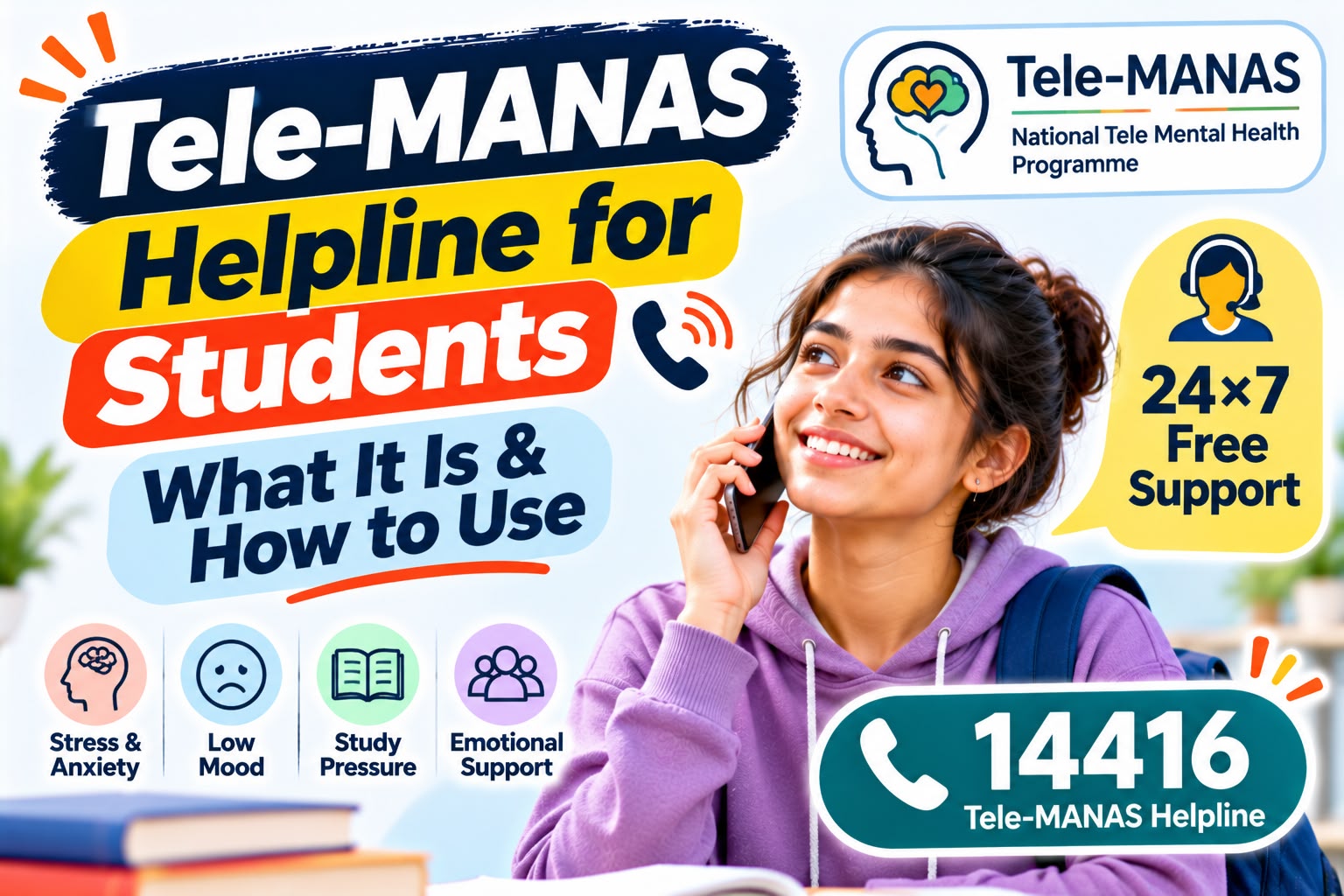
The Tele-MANAS helpline for students is a free, confidential, 24/7 mental health service run by the Government of India, reachable on 14416 or 1800-891-4416. You can call it about exam stress, low mood, trouble sleeping or anxiety, and you do not need to be in a crisis or have a diagnosis to do so. This guide explains what Tele-MANAS is, who answers, what happens after you call, and how to use it as a student.
Key Facts
- Tele-MANAS (Tele Mental Health Assistance and Networking Across States) is the National Tele Mental Health Programme of the Ministry of Health and Family Welfare. It launched on 10 October 2022, World Mental Health Day.
- The helpline numbers are 14416 and 1800-891-4416. The service is free, confidential and open 24 hours a day, 7 days a week, according to a CBSE circular dated 21 August 2025.
- As of 2 February 2026, 53 Tele-MANAS Cells were running across 36 States and UTs, and over 32.84 lakh calls had been handled, according to a Ministry of Health written reply in the Lok Sabha reported by PIB on 6 February 2026.
- Support is available in 20 languages, chosen by each state. The Tele-MANAS mobile app launched on 10 October 2024 and now supports English, Hindi and ten regional languages.
- A video consultation option now sits alongside audio calls.
- Tele-MANAS is first-line support and a route to local care. It is not an emergency service. In immediate danger, call 112.
What Is Tele-MANAS?
Tele-MANAS is a government-run tele-mental-health service that lets anyone in India talk to a trained mental health professional by phone, free of cost. The programme was announced in the Union Budget 2022-23 and launched on 10 October 2022. NIMHANS, Bengaluru, is its nodal centre, according to policy analyses by IMPRI and Organiser.
It is built on top of the existing District Mental Health Programme (DMHP). Think of Tele-MANAS as the front door: a phone call that can lead to local, in-person care if you need it.
The scale is large. The Ministry of Health told the Lok Sabha that Tele-MANAS had handled more than 32.84 lakh calls by early February 2026. Students are among the groups the service is meant for, which is why the CBSE has asked its affiliated schools to promote it.
Why Students Are Being Pointed to Tele-MANAS
CBSE’s circular of 21 August 2025 asked principals of affiliated schools to display the helpline numbers and the app’s QR code in prominent places such as near counsellor rooms, notice boards, libraries and ICT labs. Schools were also asked to mention Tele-MANAS in newsletters, student handbooks, assemblies and parent-teacher meetings, and to train counsellors to refer students to it.
Early data suggests students are not alone in feeling the pressure. A 2023 report on the service said the most common reasons for calls were sadness of mood, sleep disturbance, stress and anxiety, and that exam season brought a sudden rise in exam-related stress calls (The CSR Journal, 25 July 2023).
What Can You Call About?
You can call Tele-MANAS about everyday emotional struggles as well as more serious problems. The Ministry says the Tele-MANAS app covers concerns from general well-being to diagnosed mental disorders, and the helpline is open to anyone.
For a student, that can include:
- Exam stress, fear of failure or pressure from marks and rankings
- Feeling low, sad or hopeless for several days
- Anxiety, constant worry or panic before tests
- Sleep problems linked to studying or overthinking
- Loneliness, homesickness or trouble in relationships
- Not knowing whether what you feel is “serious enough” to talk about
That last one matters. You do not have to prove you are struggling enough. If it is affecting your day, it is a reason to call.
How Tele-MANAS Works: What Happens When You Call
A Tele-MANAS call usually moves through a few steps. The details below come from the Ministry and from secondary explainers, so the exact experience can vary by state.
Step 1: You Dial and Choose a Language
You call 14416 or 1800-891-4416. A 2023 report on the service says callers choose their language from a menu, and a 2022 explainer describes an automated voice system before the call is passed on (The CSR Journal; SheThePeople).
Step 2: A Trained Counsellor Answers (Tier 1)
The call is routed to a Tele-MANAS Cell in your region, where trained counsellors provide first-level support. According to IMPRI and Organiser, this includes a basic assessment, psychological first aid and short-term counselling. The CSR Journal adds that counsellors offer self-help strategies and call some callers back to follow up.
Step 3: Specialist Help If Needed (Tier 2)
If your situation needs more than first-line support, the counsellor can connect you to a specialist such as a psychiatrist or clinical psychologist. These consultations can take place by audio or video, reportedly through the government’s eSanjeevani telemedicine platform (IMPRI; Organiser). The Ministry confirms a video consultation option now exists.
Step 4: Referral to Local Care
For problems that need in-person help, callers can be referred to District Mental Health Programme clinics, Community Health Centres or Primary Health Centres. The Ministry’s figures, reported by Organiser, show referrals for non-emergency in-person care, mental health professionals and urgent psychiatric emergencies.
One honest caveat: IMPRI’s analysis notes that some people drop out between tiers. If you are referred somewhere, tell a parent, teacher or school counsellor so someone can help you follow through.
Using the Tele-MANAS App
The Tele-MANAS mobile app launched on 10 October 2024. The Ministry says it has been expanded with ten regional languages (Assamese, Bengali, Gujarati, Kannada, Malayalam, Marathi, Tamil, Telugu, Odia and Punjabi) in addition to English and Hindi. It is also designed to work for visually impaired users, and the phone line works without a screen.
If speaking out loud feels hard at first, the app and video option can be a gentler way in. Check the official Tele-MANAS website or your phone’s app store for the current version, since features are being added.
Tips for Making Your First Call Easier
- Find a quiet spot. A room where you can talk without being interrupted helps you say what you actually feel.
- Start small. You can say, “I have been feeling very stressed about my exams and cannot sleep.” You do not need a polished explanation.
- Mention what has changed. Sleep, appetite, focus and mood are useful clues for the counsellor.
- Ask what you can do next. Ask for practical steps, and whether you should see someone in person.
- Pick your language. The service runs in 20 languages, so use the one you think in.
- Tell one trusted person. A parent, sibling, teacher or friend can help you act on the advice.
What Tele-MANAS Is Not
Tele-MANAS is not a replacement for emergency services or for longer-term therapy. It is a first point of contact. If you or someone you know is in immediate danger, call 112 or reach the nearest hospital or a person who can be with you right away.
It is also not a place for medical self-diagnosis. A counsellor can listen and guide you, and a doctor or mental health professional is the right person to assess and treat a condition.
Is It Safe and Private?
The CBSE circular describes Tele-MANAS as a free and confidential service handled by trained mental health professionals. Specific data-handling rules were not spelled out in the sources reviewed for this article, so if privacy worries you, ask the counsellor at the start of the call how your information is handled.
FAQs
Q. What is the Tele-MANAS helpline number?
Ans. The numbers are 14416 and 1800-891-4416. Both are toll-free and work 24 hours a day, 7 days a week.
Q. Is Tele-MANAS free for students?
Ans. Yes. The CBSE circular describes the helpline as free and confidential, and the Ministry of Health runs it as a national programme.
Q. Can I call Tele-MANAS about exam stress?
Ans. Yes. A 2023 report on the service noted a rise in exam-related stress calls during exam season, and the helpline is open to anyone with stress, anxiety, low mood or sleep problems.
Q. Which languages does Tele-MANAS support?
Ans. The helpline operates in 20 languages, chosen by each state. The mobile app supports English, Hindi and ten regional languages, according to the Ministry.
Q. Do I need my parents’ permission to call?
Ans. The sources reviewed do not set an age or permission requirement for calling. Involving a trusted adult is still a good idea, especially if you are referred for in-person care.
Q. Is Tele-MANAS an emergency service?
Ans. No. It offers first-line support and referrals. In an emergency or if someone’s life is at risk, call 112 or go to the nearest hospital.
Next Steps
Save 14416 in your phone today, even if you do not need it right now, and tell a friend or sibling it exists. If stress, low mood or sleep trouble has been building for more than a few days, call, or speak to a parent, teacher, school counsellor or doctor. Board and entrance exam season is approaching, so check back for updates as the service adds features and languages.
Sources
- PIB / Ministry of Health and Family Welfare: Tele-MANAS written reply in Lok Sabha (6 Feb 2026)
- CBSE Circular on Tele-MANAS, 21 Aug 2025
- Tribune India: CBSE urges schools to display Tele-MANAS helpline (28 Aug 2025)
- The CSR Journal: Tele-MANAS gets over 2 lakh calls (25 Jul 2023)
- IMPRI: Tele MANAS, India’s National Tele Mental Health Programme
- Organiser: National Tele Mental Health Programme (31 Mar 2026)
- SheThePeople: What is Tele-MANAS? (11 Oct 2022)
- Official Tele-MANAS website