
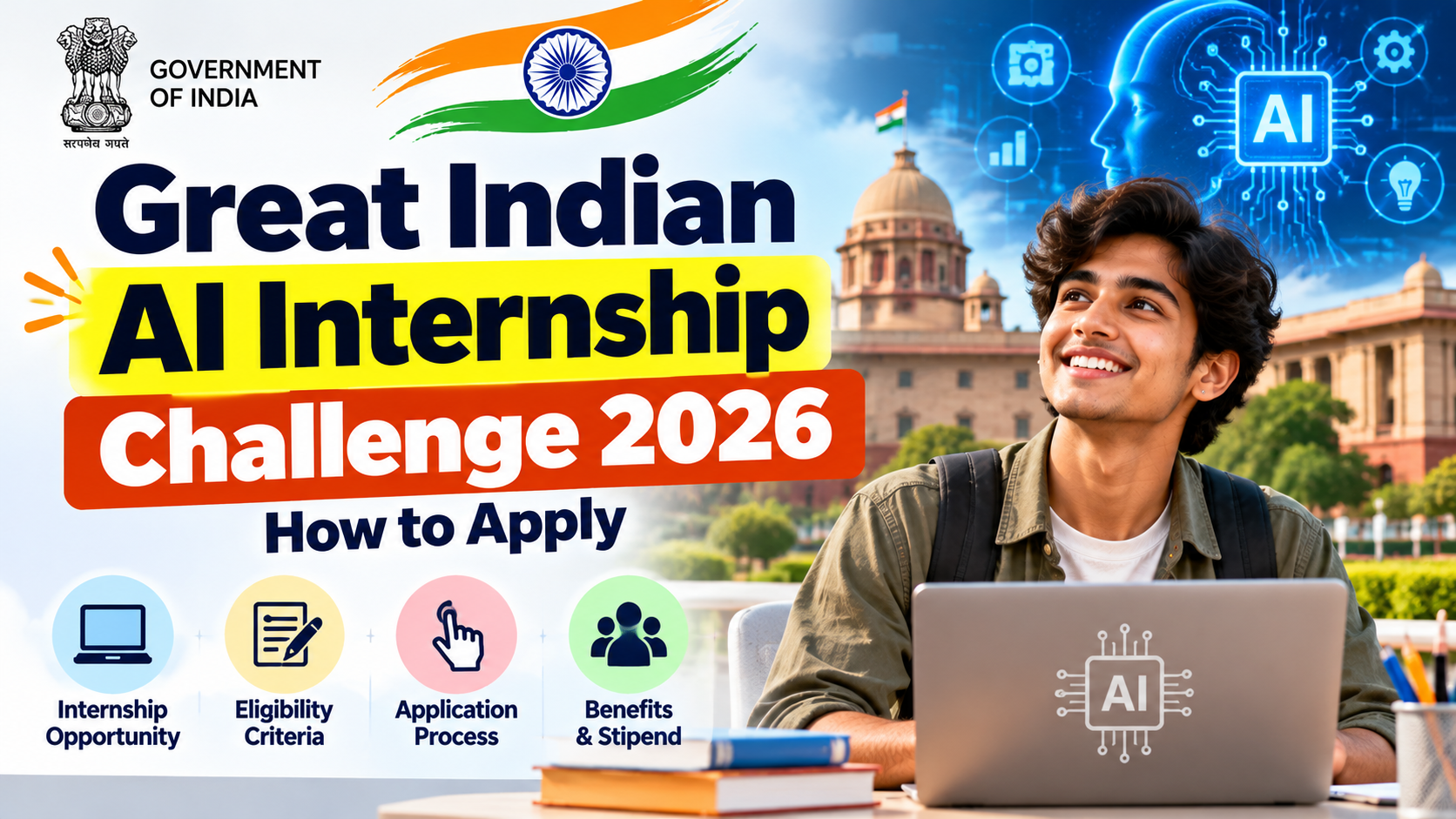
The Great Indian AI Internship Challenge 2026 is a free build contest from Bengaluru AI company Gnani.ai. It offers up to 100 paid six-month internships, with stipends of up to Rs 1 lakh a month, to Indian college students who build a working app on the company’s voice and language models. Entries opened on October 1, 2026, and final submissions close at 11:59 PM IST on November 10, 2026, with no extensions.
If you are in college, 18 or older and curious about AI for Indian languages, this guide covers what the challenge involves, who can enter, how selection works and how to build an entry worth submitting in about four weeks.
Key Facts
- Organiser: Gnani.ai, a Bengaluru company that builds speech and language AI and was picked under the government’s IndiaAI Mission in 2025 to build a voice foundation model for Indian languages (Inc42, Dec 19, 2025).
- Prize pool: up to 100 paid six-month internships starting January 1, 2027, plus ten awards of Rs 50,000 each (Gnani.ai official challenge page).
- Stipend: up to Rs 1 lakh a month per intern, paid individually. This is a ceiling, and the written offer sets the final figure.
- Cost: free to enter, and every registrant gets 5,000 programme credits for the API.
- Eligibility: currently enrolled at a college or university in India, aged 18 or over on the day you register, working alone or with one teammate.
- Deadline: 11:59 PM IST, November 10, 2026. The page says there will be no extensions.
- Official pages: gnani.ai/internship and the developer docs at docs.gnani.ai.
What Is the Great Indian AI Internship Challenge?
The Great Indian AI Internship Challenge is an open-brief contest where you build a working application using Gnani.ai’s models, demo it publicly and explain how you built it. The theme is “Build Sovereign AI for India.” There is no fixed problem statement, so you choose the problem.
That makes it different from a typical hackathon. You get about six weeks rather than a weekend, you work alone or as a pair, and the main reward is an internship rather than a cash trophy. YourStory reported the launch on October 1, 2026, describing it as a link between students and India’s sovereign AI ambitions.
The internship is the main prize, but it is not automatic. A strong project gets you onto a shortlist. From there, you are interviewed one-to-one, and only a written offer confirms a place.
Who Can Apply: Eligibility Rules
Any student currently enrolled in a degree or course at an Indian college or university can apply, provided they are 18 or older on the day they register. The registration form lists BTech, MTech, BBA, MBA, BCA, MCA and BSc, plus an “Other” option. Engineering students are not the only ones invited.
You have two ways to enter:
- Solo: you build and submit on your own.
- Team of two: you register and add exactly one eligible teammate by email. Your teammate accepts the terms separately.
The official page mentions verification through your institutional email. If your college does not give you one, the page says sign-in with a personal email opens in the second week of October. It does not list any documents you need to upload. Keep your college ID or a bonafide certificate handy anyway, since you may be asked to prove enrolment later.
A Note for Class 12 Students and Under-18s
If you are still in school, or in college but not yet 18, you cannot enter this round. The rules apply on the registration date, with no exceptions listed. You can still use the free developer docs to practise, so you are ready for a future edition.
What You Will Build With: Gnani’s Models
Every entry must use Gnani.ai models or APIs, and you have to name each one in your submission. The challenge page lists three:
- Prisma v2.5 (speech to text): trained on more than 14 million hours of telephone audio, streams transcripts in under 200 milliseconds, and handles more than ten Indian languages, including code-mixed speech such as Hinglish, Tanglish and Benglish.
- Timbre v2.5 (text to speech, beta): more than ten Indian languages, with prosody that adapts to context and correct reading of lakh and crore figures.
- Evon v3.3 (open-weight reasoning model): 30 billion parameters with about 3.5 billion active per token, a 128K context window, 11 Indian languages and an Apache 2.0 licence. It is not on the API platform yet, so you request the weights through Hugging Face.
Prisma and Timbre run on the API dashboard at app.gnani.ai/voice, which is where your 5,000 credits apply. If you enter as a team, the credits go to the primary registrant, so decide early who holds the API key.
In practice, most entries will be voice apps: something that listens to a person speaking an Indian language, understands it and replies out loud. Public GitHub repositories from early entrants show the range. One is a voice help desk for farmers called Kisan Setu. Another, SunoAI, checks food-delivery support calls for customer frustration and produces coaching notes. Both are student projects, not official examples, but they show the kind of practical problem the brief is pointing at.
The Ten Award Categories (Rs 50,000 Each)
Ten awards of Rs 50,000 each are judged separately from the internship shortlist, so you could win an award without an internship offer, or the other way round. No person or team can win more than one award. The categories are:
- Main Character: best build in a regional or low-resource Indian language.
- Mixed Vibes: best code-mixed voice build.
- Real Deal: most useful real-world problem solved.
- Noise Canceller: best performance on noisy telephone audio.
- Two-Person Army: best two-person team project.
- Solo Ninja: best single-participant project.
- Jugaad Genius: most creative or unexpected use of the models.
- Small Town, Big Build: best entry from a Tier 2 or Tier 3 city or college.
- Demo Day Drop: best 60-second demo video.
- Crowd Favourite: decided by public engagement on LinkedIn and X.
The page does not publish a scoring rubric or weightings, so read each category name as the brief. If you study at a smaller college, “Small Town, Big Build” is a category designed for you. If your strength is a regional language other than Hindi, “Main Character” rewards exactly that.
How to Apply: Step by Step
You apply by registering on the official form, building your project, submitting a demo and posting about it publicly before November 10. The steps on the official page are:
- Register. Fill in your name, email, phone, college, degree, year, city and whether you are solo or in a team. Add your teammate’s email if you have one.
- Describe your project. Give a title, the problem, the target users, the models you are using and who did what. You can edit this until you make your final submission.
- Build it. Use the API dashboard, the docs at docs.gnani.ai and the company’s Discord community, where the team answers questions.
- Submit. Upload a working demo or video, a written explanation, the list of models and APIs used, and links to your public posts.
- Post publicly. Share your demo on LinkedIn or X with both hashtags, #GreatIndianAIInternshipChallenge and #GnaniAI, then nominate those posts so Gnani can verify them.
After the deadline, Gnani shortlists entries, interviews each shortlisted person individually and sends written offers. The page does not give dates for shortlisting or interviews, so check your email after November 10.
Rules Students Most Often Miss
Most disqualification risks come from data and promotion rules, not from code quality. Read these before you start:
- Use synthetic data only. Do not use real phone numbers, account numbers, Aadhaar, PAN or recorded calls. You may record yourself or a teammate who consents. The page notes that voice counts as personal data under India’s Digital Personal Data Protection Act.
- No bought engagement. Purchased likes, bots, paid promotion and “like-for-like” groups are banned and do not count towards Crowd Favourite.
- No faked demos. The organisers say they prefer an honest limitation to a faked result. If your app struggles with background noise, say so.
- Offers are individual. In a team, each person is interviewed and judged separately. One of you may get an offer while the other does not. Stipends are never split.
- Read the terms on ownership. The public page says project ownership is covered by the programme terms on the registration page, and it does not summarise them. Read that section before you submit, especially if you hope to keep developing the idea afterwards.
How to Build a Strong Entry in Four Weeks
A strong entry solves one narrow, real problem for a clearly named user and shows it working in under a minute. With about four weeks left as of mid-October, here is a realistic plan.
Week 1: Pick One Problem and One User
Choose a situation where speaking is easier than typing. Examples: a shopkeeper logging stock by voice, a parent checking a school notice in Kannada, or an elderly patient asking about medicine timings in Marathi. Talk to two or three real people who face the problem. Their words will make your written explanation far stronger than generic claims about “empowering Bharat.”
Week 2: Get the Core Loop Working
Build the simplest version: audio in, transcript, a response, audio out. Do this before adding a login page or a dashboard. Test it with your own voice in a noisy room, because real users rarely speak in a quiet studio. Keep an eye on your credit balance and note anything that fails.
Week 3: Test, Measure and Fix
Run your app with five to ten friends or family members. Write down how often it misunderstood them and what you changed. Two sentences of honest numbers, such as “it misheard 3 of 20 test phrases in a crowded market,” will stand out next to a polished demo that hides its weak spots.
Week 4: Record, Write and Post
Record a 60-second demo that opens with the problem, not your tech stack. Write the explanation in plain language: who it is for, what it does, which models it uses and what you would fix next. Post on LinkedIn or X with both hashtags a few days before November 10 rather than on the last night, so you have time to nominate your posts.
Is It Worth Your Time? An Honest Look
For most eligible students, yes, because even without an offer you end up with a public, working project and a demo you can link on your CV and show recruiters.
Keep your expectations realistic, though. “Up to 100 internships” and “up to Rs 1 lakh a month” are both ceilings, not promises. The page does not say how many people have registered, where interns will work, or whether internships are remote. Location and working arrangements are confirmed only in each written offer. Full-time conversion afterwards is possible but not guaranteed.
The October–November build window may also clash with exams at your college. Look at your exam timetable before you commit, and plan a version of the project you can finish even in your busiest week.
Frequently Asked Questions
Q. Is the Great Indian AI Internship Challenge free?
Ans. Yes. Entry is free, and every registrant gets 5,000 programme credits to use Gnani.ai’s APIs while building.
Q. What is the last date to submit?
Ans. Final submissions close at 11:59 PM IST on November 10, 2026. The official page says there will be no extensions.
Q. Can first-year or non-engineering students apply?
Ans. Yes, provided you are 18 or older and currently enrolled at a college or university in India. The form lists BBA, BSc, BCA and other courses alongside BTech, and the page sets no minimum year of study.
Q. How much is the stipend, and is it shared in a team?
Ans. The stipend is up to Rs 1 lakh a month per intern, with the final amount set in the written offer. It is paid to each person individually and is never split between teammates.
Q. Do I need coding experience?
Ans. You need to submit a working application, so you need enough programming skill to call an API and connect audio input and output. A team of two lets one person handle code while the other handles user research, testing and the demo video.
Next Steps
If you are eligible, register on the official Great Indian AI Internship Challenge page this week, join the Discord and pick your problem before you write any code. Read the programme terms on the registration page before you submit. Check back here for updates on shortlisting, interview dates and any changes the organisers announce before November 10.