
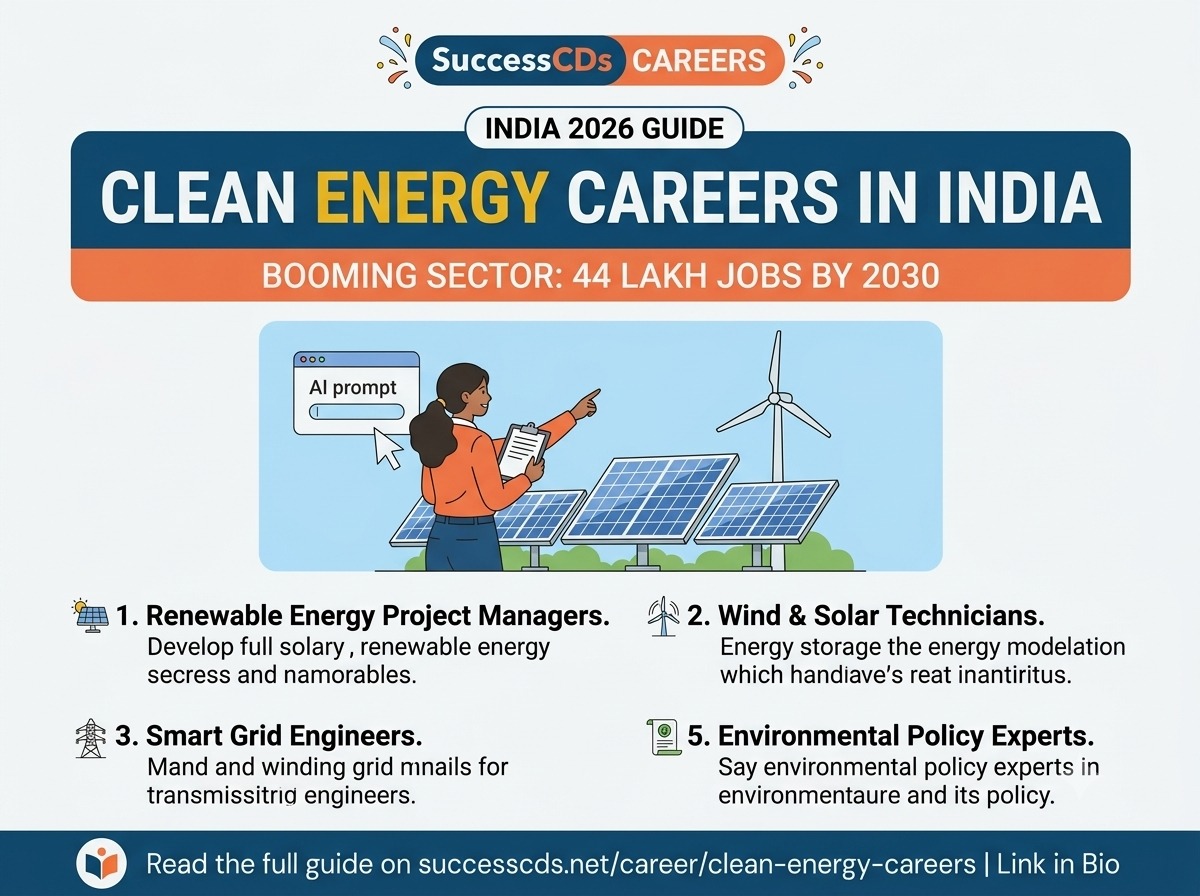
Clean energy careers in India are set to grow into more than 44 lakh full-time jobs by 2030, according to a June 2026 study by CEEW and NRDC India, prepared with technical guidance from the Ministry of New and Renewable Energy (MNRE). Rooftop solar alone could account for 43% of those jobs. If you are an engineering student, an ITI or diploma holder, or a graduate looking for a field that is still hiring in volume, this guide covers what clean energy is, the jobs on offer, and the degrees and certifications that lead there.
Key Facts Box
- India’s clean energy targets could generate over 44 lakh full-time equivalent (FTE) jobs by 2030, per the CEEW-NRDC India report “Driving Energy Transition: Workforce, Skills, and Gender in India’s Renewable Energy Sector” (June 3-4, 2026).
- Rooftop solar could account for 43% of the estimated clean energy jobs by 2030.
- Between FY23 and FY26, the sector added about 6.5 lakh clean energy workers. Rooftop solar produced 62% of them, PM-KUSUM 16.3%, biomass power 12.6% and ground-mounted solar 6%.
- Rooftop solar creates about 45 FTE job-years per MW, against roughly 1 for ground-mounted solar and about 0.6 for wind.
- About 60% of deployment jobs need highly or semi-skilled workers. Manufacturing needs 80-90% skilled workers.
- The Suryamitra solar technician course is a three-month, 600-hour residential programme for candidates with 10th pass plus an ITI trade.
- Women make up only 11% of the solar and wind workforce, and 15% in rooftop solar.
What Is Clean Energy?
Clean energy is energy produced with little or no greenhouse gas emissions, mainly from sources that renew themselves naturally. It covers solar, wind, hydropower, bioenergy (power from biomass) and green hydrogen, plus the batteries, grids and efficiency work that make them usable. “Renewable energy” is the term you will see most often in government schemes and job ads, and for career purposes the two are used almost interchangeably.
Here is how each source turns into work:
- Solar: rooftop systems on homes and shops, farm solar pumps and large ground-mounted plants. Jobs in manufacturing, design, installation and maintenance.
- Wind: turbines onshore and offshore. Jobs in turbine maintenance, blade and tower manufacturing, and site operations.
- Hydropower: small and large hydro plants. Jobs in civil, mechanical and electrical operations.
- Bioenergy: power from agricultural and organic waste. Biomass power produced 12.6% of the jobs added between FY23 and FY26.
- Green hydrogen: hydrogen made with renewable power, under the National Green Hydrogen Mission. Still early, with training capacity being built.
- Storage and grid: batteries and the systems that connect clean power to the grid.
- Energy efficiency: auditing and reducing energy use in buildings and factories.
Are Clean Energy Careers in India Worth It in 2026?
Yes, because the job count is large and the entry points are wide. The CEEW-NRDC study projects over 44 lakh FTE jobs by 2030, and it counts solar, wind, bioenergy and hydropower, not just big power plants. A good share of those jobs sit in installation, operations and maintenance, so you do not need a premium engineering degree to get in.
One caution. These are projections tied to government targets, and “FTE job-years” is a counting method, not a promise of 44 lakh permanent posts. Treat it as a direction of travel and plan accordingly.
Why Rooftop Solar Is Driving Most of the Jobs
Rooftop solar creates far more work per megawatt than any other clean energy source, which is why it leads. The study estimates about 45 FTE job-years per MW for rooftop, compared with 1 for ground-mounted solar and about 0.6 for wind.
Rooftop systems go in home by home, shop by shop and building by building. Every installation needs customer outreach, a site survey, design, installation, grid connection and later maintenance. A single large solar farm needs far fewer people per MW. That also spreads demand across towns and small cities, not only metros.
What Career Openings Exist in Clean Energy?
Clean energy offers four job families: technician and installation roles, engineering roles, manufacturing roles and business or support roles. Pick the lane that matches your qualification.
Technician and installation roles
- Solar PV installer or technician: installs panels, wiring and inverters on rooftops and farms.
- Solar pump technician: installs and services solar water pumps, linked to PM-KUSUM.
- Wind turbine technician: maintains and repairs turbines, often at height.
- Small hydro plant technician: operates and maintains small hydropower plants.
- Operations and maintenance (O&M) staff: keep plants running. The study counts about 13 lakh FTE jobs in operations, maintenance and manufacturing roles.
Engineering roles
- Solar system design engineer: sizes and designs rooftop and ground-mounted systems.
- Power electronics and grid engineer: inverters, grid connection and integration.
- Battery storage engineer: storage systems paired with solar and wind.
- Green hydrogen engineer: electrolysers, storage and handling. The Skill Council for Green Jobs reports 92+ green hydrogen training facilities and two Centres of Excellence.
- Energy auditor or energy manager: finds and cuts energy waste in factories and buildings.
Manufacturing roles
Module, cell, inverter and component manufacturing needs 80-90% skilled workers, according to the study. Roles include process technicians, quality inspectors, production supervisors and maintenance engineers.
Business and support roles
Sales, customer outreach, project management, finance, HR, accounting and administration all sit inside clean energy firms. The study found 61% of women in the workforce are in these non-technical roles, so commerce and arts graduates have a real way in. ESG and sustainability reporting is another route for analytical graduates.
Which Degree Paths Lead to Clean Energy Careers?
There is no single required degree. The right path depends on whether you want a technician job, an engineering job or a research and policy role.
After Class 10: ITI and certificate route
ITI trades such as Electrician, Wireman, Electronics Mechanic, Fitter and Sheet Metal are the standard entry route for technician roles. The Suryamitra programme, for example, asks for 10th pass plus an ITI in one of these trades. It is the fastest way into the field, with the lowest cost.
After Class 12 or Class 10: Diploma engineering
A diploma in electrical, electronics or mechanical engineering suits supervisor, O&M and site engineer roles. It also keeps the door open to a lateral-entry B.Tech.
Bachelor’s degrees
- B.Tech in Electrical or Electronics Engineering: the most common route into solar design, inverters, grid and storage work.
- B.Tech in Mechanical Engineering: suits wind turbines, thermal systems, hydrogen equipment and manufacturing.
- B.Tech in Energy Engineering or Renewable Energy Engineering: a dedicated programme. IIT Guwahati offers a four-year B.Tech in Energy Engineering covering solar, wind and ocean energy, hydrogen and fuel cells, energy storage and energy economics. A few other institutes offer similar degrees, so check each college’s approval and placement record.
- B.Tech in Chemical Engineering: relevant to green hydrogen, fuel cells and battery materials.
- B.Sc in Physics, Chemistry or Environmental Science: a base for research, testing, materials and sustainability work.
- BBA, B.Com or BA: project finance, sales, compliance, ESG and administration roles.
Master’s and research degrees
M.Tech programmes in energy systems or renewable energy lead into design, research and consulting roles. IIT Bombay’s Department of Energy Science and Engineering runs an M.Tech in Energy Systems Engineering covering renewable energy technologies, energy efficiency and demand-side management, solar applications and power systems. Most M.Tech admissions at IITs and NITs use GATE scores, so check each institute’s current criteria. MBA programmes with an energy or sustainability focus suit management and policy careers.
Which Technical Certifications Matter for Clean Energy Jobs?
Certifications matter most for technician and mid-level roles, because employers want proof of hands-on skill. These are the ones with official or industry backing.
Suryamitra (solar technician)
Suryamitra is a government skill programme run through the National Institute of Solar Energy (NISE) in Gurugram and its selected training centres. Eligibility is 10th pass plus an ITI in Electrician, Wireman, Electronics Mechanic, Fitter or Sheet Metal. The course lasts three months on a residential basis and totals 600 hours, mixing classroom teaching, lab practicals, solar plant exposure, on-the-job training and soft skills. Assessment and certification come from the Skill Council for Green Jobs or another MSDE-approved body. MNRE reports 51,529 Suryamitras trained between 2015 and September 2022.
Related MNRE technician programmes
- Varunmitra: solar water pumping technicians, implemented through NISE.
- Vayumitra: wind power plant technicians, coordinated by the National Institute of Wind Energy, with a target of 5,734 skilled workers.
- Jal Urja Mitra: small hydropower technicians, coordinated by IIT Roorkee, with a target of 1,780 skilled workers over five years.
Skill Council for Green Jobs (SCGJ) qualifications
SCGJ, set up in 2015 under the Ministry of Skill Development and Entrepreneurship, has developed 56 qualifications across solar, wind, green hydrogen, small hydro, waste management and sustainability. It has affiliated 1,000+ training centres and trained 6,20,352 people, per a September 2025 Careers360 piece by its CEO. It also runs PMKVY courses and Recognition of Prior Learning (RPL) for workers who already have field experience.
BEE Certified Energy Manager and Energy Auditor
The Bureau of Energy Efficiency runs a national certification exam for Certified Energy Managers and Certified Energy Auditors. This is not a fresher certification, because eligibility needs work experience. For example, a graduate engineer needs three years of relevant experience, a postgraduate engineer needs two years, and a diploma engineer needs six years for the Energy Manager category. The 2026 application window closed on July 30, 2026, so plan for the next cycle and confirm dates on the BEE website.
GWO Basic Safety Training (wind)
The Global Wind Organisation’s Basic Safety Training covers four modules: first aid, manual handling, fire awareness and work at height. Training providers describe it as mandatory or preferred for wind turbine technicians, rope access workers, OEM field service engineers and people applying for international wind projects. This detail comes from a training provider’s page, so confirm requirements and validity with GWO or your prospective employer.
What Skills Do Employers Want?
Employers want hands-on, certified skill for most roles. The study says about 60% of deployment jobs require highly or semi-skilled workers. A degree alone will not carry you through a site interview.
- Basic electrical knowledge, wiring, safety and use of testing tools.
- Solar PV design and installation basics.
- Battery storage and grid connection, for engineers.
- Data and reporting skills for sustainability and ESG analyst roles.
- Customer handling and site-survey skills for rooftop sales and design.
Which Path Fits You? A Quick Guide
- 10th pass or ITI holder: do the Suryamitra course or another SCGJ-certified technician course, then look for installer and O&M jobs.
- Diploma holder: add a certificate in solar PV or wind maintenance and aim for supervisor roles.
- B.Tech student (EEE, ECE, Mechanical): pick energy electives, do one solar design or storage project, and consider GATE for an M.Tech in energy systems.
- Science graduate: look at M.Sc or M.Tech routes in energy and materials, or sustainability analysis.
- Commerce, MBA and arts graduate: target project finance, sales, compliance and ESG roles at installers and developers.
- Working professional with 3+ years in energy: look at the BEE energy manager or auditor certification.
No salary data was published in the CEEW-NRDC study or the SCGJ material, so we are not quoting figures. Compare live offers from installers, manufacturers and developers before you decide.
The Gender Gap: A Real Opening for Women
Women are only 11% of the solar and wind workforce, rising to 15% in rooftop solar, and most are in HR, accounting and administration. That gap means employers and skilling programmes have a reason to recruit women into technical roles. Female students with a technical certificate should check which employers run targeted hiring.
FAQs
Q. What is clean energy?
Ans. Clean energy is energy produced with little or no greenhouse gas emissions, mainly from solar, wind, hydropower, bioenergy and green hydrogen. Batteries, grids and energy efficiency work are part of the same sector.
Q. How many jobs will clean energy create in India by 2030?
Ans. A CEEW and NRDC India study published in June 2026 estimates over 44 lakh full-time equivalent jobs by 2030 if India meets its clean energy targets. Rooftop solar could account for 43% of them.
Q. Which degree is best for a clean energy career?
Ans. Electrical, electronics and mechanical engineering are the most common routes, and dedicated energy engineering degrees such as IIT Guwahati’s B.Tech in Energy Engineering exist too. ITI and diploma holders can enter as technicians without a bachelor’s degree.
Q. Can I get a clean energy job without an engineering degree?
Ans. Yes. About 60% of deployment jobs need highly or semi-skilled workers, so ITI and diploma holders can work as solar installers and O&M technicians. The Suryamitra course accepts candidates with 10th pass plus an ITI trade.
Q. What is the Suryamitra course?
Ans. It is a three-month, 600-hour residential solar technician programme run through NISE in Gurugram and its approved centres. Candidates need 10th pass plus an ITI in Electrician, Wireman, Electronics Mechanic, Fitter or Sheet Metal.
Q. Which certification is needed for energy auditing in India?
Ans. The Bureau of Energy Efficiency certifies Energy Managers and Energy Auditors through a national exam. You need relevant work experience, such as three years for a graduate engineer.
Conclusion / Next Steps
If clean energy careers in India appeal to you, pick one lane this month, such as solar installation, O&M, energy design or sustainability analysis, and choose the matching degree or certification. Ask your college or ITI whether it is affiliated with SCGJ or an MNRE programme, and check current course dates on the NISE and BEE websites. Check back here for updates as new workforce data and skilling announcements come out.
Sources: CEEW and NRDC India, “Driving Energy Transition: Workforce, Skills, and Gender in India’s Renewable Energy Sector” (June 3-4, 2026), via CEEW press release and Business Today (June 3, 2026); MNRE, “Short term trainings and skill development in renewable energy” (mnre.gov.in); Careers360, interview with SCGJ CEO Arpit Sharma (September 12, 2025); BEE National Certification Examination 2026 eligibility, via SEA Energy; IIT Guwahati, B.Tech in Energy Engineering; IIT Bombay, M.Tech in Energy Systems Engineering; CESL Training, GWO Basic Safety Training.