

Class 12 English (Elective) Non Fiction Chapter 3 – Film-making Important Question Answers from Kaleidoscope Book
Class 12 English (Elective) Film-making Question Answers – Looking for questions and answers for CBSE Class 12 English (Elective) Non Fiction Chapter 3- Film-making? Look no further! Our comprehensive compilation of important questions will help you brush up on your subject knowledge. Practising Class 12 English question answers can significantly improve your performance in the exam. Improve your chances of scoring high marks by exploring Non Fiction Chapter 3- Film-making now. The questions listed below are based on the latest CBSE exam pattern, wherein we have given NCERT solutions to the chapter’s extract-based questions, multiple choice questions and Extra Question Answers
Also, practising with different kinds of questions can help students learn new ways to solve problems that they may not have seen before. This can ultimately lead to a deeper understanding of the subject matter and better performance on exams.
- Film-making NCERT Solutions
- Film-making Grammar Exercise
- Film-making Extra Question Answers
- Film-making Multiple Choice Questions
- Film-making Extract Based Questions
Related:
Film-making Textbook Questions (NCERT Solutions)
Stop and Think
1. What childhood memories does the author recollect that had a bearing on his later involvement with filmmaking?
Ans. The author’s childhood made him aware of two main types of characters in life: the good and the villainous. He learned about these distinctions from his father, who was a priest and prepared sermons. This understanding allowed him to easily connect with the characters of Little Red Riding Hood and the Wolf, where the wolf symbolized the Devil, without horns but with a tail and a wide, gaping red mouth. His creative imagination was fueled by the memories of his childhood, from envisioning those tales to hearing church bells and music from a piano in a picture at his grandmother’s house in Uppsala. Everything contributed to his rich tapestry of associations.
2. What connection does the author draw between filmmaking and conjuring?
Ans. The author states that filmmaking and conjuring are similar because both involve deceiving the human eye. Often, viewers find themselves caught up in the scenes of a movie, as the emotions and situations depicted are not real but rather performed. However, with the aid of certain filming techniques, movies can appear as if they depict real-life events, allowing people to express genuine emotions while watching them.
Stop and Think
1. What is the nature of the first impressions that form the basis for a film?
Ans. A film is the finished product of a creative process that begins with fleeting impressions that vanish almost instantly. This means that the genesis of a film can stem from anything as small as a musical note or an actor who seems perfectly suited for a yet-to-be-played role. It is not just the story that takes shape in a film; rather, it is an idea, a feeling, or a momentary reaction that can beautifully evolve into a film if pursued thoughtfully.
2. Which art form is film-making closest to? What is the reason for the similarity?
Ans. The author suggests that filmmaking is most akin to music. This similarity arises from the fundamental rhythm found in both art forms. Filmmaking, like music, involves a continuous sequence of creation that directly impacts emotions rather than just appealing to the intellect.
Stop and Think
1. Quite often a film made out of a book is not very successful. Discuss.
Ans. The main reason one should refrain from adapting books into films is due to the differences between the two mediums. The illogical aspects that give a literary work its essence often cannot be expressed visually, and this, in turn, undermines the unique, illogical quality of a film. If one still decides to convert literary elements into film, one often needs to make countless complex alterations that yield little or no significant results relative to the effort involved.
2. What, according to Bergman, is the relationship between a film-maker and his audience?
Ans. A filmmaker brings the story to life, while the audience provides their reactions. This dynamic is similar to the relationship between a teacher and a student, where the audience is expected to evaluate the director’s work. It means that the audience is meant to evaluate what the director has put into action. The audience’s response is a crucial element of the movie experience.
Stop and Think
1. What is the story of the Cathetdral of Chartres and how does the author relate it to his profession?
Ans. The Cathedral of Chartres was once struck by lightning and burned to the ground. Afterwards, thousands of people gathered from all directions, working together to rebuild the cathedral in its original location. Master builders, artists, labourers, clowns, noblemen, priests, and townspeople all contributed, but no one knew who they were. In the past, craftsmanship was a source of pride. People worked not for personal fame but for the glory of God. The author expresses a desire to enjoy his own work, valuing the quality of what he creates. His only wish is to take satisfaction in his craftsmanship.
2. What are some of the flaws of the world of filmmaking today?
Ans. Filmmaking relies on learning from one another and working together. However, many people now hesitate to share their ideas because they worry that sharing will expose their films to criticism. Additionally, people are less polite and more direct in their expressions today. What was once enjoyable for the author has now become challenging. Failure, criticism, and public indifference hurt more now than before. The harshness of the industry is clear.
Understanding the Text
1. Pick out examples from the text that show Bergman’s sensitivity to sensory impressions which have made him a great filmmaker.
Ans. There are many examples, but the most notable ones are when he can imagine a live scene of the wall hanging and even hear the church bells ringing. He can also see the pigeons flying, which takes him to a different world. This creates a dramatic scene in his imagination, influenced by Bergman. Another example is when he sees the cranes at Dalarna and stops all his work to watch them fly.
2. What do you understand of the complexity of the little invisible steps that go into the making of a good film?
Ans. The first step in filmmaking is to establish a clear theme. Once the theme is defined through initial impressions and the topic is compelling enough, the next step is to develop the storyline. This includes considering the montage, rhythm, and the relationship between images—elements that create a vital third dimension; without these, the film becomes just a lifeless product from a factory. The next crucial aspect is the actual shooting of the movie. Everyone involved should work collaboratively towards the same goal to ensure the film’s success.
To summarize it, the key steps in filmmaking are idea formulation, storyline scripting, and shooting.
3. What are some of the risks that film-making involves?
Ans. Filmmaking tells stories using a series of images. The audience needs to connect with the movie’s theme. If the theme is too unfamiliar, the film’s message may be misunderstood. Choosing the right idea is also important. If the movie’s theme does not match what viewers are interested in, it will be hard for the producer to keep them engaged.
4. What misgivings does Bergman have about the contemporary film industry?
Ans. The current film industry often ignores the important fact that everyone learns from one another, and this process never stops. Many filmmakers today feel the need to isolate their ideas from others. They see sharing as cheating or as creating stolen content. However, we are all part of a community, and we should learn from each other. Learning together is the best way to gain knowledge.
5. Compare Bergman’s views about making films out of books with that of Umberto Eco’s.
Ans. Bergman believes that a novel cannot be fully adapted into a film. If it is, it does an injustice to the novel because novels engage a person’s intellect, while films appeal directly to emotions. On the other hand, Umberto Eco argues that films help boost the popularity of novels. A novel often reaches its peak popularity only when it is adapted into a movie. Thus, films indirectly support the success of novels.
Talking about the Text
1. According to the author, split-second impressions form a ‘mental state, not an actual story, but one abounding in fertile associations and images’.
Compare this with Virginia Woolf’s experiment with the stream of consciousness technique in ‘The Mark on the Wall’.
Ans. Split Second Impressions connects Bergman to the start of a film. He describes it as a vague but pleasant event that fades away, leaving behind a certain mood. He explains that this mood is a mental state rather than an actual story. It is like a brightly coloured thread sticking out of a dark bag of unconsciousness. By gathering these threads, one can carefully create a complete film. However, this process takes patience and a pattern that follows certain rhythms. These rhythms are shaped by the original inspiration, gaining enough strength to become a film. Proper analysis of these impressions, including their rhythms, moods, atmosphere, tensions, and sequences, leads to a perfect screenplay. On the other hand, Virginia Woolf’s “Mark on the Wall” is a first-person narrative that recalls a past event. The narrator skillfully expresses their thoughts and feelings about a specific mark on the wall. This thinking process reveals various related events while showing the richness of the mind’s imagination.
2. Bergman talks about the various influences in his life including his parents and his religious upbringing. To what extent are an individual’s achievements dependent on the kind of influences he or she has had in life? Discuss.
Ans. An individual’s achievements come from a mix of their thoughts, life experiences, and background. This mixture shapes how they see the world and sets the path for positivity and success. For example, filmmaker Bergman says that his motivation to create films and move viewers emotionally connects to his childhood and religious upbringing. Similarly, everyone can link their memories to the ups and downs of their lives. Research shows that how people are raised significantly affects how they handle the future. Their upbringing serves as a guide for how they understand success and their potential for future achievements. Human behaviour relates more to one’s environment and upbringing than to education. People develop better interpersonal skills and personality traits in disciplined environments. There are many examples of this. As one grows and faces various influences, these elements work together to help us choose our paths toward achievement, based on the roles we play. A person’s achievements depend closely on their personality, which is shaped by a pattern of thoughts, feelings, and behaviours developed over time and in different situations. One can map a person’s learned behaviours to their accomplishments in life. The environment someone lives in helps them develop problem-solving, decision-making, and creative skills. This can contribute to positive or negative growth. Given these insights, along with Bergman’s reflections on his childhood, one can safely assume that an individual’s achievements connect to their life experiences and the influences they encounter.
Appreciation
1. Autobiographical accounts make interesting reading when the author selects episodes that are connected to the pursuit of excellence. How does this apply to Ingmar Bergman’s narration of the details of film-making?
Ans. Autobiographies can be very engaging when the author shares experiences related to striving for excellence. In Ingmar Bergman’s account of filmmaking, he provides examples that highlight his desire for perfection. He discusses how childhood experiences and environment shape a person and influence their path to success. Bergman explains how brief impressions come together to create a movie, emphasizing the effort and attention to detail needed to craft a strong screenplay with fitting dialogues. He also highlights the importance of starting from the basics, writing, and the differences between film and literature. Additionally, he stresses the role of people in achieving success; he reflects on how his parents and the values they instilled in him contributed to his journey. Bergman encourages using setbacks as opportunities to grow stronger, showing how one can achieve excellence in their career.
2. Comment on the conversational tone of the narration. Compare this with the very informal style adopted by Umberto Eco in the interview.
Ans. People usually prefer reading material that uses a conversational tone. This style makes them feel more involved as if they are part of a conversation. As a result, a conversational tone is more effective in getting a message across and helping it stick. The narrator uses this approach in their story, which inspires and motivates readers. They can connect with the narrator’s experiences and find insights that can help them achieve their own goals. On the other hand, Umberto Eco uses an informal style in his interview. It consists of questions and answers, making it feel like a documentary of events. This casual approach works well when communicating with a large audience.
Film-making Grammar Exercises
Language Work
A. Vocabulary
Find out and write down the definitions of the following terms used in the film industry
| script | project | montage | flashback |
| stage prop | footlights |
Ans.
Script: the written text of a play, film, or broadcast.
Project: a plan for implementation of a film idea submitted with a view to obtaining State funding.
Montage: the technique of selecting, editing, and piecing together separate sections of film to form a continuous whole.
Flashback: move to a scene in a film, novel, etc. that is set in a time earlier than the main story.
Stage prop: any movable or portable object used by actors on stage or in a film set, distinct from scenery, costumes, or electrical equipment, to enhance a performance or create a realistic environment.
Footlights: a row of spotlights along the front of a stage at the level of the actors’ feet.
B. Grammar
We saw in the grammar section of the unit on Freedom that a sentence can consist of clauses and phrases.
Let us now look at the basic form of a sentence and study its parts. A sentence consists of a subject and a predicate. Take the sentence
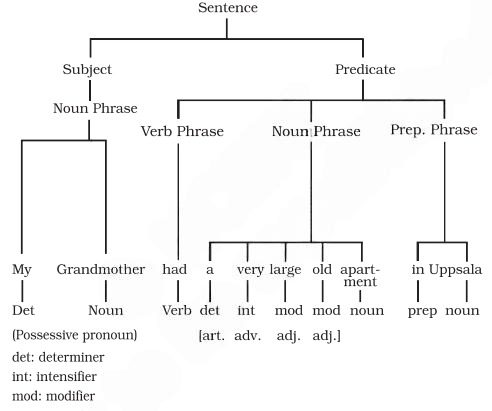
My grandmother had a very large old apartment in Uppsala
The sentence here talks about ‘the grandmother’. ‘The grandmother’ is the subject of the sentence. What is said about the subject ‘grandmother’ is the predicate of the sentence. ‘had a very large old apartment in Uppsala’ is the predicate.
Generally a sentence begins with the subject. The predicate begins with a verb. ‘had’ is the verb in the example above. The subject answers the question ‘who’ or ‘what’ before the verb.
Question: ‘Who had?’
Answer: ‘the grandmother had’.
The object of a sentence generally comes after the verb. It answers the question ‘what’ after the verb. ‘Had what?’ ‘had an apartment’ is the answer. ‘Apartment’ is the object of the sentence. The word ‘apartment’ has an article and two adjectives preceding it.
‘a very large old apartment’; the word ‘very’ is an intensifier for the adjective ‘large’. We are also given information about the location of the apartment, ‘in Uppsala’. This is a prepositional phrase and consists of a preposition and a noun. ‘in Uppsala’ is an adjunct. It gives additional information.
TASK
Analyse the parts of the following sentences according to the pattern above
- My association with film goes back to the world of childhood.
- This is an almost impossible task.
- Thus the script is a very imperfect technical basis for a film.
- I would play my part in the collective building of the cathedral.
- The ability to create was a gift.
Ans.
| Subject | Predicate |
| My association with film | goes back to the world of childhood. |
| This is | an almost impossible task. |
| Thus the script is | a very imperfect technical basis for a fim. |
| I would | play my part in the collective building of the cathedral. |
| The ability to create | was a gift |
C. Pronunciation
We have seen that it is not necessary, nor desirable, to pronounce every sound perfectly to be understood. Quite a lot of sounds that you might expect to hear are not actually pronounced. In rapid speech, sounds may be left out or elided, especially when they occur as part of a cluster of consonants. For example in the phrase ‘next day’, the /t/ is lost
next/ day
TASK
Mark the consonants that are left out or elided in the following utterances
- new textbooks
- written scripts
- he must be ill
- mashed potatoes
Ans. New textbooks /t/
written scripts /w/
he must be ill /t/
mashed potatoes /d/
Things to do
Think of a particular episode that could be enacted. Now imagine that you are a scriptwriter and write the screenplay for the first ten minutes of the episode, in the following format
| Title : Actors : Scene -1 |
|
| Description | Dialogue |
The column ‘Dialogue’ would contain the words to be actually spoken by the characters. ‘Description’ would include instructions regarding stage props, position of lights, movement of actors and so on.
Ans.
| Title : Julius Caesar’s last moments and his interaction with Brutus Actors : Julius Caesar, Brutus, Cassius, other senators, guards. Scene -1 |
|
| Description | Dialogue |
| Setting: The Roman Forum, a chaotic scene with senators and guards milling around. A platform or raised area is where Caesar usually stands.
Lighting: A harsh, cold light floods the stage, with a few torches casting flickering shadows. Props: Caesar’s toga, a sword, a dagger. (Scene opens with Caesar standing on the platform, surrounded by senators. Brutus and Cassius are among them, their faces grim. Caesar speaks with a mix of confidence and weariness.) (Caesar turns to Brutus, a flicker of recognition in his eyes.) (Caesar falls to the ground, his toga slipping. The senators and guards gasp and scramble. Brutus stands over Caesar, his face a mask of grim resolve. The stage lights dim as Caesar’s last breath is taken.) (Brutus raises his dagger, and the scene ends with a final, lingering shot of Caesar’s lifeless body.) |
Caesar: (To the senators) I trust my friends, my loyal friends, that I am safe amongst you.
Brutus: (Stepping forward, a dagger concealed) Caesar, I love you, but Rome must be free. Caesar: (Scoffs) Rome is mine, and I will not be controlled by any man. Cassius: (Standing beside Brutus) Then we must do what must be done. Caesar: (To the senators) I trust my friends, my loyal friends, that I am safe amongst you. Brutus: (Stepping forward, a dagger concealed) Caesar, I love you, but Rome must be free. Caesar: (Scoffs) Rome is mine, and I will not be controlled by any man. Cassius: (Standing beside Brutus) Then we must do what must be done. Caesar: Brutus, my friend, is it you? Brutus: (Draws his dagger) Caesar, I am Brutus. Caesar: (Looks at Brutus, then at Cassius, a mixture of surprise and betrayal on his face) Et tu, Brute? Brutus: (To the senators) I have done it for Rome. |
CBSE Class 12 English (Elective) Non Fiction Chapter 3- Film-making Extra Question and Answers
Answer the following questions.
Q1. How music operates in the similar way as filmmaking?
Ans. Music operates in a similar way; he believes that no other art form shares as much commonality with film as music does. Both art forms impact our feelings directly, rather than engaging the mind. Furthermore, film largely relies on rhythm; it represents the cycle of inhaling and exhaling in a continuous flow. Since the narrator was a child, music has served as his primary source of enjoyment and inspiration, and he frequently perceives a film or play through a musical lens.
Q2. Why is Bergman suggesting the aspiring filmmakers to take a risky path?
Ans. The aspiring filmmaker today must navigate a risky path without any safety net. While he may possess magical talents, he cannot sway the producer, the bank executive, or the theatre proprietors when audiences choose not to attend a film and spend money, which sustains the producer, bank executive, theatre owner, and magician. In such cases, the magician may find himself without his magical tools. He wishes he could quantify the level of talent, initiative, and creativity that the film industry has destroyed through its mercilessly efficient assembly line. What used to feel like a game for him has transformed into a battle. Setbacks, criticism, and public apathy sting more profoundly today than they did in the past. The industry’s harshness is openly displayed and yet that can also serve as a benefit.
Q3. Why Umberto Eco wasn’t happy with the film by Jean Jacques Annaud and starring Sean Connery?
Ans. Umberto Eco wasn’t happy with the film directed by Jean Jacques Annaud and starring Sean Connery. He wonders why Umberto is not happy with it. Umberto explains that he expected the film to be different. He describes his novel as a club sandwich with layers like lettuce, tomato, and cheese. Mukund asks about these different layers of meaning. Umberto agrees, saying a film can’t cover all the layers and has to settle for just one, like ham or cheese. He is not like other authors who claims a film is nothing like their book right after it’s released. However, after that experience, he told his publisher not to sell the movie rights to his novel. He did this because he learned that 80 percent of readers watch the movie before reading the book. This fact is very painful for a novelist.
Q4. Writing a script was a challenging phase for the narrator. What are the challenges the narrator faced while writing a script?
Ans. Writing the script is a challenging phase, yet a valuable one, as it forces him to logically validate his concepts. In this process, he finds himself in a dilemma, a struggle between his need to convey a complex situation through visual representation and his aim for utmost clarity. He does not create his work solely for his benefit or that for a few selected ones, but rather for the enjoyment of the wider audience. The preferences of the audience are essential. However, at times, he takes the risk of following his instincts, and it has been demonstrated that the public can react with unexpected sensitivity to the most unorthodox narrative choices.
Q5. Why should one refrain from adapting books into films?
Ans. The main reason one should refrain from adapting books into films is due to the differences between the two mediums. The illogical aspects that give a literary work its essence often cannot be expressed visually, and this, in turn, undermines the unique, illogical quality of a film. If one still decides to convert literary elements into film, one often needs to make countless complex alterations that yield little or no significant results relative to the effort involved.
Class 12 Film-making Multiple Choice Questions
Q1. What is considered as ‘an imperfect technical basis for a film’?
A. Literature
B. Script
C. Books
D. Music
Ans. B. Script
Q2. What operates in a similar way as films?
A. Literature
B. Books
C. Music
D. Script
Ans. C. Music
Q3. What is considered as ’fundamentally different’ from films?
A. Literature
B. Books
C. Music
D. Script
Ans.A. Literature
Q4. What was the narrator’s initial film about?
A. A boy sleeping on the bed
B. A girl sleeping on the bed
C. A boy sleeping on the meadow
D. A girl peacefully sleeping in a meadow
Ans. D. A girl peacefully sleeping in a meadow
Q5. Who became the early companion of the narrator?
A. Devil personified by rickety device
B. His father
C. Devil personified by magic lantern
D. Angel personified by magic lantern
Ans. C. Devil personified by magic lantern
Q6. When did the narrator get his first film projector?
A. At the age of nine
B. At the age of eleven
C. At the age of twelve
D. At the age of ten
Ans. D. At the age of ten
Q7. What profession did the narrator’s father follow?
A. Vicar
B. Filmmaking
C. Doctor
D. Businessman
Ans. A. Vicar
Q8. How was the weather while filming The Virgin Spring?
A. Summer
B. Spring
C. chilly winters
D. Autumn
Ans. C. chilly winters
Q9. Which of novel is written by Umberto Eco?
A. A Name of the Flower
B. Da Vinci Code
C. Foucault’s Pendulum
D. The Virgin Spring
Ans. C. Foucault’s Pendulum
Q10. Who wrote the essay ‘Filmmaking’?
A. Stanley Kubrick
B. Ingmar Bergman
C. Umberto Eco
D. Mukund Padmanabhan
Ans. B. Ingmar Bergman
Q11. Who took the interview of Umberto Eco?
A. Stanley Kubrick
B. Mukund Padmanabhan
C. Ingmar Bergman
D. Jean Jacques Annaud
Ans. B. Mukund Padmanabhan
Q12. Who is walking on the Tightrope?
A. Theatre Owners
B. Production House
C. Aspiring Filmmaker
D. Writers
Ans. C. Aspiring Filmmaker
Q13. Whom did Bergman suggest took a risky path?
A. Carl Anders Dymling
B. Jean Jacques Annaud
C. Aspiring filmmakers
D. Aspiring writers
Ans. C. Aspiring filmmakers
Q14. What does the ‘primitive nucleus’ represent?
A. Book
B. Rhythm
C. Filmmaker’s creative vision
D. Script
Ans. C. Filmmaker’s creative vision
Q15. What is referred to as a ‘difficult period but a useful one’ in the narrator’s life?
A. Filmmaking
B. Using production equipment
C. Writing a book
D. Writing a script
Ans. D. Writing a script
Q16. Which book of Umberto Eco’s ended up selling two to three million copies in the U.S.?
A. Foucault’s Pendulum
B. The Name of the Rose
C. History of Beauty
D. Numerous Zero
Ans. B. The Name of the Rose
Q17. Which of the following is not considered as ‘bourgeois’ values?
A. Efficiency
B. Punctuality
C. Financial responsibility
D. Inefficiency
Ans. D. Inefficiency
Q18. What is the name of the director who was interested in adapting Umberto Eco’s novel Foucault’s Pendulum?
A. Stanley Kubrick
B. Alf Sjöberg
C. Dan Brown
D. Carl Anders Dymling
Ans. A. Stanley Kubrick
Q19.Who said the following line ‘A film cannot select all the layers. It has to make do with jambon or cheese…’?
A. Jean Jacques Annaud
B. Mukund Padmanabhan
C. Ingmar Bergman
D. Umberto Eco
Ans. D. Umberto Eco
Q20. With whom does the narrator’s coming across considered as the ‘most significant literary encounter’?
A. His crew members
B. His father
C. Strindberg
D. Umberto Eco
Ans. C. Strindberg
CBSE Class 12 English (Elective) Non Fiction Chapter 3- Film-making Extract-Based Questions
Answer the following extract-based questions.
A.
During the shooting of The Virgin Spring, we were up in the northern province of Dalarna in May and it was early in the morning, about half past seven. The landscape there is rugged, and our company was working by a little lake in the forest. It was very cold, about 30 degrees, and from time to time a few snowflakes fell through the grey, rain-dimmed sky. The company was dressed in a strange variety of clothing—raincoats, oil slickers, Icelandic sweater jackets, old blankets, coachmen’s coats, medieval robes. Our men had laid some ninety feet of rusty, buckling rail over the difficult terrain, to dolly the camera on. We were all helping with the equipment—actors, electricians, makeup men, script girl, sound crew—mainly to keep warm. Suddenly someone shouted and pointed toward the sky. Then we saw a crane floating high above the fir trees, and then another, and then several cranes floating majestically in a circle above us. We all dropped what we were doing and ran to the top of a nearby hill to see the cranes better. We stood there for a long time, until they turned westward and disappeared over the forest. And suddenly I thought: this is what it means to make a movie in Sweden. This is what can happen, this is how we work together with our old equipment and little money, and this is how we can suddenly drop everything for the love of four cranes floating above the tree tops.
Q1. When and where was the filming of The Virgin Spring done?
Ans. The filming of The Virgin Spring was done in the northern province of Dalarna in May, early in the morning, around seven-thirty.
Q2. What were the weather conditions during the filmmaking of The Virgin Spring?
Ans. The weather was quite chilly, about 30 degrees Fahrenheit, and occasionally a few snowflakes drifted down from the grey, rain-covered sky.
Q3. How did the crew tackle the weather conditions?
Ans. The weather was quite chilly, about 30 degrees, and occasionally a few snowflakes drifted down from the grey, rain-covered sky. The crew wore an odd assortment of clothing like raincoats, oil raincoats, Icelandic sweater jackets, old blankets, coachmen’s coats, and medieval robes. Everyone was helping in with the equipment like actors, electricians, makeup artists, the script supervisor, and the sound crew mainly to keep others warm.
Q4. Describe the scenery where The Virgin Spring was being filmed?
Ans. The scenery was uneven and their crew was set up by a small lake in the woods. The weather was quite chilly, about 30 degrees, and occasionally a few snowflakes drifted down from the grey, rain-covered sky.
Q5. How was filmmaking done in Sweden?
Ans. The team had laid out approximately ninety feet of rusty, uneven rail across the rough terrain to move the camera on. Everyone was helping in with the equipment like actors, electricians, makeup artists, the script supervisor, and the sound crew mainly to keep others warm. People noticed a crane soaring high above the fir trees, followed by another, and soon several cranes gliding gracefully in a circle above them. After some time, they turned westward and vanished into the forest. At that moment, the narrator realised this is what it means to create a film in Sweden. This is the type of experience they share, this is how they work with their limited resources and old equipment, and this is how they can instinctively stop everything for the beauty of four cranes flying above the treetops.
B.
A child who is born and brought up in a vicarage acquires an early familiarity with life and death behind the scenes. Father performed funerals, marriages, baptisms, gave advice and prepared sermons. The devil was an early acquaintance, and in the child’s mind there was a need to personify him. This is where my magic lantern came in. It consisted of a small metal box with a carbide lamp—I can still remember the smell of the hot metal—and coloured glass slides: Red Riding Hood and the Wolf, and all the others. And the wolf was the Devil, without horns but with a tail and a gaping red mouth, strangely real yet incomprehensible, a picture of wickedness and temptation on the flowered wall of the nursery. When I was ten years old I received my first, rattling film projector, with its chimney and lamp. I found it both mystifying and fascinating. The first film I had was nine feet long and brown in colour. It showed a girl lying asleep in a meadow, who woke up and stretched out her arms, then disappeared to the right. That was all there was to it. The film was a great success and was projected every night until it broke and could not be mended any more.
Q1. What did the narrator’s father do?
Ans. The narrator’s father was a vicar. His father conducted funerals, weddings, and baptisms, offered counsel, and crafted sermons.
Q2. How did the narrator, in his childhood, personify the devil?
Ans. The devil became an early companion, and the narrator felt the urge to give him a form. This is where his magic lantern was useful. It was a small metal box featuring a carbide lamp as he could still recall the odour of the heated metal and coloured glass slides: Red Riding Hood and the Wolf, among others. In this imagery, the wolf represented the Devil, lacking horns but possessing a tail and an open red mouth, appearing both vividly real and mysterious, embodying evil and temptation projected onto the floral wallpaper of the nursery.
Q3. Who became the early companion of the narrator?
Ans. The devil became the early companion of the narrator. The devil was personified by the magic lantern.
Q4. When did the narrator get his first film projector?
Ans. At the age of ten, the narrator got his first film projector.
Q5. Describe the narrator’s initial film?
Ans. The narrator’s initial film was nine feet long and had a brown hue. It depicted a girl peacefully sleeping in a meadow, who then awoke, stretched her arms, and vanished to the right. That was the entirety of the film. It became quite popular and was shown every night until it broke beyond repair.
C.
Thus the script is a very imperfect technical basis for a film. And there is another important point in this connection which I should like to mention. Film has nothing to do with literature; the character and substance of the two art forms are usually in conflict. This probably has something to do with the receptive process of the mind. The written word is read and assimilated by a conscious act of the will in alliance with the intellect; little by little it affects the imagination and the emotions. The process is different with a motion picture. When we experience a film, we consciously prime ourselves for illusion. Putting aside will and intellect, we make way for it in our imagination. The sequence of pictures plays directly on our feelings. Music works in the same fashion; I would say that there is no art form that has so much in common with film as music. Both affect our emotions directly, not via the intellect. And film is mainly rhythm; it is inhalation and exhalation in continuous sequence. Ever since childhood, music has been my great source of recreation and stimulation, and I often experience a film or play musically.
Q1. What serves as an ‘imperfect technical basis for a film’?
Ans. The script serves as a rather flawed technical foundation for a movie.
Q2. Which forms of art are different and similar to films?
Ans. Film and literature are fundamentally different to each other, while music and film are similar to each other.
Q3. How film and literature are fundamentally different from each other?
Ans. The written word is engaged with and absorbed through a deliberate effort of the will combined with intellect; gradually, it influences people’s imagination and emotions. In contrast, the experience of watching a film was different. When viewing a movie, they intentionally prepare themselves to accept the illusion. Setting aside their will and intellect, they allow it to influence their imagination. The flow of images directly impacts their emotions.
Q4. What is an imperfect technical basis for a film?
Ans. The script is a very imperfect technical basis for a film.
Q5. How does music operate in a similar way as films?
Ans. Music operates in a similar way as films; he believes that no other art form shares as much commonality with film as music does. Both art forms impact people’s feelings directly, rather than engaging the mind. Furthermore, film largely relies on rhythm; it represents the cycle of inhaling and exhaling in a continuous flow. Since the narrator was a child, music has served as his primary source of enjoyment and inspiration, and he frequently perceives a film or play through a musical lens.
D.
On a personal level, there are many people who have meant a great deal to me. My father and mother were certainly of vital importance, not only in themselves but because they created a world for me to revolt against. In my family there was an atmosphere of hearty wholesomeness which I, a sensitive young plant, scorned and rebelled against. But that strict middle-class home gave me a wall to pound on, something to sharpen myself against. At the same time they taught me a number of values—efficiency, punctuality, a sense of financial responsibility—which may be ‘bourgeois’ but are nevertheless important to the artist. They are part of the process of setting oneself severe standards. Today as a film maker I am conscientious, hard-working and extremely careful; my films involve good craftsmanship, and my pride is the pride of a good craftsman. Among the people who have meant something in my professional development is Torsten Hammaren of Gothenburg. I went there from Hälsingborg, where I had been head of the municipal theatre for two years. I had no conception of what theatre was; Hammaren taught me during the four years I stayed in Gothenburg. Then, when I made my first attempts at film, Alf Sjöberg—who directed Torment—taught me a great deal. And there was Lorens Marmstedt, who really taught me filmmaking from scratch after my first unsuccessful movie. Among other things I learned from Marmstedt is the one unbreakable rule: you must look at your own work very coldly and clearly; you must be a devil to yourself in the screening room when watching the day’s rushes. Then there is Herbert Grevenius, one of the few who believed in me as a writer. I had trouble with script-writing, and was reaching out more and more to the drama, to dialogue, as a means of expression. He gave me great encouragement. Finally, there is Carl Anders Dymling, my producer. He is crazy enough to place more faith in the sense of responsibility of a creative artist than in calculations of profit and loss. I am thus able to work with an integrity that has become the very air I breathe, and one of the main reasons I do not want to work outside of Sweden. The moment I lose this freedom I will cease to be a film-maker, because I have no skill in the art of compromise. My only significance in the world of film lies in the freedom of my creativity.
Q1. What is referred to as ‘bourgeois’ in the given context?
Ans. His parents instilled several values in him like efficiency, punctuality, and financial responsibility, which might be seen as ‘bourgeois’ but are nonetheless significant to an artist. These values are essential in establishing rigorous standards for oneself.
Q2. Who are the people influencing the narrator in his professional growth?
Ans. Torsten Hammaren from Gothenburg significantly influenced the narrator’s professional growth after he moved there from Hälsingborg, where he had been head of the municipal theatre. During his four years in Gothenburg, Hammaren educated him about theatre. When he ventured into filmmaking, Alf Sjöberg, director of Torment, taught him much about the craft, while Lorens Marmstedt emphasized the importance of viewing one’s work critically. Herbert Grevenius provided essential encouragement as the narrator struggled with scriptwriting and found his voice in drama and dialogue. Finally, producer Carl Anders Dymling trusted the creative artist’s integrity over profit, allowing the narrator to maintain his artistic freedom in Sweden. He believes that compromising this autonomy would mean losing his identity as a filmmaker.
Q3. Was the bourgeois values playing a crucial role in the narrator’s life?
Ans. His parents instilled several values in him like efficiency, punctuality, and financial responsibility, which might be seen as ‘bourgeois’ but are nonetheless significant to an artist. These values are essential in establishing rigorous standards for oneself. As a filmmaker today, he was diligent, hardworking, and careful; his films exhibit good craftsmanship, and his apride stems from being a skilled craftsman.
Q4. How was the narrator’s upbringing’s environment?
Ans. During his upbringing, there was an environment of solid wholesomeness that he, as a sensitive young individual, rejected and opposed. However, that strict middle-class household offered him a surface to strike against, a means to refine himself.
Q5. Who are the people who impacted the narrator’s life on a personal level?
Ans. On a personal level, there have been numerous individuals who have greatly impacted the narrator’s life. His parents played a crucial role, not only in their own life but also by providing a foundation for him to push against.