
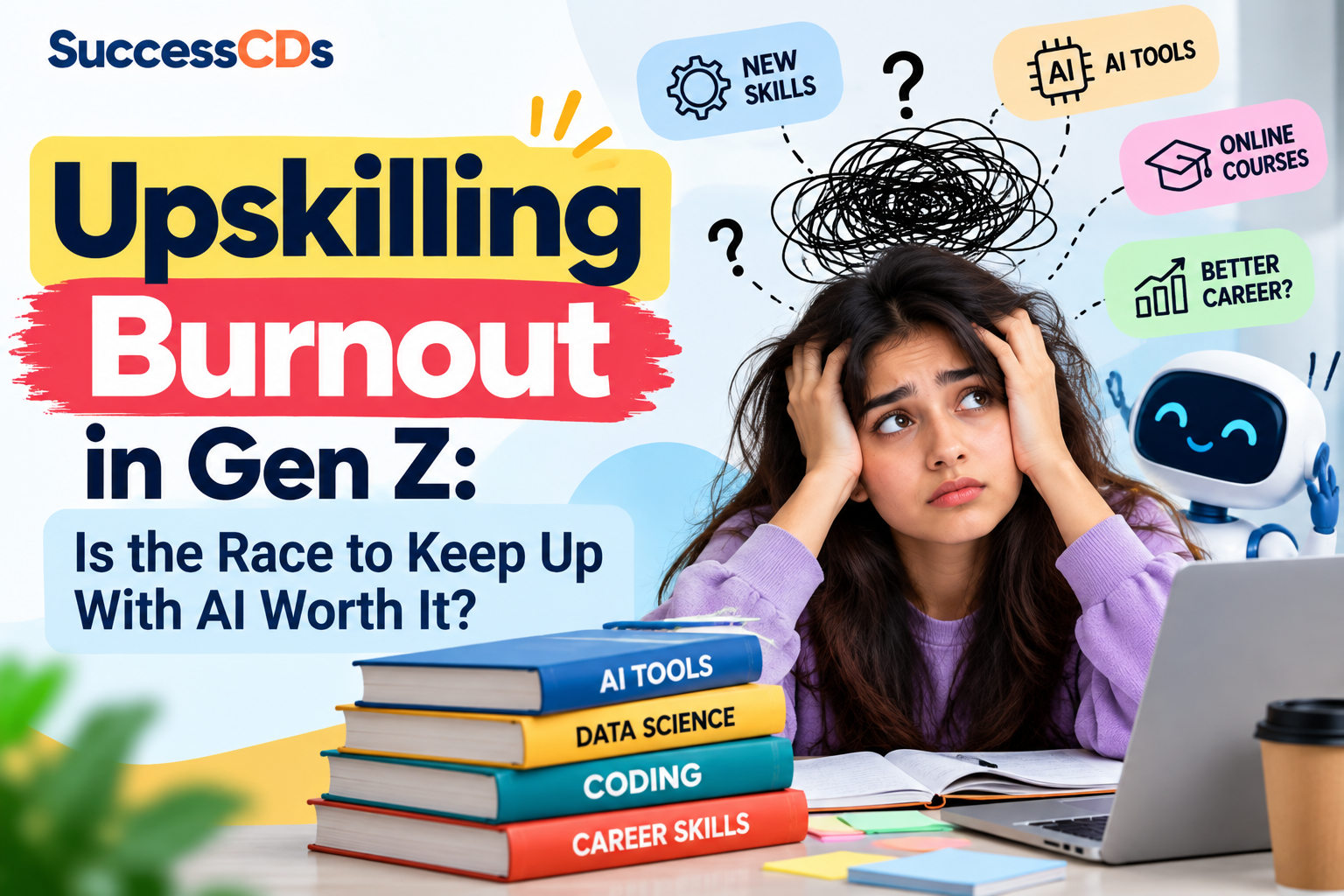
Upskilling burnout, the exhaustion that comes from feeling you must keep learning new skills just to stay employable, now affects roughly 60% of young Indians, according to a September 2026 survey by Emeritus. The same group is also leaning hard on AI: 82% use AI tools at least once a week to learn. If you are a student who feels behind no matter how much you study, you are not alone, and the data suggests the pressure is built into the moment, not into you.
Key Facts
- The report is “India’s GenZ Outlook 2026: Recalculating Education, Ambition, and Success; The No Cap Generation,” published by Emeritus on September 1, 2026.
- It surveyed 1,010 people aged 15 to 28 in major Indian metros, across pre-college, transitioning and early-career stages.
- About 60% say they feel burned out or overwhelmed by the pressure to keep upgrading their skills (one outlet reports “over 60%”, another “60%”).
- 75% still believe learning the right skills keeps them competitive.
- 82% use AI or generative AI tools at least weekly to build skills.
- 65% of early-career respondents say a degree alone no longer guarantees success.
- Sources: The CSR Journal and CXOToday. Both report on the Emeritus survey, which is company-run research, not peer-reviewed.
What the Emeritus Survey Found About Upskilling Burnout
About six in ten young Indians in the survey feel worn down by the expectation to keep learning. That sits next to a stubborn belief: three in four (75%) still think the right skills are what keep them competitive.
So the problem is not that students don’t care. They care a lot, and the finish line keeps moving. When AI tools change what employers ask for every few months, a course you finished in March can feel out of date by October.
The survey also shows how much trust has shifted away from degrees. Among early-career respondents, 65% said a degree on its own is not enough. Taken together, the message young people hear is: get the degree, then keep stacking more.
Why AI Makes the Pressure Feel Heavier
AI is both the cause and the coping tool. 82% of respondents use AI at least weekly to learn, which means the same technology raising the bar is also what they use to try to clear it.
That loop is tiring. Every new tool seems to come with a new skill you “should” learn, and social feeds amplify it. The survey describes the feeling; it does not prove why it happens, so treat the cause as a reasonable reading, not a measured fact.
Note one limit of the data: it covers urban respondents in major metros. Students in smaller towns may face different pressures, and the survey does not tell us.
What This Means for Students
If you feel overwhelmed by the pace of skill-building, the survey says you are in the majority. That is useful in itself, because it shifts the question from “what is wrong with me?” to “how do I pace this?”
For school students in Class 11 and 12
Your priority is still your board exams and entrance preparation. You do not need to learn five AI tools this term. One or two habits, such as using AI to quiz yourself on a chapter, are plenty.
For college students
Employers and surveys keep stressing skills, but a skill list is not a project. One small thing you actually built or finished says more than a dozen half-finished courses.
How to Handle Upskilling Burnout: 5 Practical Steps
Handle upskilling burnout by narrowing your focus and protecting your rest. These steps are general study tips, not medical advice.
- Pick one skill per term. Choose the one most tied to the work you want, and ignore the rest until it is done.
- Set a weekly cap. Decide on a fixed number of hours for extra learning and stop when you hit it.
- Finish small projects. A short, completed project beats an unfinished long course.
- Use AI to practise, not to skip the work. Ask it to quiz you or explain where you went wrong, rather than hand you answers.
- Keep rest on the calendar. Sleep, exercise and time with friends are part of the plan, not a reward after it.
If the pressure is affecting your sleep, mood or daily life for more than a few weeks, talk to a school or college counsellor, a doctor, or a trusted adult. Asking for help early is a normal, sensible step.
Is the Pressure Worth It? What the Survey Does and Doesn’t Say
The survey supports a cautious reading: skills matter to young people, and they are tired. It does not say that more courses lead to better jobs, and it does not measure outcomes like salary or hiring.
It also shows young people want balance. Nearly three in four (about 74%) prioritise work-life balance, and 65% say a successful career does not require a leadership role. Many are redefining success, not just chasing it.
FAQs
Q. What is upskilling burnout?
Ans. Upskilling burnout is the tiredness and overwhelm that comes from feeling you must constantly learn new skills to stay employable. In the Emeritus survey, about 60% of young Indians said they feel it.
Q. Is a degree still worth it in India in 2026?
Ans. The survey does not say degrees are worthless. It found 65% of early-career respondents believe a degree alone is not enough, so most suggest pairing it with practical skills and projects.
Q. How many Indian students use AI to learn?
Ans. In the Emeritus survey of 1,010 people aged 15 to 28, 82% use AI or generative AI tools at least weekly to learn or build skills.
Q. How can I avoid burnout while learning new skills?
Ans. Focus on one skill at a time, set a weekly time limit, finish small projects, and keep sleep and rest in your routine. If stress persists, speak with a counsellor or trusted adult.
Q. Should I learn every new AI tool?
Ans. No. Pick the tools that match your subjects or career goals and learn them well enough to use. Chasing every new tool is a fast route to upskilling burnout.
Next Steps
This week, choose one skill you will work on this term and write down how many hours you will give it. Drop the rest for now. We will keep an eye on new research about student stress and AI, so check back for updates on upskilling burnout and what helps.