
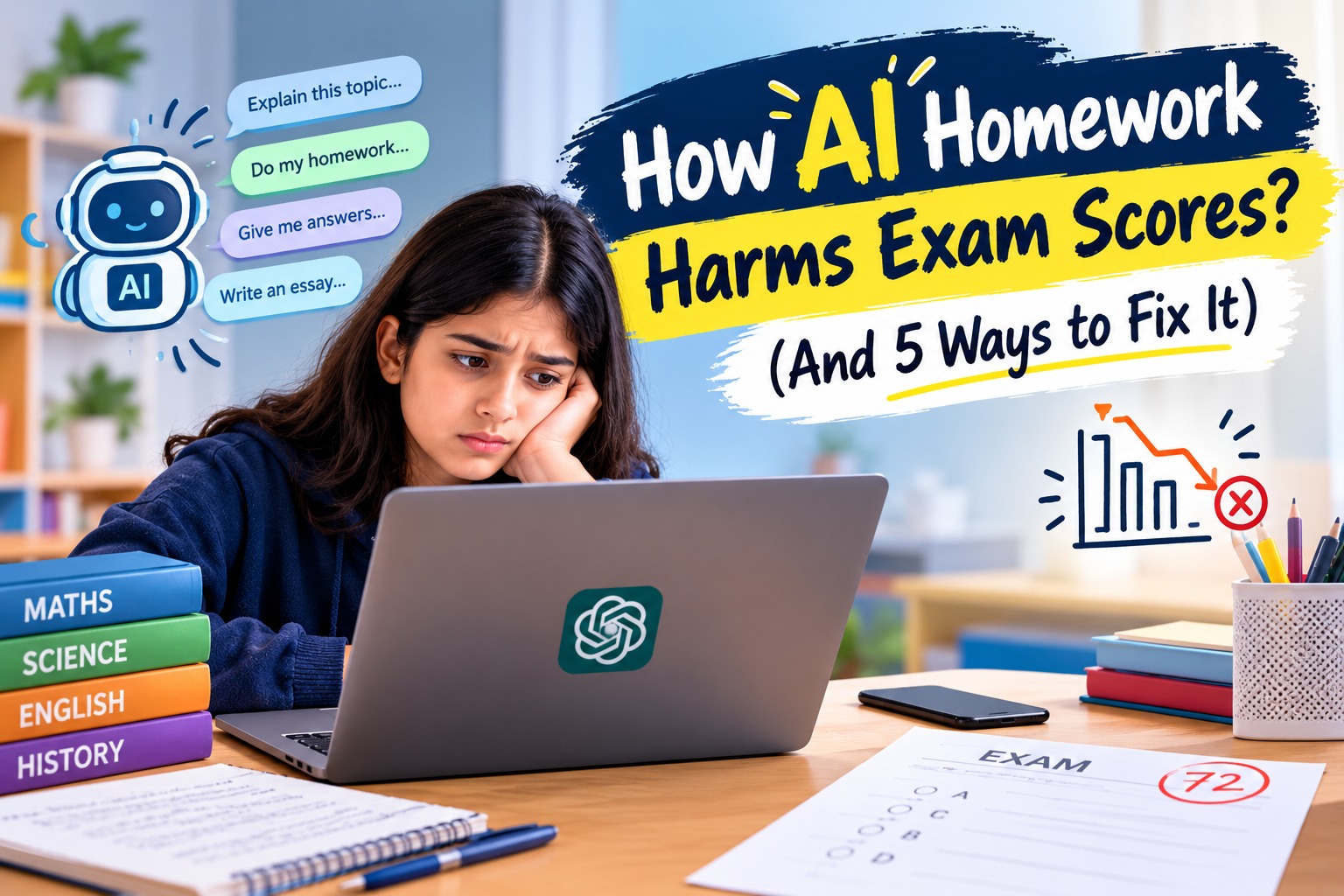
How AI Homework Harms Exam Scores (And 5 Ways to Fix It)
The “illusion of learning” is the term educators are using for students who hand in strong AI-assisted homework but struggle when the AI is taken away. Stories published on 22 and 24 September 2026 describe exactly that pattern, though the hard evidence is still early. This article separates what is documented from what is anecdote, and shows students how to protect their own learning.
Key Facts
- The Washington Post and the Detroit News both ran stories on 22 September 2026 about educators who say AI is hurting students’ thinking, under the headline theme “the illusion of learning” (Washington Post, Detroit News).
- GBH reported on 24 September 2026 that an MIT report warns overreliance on AI can weaken memory and create an illusion of learning, which it calls “cognitive surrender” (GBH).
- In a Brown University economics course, a take-home midterm averaged 96 against a usual 65 to 80. The in-person final averaged 48 (GBH).
- An earlier MIT Media Lab preprint tracked 54 participants writing essays with an AI chatbot, a search engine, or no tools (MIT Media Lab, June 2025).
- Most of this evidence is early, small-scale or anecdotal. Nothing here proves AI harms every student.
What Is the Illusion of Learning?
The illusion of learning is feeling like you understand something because a finished answer is sitting in front of you. Reading a polished AI explanation feels like knowing it. Recalling it in a silent exam hall is a different skill.
Educators quoted by GBH describe a wider shift too: students studying alone, skipping office hours and avoiding group study spaces.
What the Evidence Actually Shows
The clearest example is a single classroom story, not a controlled study. GBH reported that Brown economics professor Roberto Serrano saw a take-home midterm average of 96, well above his historical 65 to 80, with forty perfect scores whose patterns matched ChatGPT output. When he announced an in-person final, 22 of those students dropped the course. The final averaged 48.
That story is striking, but it is one course. It shows what can happen when a take-home task is easy to outsource, not how common it is.
The MIT Research
The MIT Media Lab’s “Your Brain on ChatGPT” preprint is small and not yet peer-reviewed. Fifty-four participants completed the first three sessions. People writing with an AI chatbot showed the weakest brain connectivity, reported the lowest sense of ownership over their essays, and struggled to quote their own work. People who wrote unaided first and then switched to AI showed stronger recall.
Treat this as a signal worth watching, not a verdict. It measured essay writing in a lab, not everyday studying.
How Students Can Avoid the Illusion of Learning
These are practical suggestions drawn from the pattern above, not findings from the studies.
- Draft before you prompt. The MIT participants who worked unaided first did better on recall, so start with your own attempt.
- Test yourself with the screen off. Write out what you remember, then check it.
- Treat homework as exam practice. If you couldn’t redo it in class, you haven’t learned it yet.
- Practise under exam conditions. Do timed past papers with no AI, notes or phone.
- Study with people. Explaining a topic to a classmate exposes gaps faster than rereading an AI summary.
What This Means for Class 12 and College Students
Board and university exams are still mostly written and unaided, so the gap between AI-assisted homework and independent performance is where marks are lost. Use AI as a tutor that asks you questions, not as a ghostwriter, and follow your school’s or college’s own rules on AI use.
FAQ
Q. What does “illusion of learning” mean with AI?
It means feeling that you understand material because AI produced a clear answer, without having practised recalling or applying it yourself. The gap usually shows up in exams.
Q. Does using ChatGPT for homework hurt exam results?
It can if the AI does the thinking for you. The evidence so far is early: one professor’s course results and a small MIT preprint, not a large controlled study.
Q. What is “cognitive surrender”?
GBH uses the term for an MIT report’s warning that overreliance on AI can weaken memory. It describes handing over your thinking to the tool.
Q. Can students still use AI to study?
Yes, for practice questions, feedback and explanations after you have tried the work yourself. Just test your knowledge without it before exams.
Next Steps
This week, take one piece of AI-assisted homework and redo it from memory with no help. If you get stuck, that is exactly where to study. The research on the illusion of learning is moving fast, so check back for updates as larger studies appear.