

Poems by Blake Summary and Line by Line Explanation
CBSE Class 12 English (Elective) Poem 3 – Poems by Blake Summary, Explanation along with Difficult Word Meanings from Kaleidoscope Book Poetry
Poems by Blake Summary – Are you looking for the summary, theme and lesson explanation for CBSE 12 English (Elective) Poem 3 – Poems by Blake from English Kaleidoscope Book Poetry. Get Lesson summary, theme, explanation along with difficult word meanings
CBSE Class 12 English (Elective) Poem 3- Poems by Blake
William Blake
In Poems by Blake, the poems consist of two poems, The Divine Image, which is a part of Songs of Innocence and The Human Abstract, which is a part of Songs of Experience. The Divine Image has counterparts in The Human Abstract. The Divine Image praises the virtues of delight like mercy, pity, peace and love. In The Human Abstract, Blake questions the existence of these virtues as humans have created vices.
- Poems by Blake Summary
- Poems by Blake Summary in Hindi
- Poems by Blake Theme
- Poems by Blake Explanation
- Poems by Blake Poetic Devices
Related:
Poems by Blake: Summary
The Divine Image
When people are in distress, they ask God for his mercy, pity, peace, and love. Qualities such as mercy, pity, peace, and love are personified because they are what people seek in their suffering and should be valued.
These moral qualities bring joy to individuals, who, as a result, express gratitude for the good. Only God possesses the moral attributes of mercy, pity, peace, and love, and any person embodying these traits is considered to be a child of God under his protection.
These moral qualities are primarily associated with God and subsequently with humankind, highlighting the connection between humanity and the divine, akin to a father-son relationship. The moral values can be likened to genes transferred from God to people.
Blake elaborates on these personified virtues individually and their connections to other human beings. Mercy lives in one’s heart and embodies empathy towards others, requiring a good heart to forgive. Humans show ‘pity’ in their concerns and feel sorrow for the misfortunes of others, as evident in their behaviour.
When individuals love all other people, despite their flaws, they become a reflection of the divine. Peace becomes a garment that every person can choose to wear by embodying virtues, regardless of their circumstances. Blake contends that anyone, irrespective of their faith, culture, or nationality, who prays during hardship is, in essence, praying to humans, who represent God.
According to Blake, every person possesses within them the virtues of mercy, pity, peace and love. Blake urges individuals to love every other person because they reflect the divine, regardless of their religion, be they heathen, Jew, or Turk. Blake believes that if virtues such as Mercy, Pity, Peace, and Love exist within a person, then God also dwells within them. In this context, Blake emphasizes the discrimination against Christianity, asserting that God is present in heathens, Jews, and Turks as well.
The Human Abstract
Blake opens the poem, The Human Abstract, by claiming that the four virtues pity, mercy, peace, and love, emerge solely from suffering. He asserts that virtues such as pity, mercy, and peace are a product of humanity’s struggles, sadness, and vulnerabilities. Humankind has brought out vices out of virtues. He suggests that one experiences sorrow for others’ misfortunes only in times of poverty. If everyone were rich, there would be no need for pity. Likewise, compassion or forgiveness would be unnecessary if everyone were content. Blake explains that peace exists among people when they share their fears. However, as individuals become more self-centred, their insecurities result in conflicts. Only through these virtues does cruelty come into existence. Cruelty is depicted as a cunning vice that carefully sets traps and spreads bait. Cruelty represents the harshness of organized religion, which creates traps and lures to ensnare individuals to become its followers. Blake describes the tree that grows from the seeds of Humility. In this scenario, Cruelty would bring up his sacred fears and nourish the ground with its tears, nurturing the roots of Humility beneath it. Blake argues that organized religions propagate false religious fears, drip their insincere beliefs onto the ground, and plant seeds of low views of humanity among humans. The four virtues give rise to two vices: the cruelty of religion and the humility among people. As the tree flourishes, it spreads sorrow and confusion among individuals. The term ‘mystery’ serves as a metaphor for the systems of myths and rituals tailored to lure followers. This system of myths and rituals disseminates sorrow throughout humanity. The Caterpillar and Fly consume these narratives. The ‘caterpillar’ and ‘fly’ symbolize clergy and other religious leaders who thrive on the religious system. The “fruit” of religion, appearing bright red and sweet, is deceptively healthy for humans, yet it is “the fruit of Deceit,” which is inherently false. Blake illustrates the birds on the tree. The Raven, a black bird with a harsh call, nests in the densest shade of this tree. The raven signifies death and the destructive tendencies of organized religion. It’s nest, located in the “thickest shade,” implies the secretive and obscure nature of religion. Blake underscores that organized religion ultimately leads to ruin. All gods of the sea and Earth look through nature in search of this tree, but their quest proves fruitless as it only grows in the human mind. The tree alludes to the biblical tree of Knowledge of Good and Evil, which resides solely within human consciousness. Organized religion is a construct stemming from human suffering. Good and Evil don’t exist in reality but rather creations of the human mind, where the tree of organized religion flourishes.
Summary of the Poems by Blake in Hindi
दिव्य छवियाँ
जब लोग संकट में होते हैं, तो वे भगवान से उनकी दया, दया, शांति और प्रेम की प्रार्थना करते हैं। दया, दया, शांति और प्रेम जैसे गुणों को व्यक्त किया जाता है क्योंकि वे वही हैं जो लोग अपनी पीड़ा में चाहते हैं और उन्हें महत्व दिया जाना चाहिए।
ये नैतिक गुण व्यक्तियों के लिए खुशी लाते हैं, जो परिणामस्वरूप, अच्छे के लिए कृतज्ञता व्यक्त करते हैं। केवल भगवान के पास दया, दया, शांति और प्रेम के नैतिक गुण हैं, और इन लक्षणों को मूर्त रूप देने वाले किसी भी व्यक्ति को उनके संरक्षण में भगवान की संतान माना जाता है।
ये नैतिक गुण मुख्य रूप से ईश्वर और बाद में मानव जाति के साथ जुड़े हुए हैं, जो पिता-पुत्र के रिश्ते के समान मानवता और दिव्य के बीच संबंध को उजागर करते हैं। नैतिक मूल्यों की तुलना भगवान से लोगों में स्थानांतरित जीन से की जा सकती है।
ब्लेक व्यक्तिगत रूप से इन व्यक्तिगत गुणों और अन्य मनुष्यों के साथ उनके संबंधों के बारे में विस्तार से बताते हैं। दया किसी के दिल में रहती है और दूसरों के प्रति सहानुभूति का प्रतीक है, जिसे क्षमा करने के लिए एक अच्छे दिल की आवश्यकता होती है। मनुष्य अपनी चिंताओं में ‘दया’ दिखाते हैं और दूसरों के दुर्भाग्य के लिए दुख महसूस करते हैं, जैसा कि उनके व्यवहार में स्पष्ट है।
जब व्यक्ति अपनी खामियों के बावजूद अन्य सभी लोगों से प्यार करते हैं, तो वे दिव्य का प्रतिबिंब बन जाते हैं। शांति एक ऐसा परिधान बन जाता है जिसे हर व्यक्ति अपनी परिस्थितियों की परवाह किए बिना गुणों को मूर्त रूप देकर पहनने का विकल्प चुन सकता है। ब्लेक का तर्क है कि कोई भी व्यक्ति, चाहे वह किसी भी धर्म, संस्कृति या राष्ट्रीयता का हो, जो कठिनाई के दौरान प्रार्थना करता है, वह वास्तव में मनुष्यों से प्रार्थना करता है, जो भगवान का प्रतिनिधित्व करते हैं।
ब्लेक के अनुसार, प्रत्येक व्यक्ति के भीतर दया, दया, शांति और प्रेम के गुण होते हैं। ब्लेक व्यक्तियों से आग्रह करते हैं कि वे हर दूसरे व्यक्ति से प्यार करें क्योंकि वे दिव्य को प्रतिबिंबित करते हैं, चाहे वे किसी भी धर्म के हों, चाहे वे यहूदी हों या तुर्क। ब्लेक का मानना है कि अगर दया, दया, शांति और प्रेम जैसे गुण हैं
एक व्यक्ति के भीतर मौजूद है, तो भगवान भी उनके भीतर रहते हैं। इस संदर्भ में, ब्लेक ईसाई धर्म के खिलाफ भेदभाव पर जोर देते हुए कहते हैं कि ईश्वर अन्यजातियों, यहूदियों और तुर्कों में भी मौजूद है।
द ह्यूमन एब्स्ट्रैक्ट
ब्लेक ने कविता, द ह्यूमन एब्स्ट्रैक्ट की शुरुआत यह दावा करते हुए की कि चार गुण दया, दया, शांति और प्रेम, पूरी तरह से पीड़ा से उत्पन्न होते हैं। उनका कहना है कि दया, दया और शांति जैसे गुण मानवता के संघर्षों, उदासी और कमजोरियों का परिणाम हैं। मानव जाति ने सद्गुणों से बुराइयों को बाहर निकाला है। उनका सुझाव है कि कोई व्यक्ति केवल गरीबी के समय में ही दूसरों के दुर्भाग्य के लिए दुःख का अनुभव करता है। अगर हर कोई अमीर होता तो दया करने की कोई जरूरत नहीं होती। इसी तरह, अगर हर कोई संतुष्ट होता तो करुणा या क्षमा अनावश्यक होती। ब्लेक बताते हैं कि लोगों के बीच शांति तब होती है जब वे अपने डर को साझा करते हैं। हालाँकि, जैसे-जैसे व्यक्ति अधिक आत्म-केंद्रित हो जाते हैं, उनकी असुरक्षाओं के परिणामस्वरूप संघर्ष होते हैं। इन गुणों के माध्यम से ही क्रूरता अस्तित्व में आती है। क्रूरता को एक चालाक बुराई के रूप में चित्रित किया गया है जो सावधानीपूर्वक जाल बिछाती है और चारा फैलाती है। क्रूरता संगठित धर्म की कठोरता का प्रतिनिधित्व करती है, जो व्यक्तियों को उनके अनुयायी बनने के लिए जाल और प्रलोभन पैदा करती है। ब्लेक विनम्रता के बीज से उगने वाले पेड़ का वर्णन करते हैं। इस परिदृश्य में, क्रूरता अपने पवित्र भय को सामने लाएगी और अपने आंसुओं से जमीन को पोषित करेगी, जिसके नीचे विनम्रता की जड़ें पोषित होंगी। ब्लेक का तर्क है कि संगठित धर्म झूठे धार्मिक भय का प्रचार करते हैं, अपने निष्ठाहीन विश्वासों को जमीन पर गिरा देते हैं और मनुष्यों के बीच मानवता के निम्न विचारों के बीज बोते हैं। चार गुण दो बुराइयों को जन्म देते हैंः धर्म की क्रूरता और लोगों के बीच विनम्रता। जैसे-जैसे पेड़ फलता-फूलता है, यह लोगों के बीच दुख और भ्रम फैलाता है। ‘रहस्य’ शब्द अनुयायियों को लुभाने के लिए बनाए गए मिथकों और अनुष्ठानों की प्रणालियों के लिए एक रूपक के रूप में कार्य करता है। मिथकों और अनुष्ठानों की यह प्रणाली पूरी मानवता में दुख का प्रसार करती है। कैटरपिलर और फ्लाई इन कथाओं का उपभोग करते हैं। ‘कैटरपिलर’ और ‘फ्लाई’ पादरी और अन्य धार्मिक नेताओं का प्रतीक हैं जो धार्मिक प्रणाली पर फलते-फूलते हैं। धर्म का “फल”, जो चमकीला लाल और मीठा दिखाई देता है, मनुष्यों के लिए भ्रामक रूप से स्वस्थ है, फिर भी यह “छल का फल” है, जो स्वाभाविक रूप से गलत है। ब्लेक पेड़ पर पक्षियों का चित्रण करता है। रेवेन, एक कठोर कॉल वाला एक काला पक्षी, इस पेड़ की घनी छाया में घोंसला बनाता है। कौआ मृत्यु और संगठित धर्म की विनाशकारी प्रवृत्तियों को दर्शाता है। “सबसे मोटी छाया” में स्थित इसका घोंसला धर्म की गुप्त और अस्पष्ट प्रकृति को दर्शाता है। ब्लेक इस बात को रेखांकित करते हैं कि संगठित धर्म अंततः विनाश की ओर ले जाता है। समुद्र और पृथ्वी के सभी देवता इस पेड़ की खोज में प्रकृति के माध्यम से देखते हैं, लेकिन उनकी खोज निष्फल साबित होती है क्योंकि यह केवल मानव मन में बढ़ता है। पेड़ अच्छे और बुरे के ज्ञान के बाइबिल के पेड़ को इंगित करता है, जो पूरी तरह से मानव चेतना के भीतर रहता है। संगठित धर्म मानव पीड़ा से उपजी एक संरचना है। अच्छाई और बुराई वास्तविकता में मौजूद नहीं हैं, बल्कि मानव मन की रचनाएँ हैं, जहाँ संगठित धर्म का वृक्ष पनपता है।
Themes of the Poems by Blake
The Divine Image
Humankind and Divinity
William Blake in the poem ‘The Divine Image’ has emphasised that humanity was made in god’s image, humanity embodies the god’s virtues of delight like mercy, pity, peace and love, as he has personified these virtues as human beings. This connection with god has also connected humanity, as, according to Blake, every human being embodies divinity, regardless of their religion, culture, and country.
Divine Image
William Blake has personified the virtues of delight like mercy, pity, peace and love in the human form. It emphasises that everybody carries god with them. The reference to God’s ‘Divine Image’ on the earth is the humankind walking in the ‘human form divine’. The repetition of the phrase ‘pray in their distress’ emphasises that humans not only pray to god, but the goodness and kindness in humankind.
The Human Abstract
Organized Religion and Sufferings
William Blake in his poem ‘The Human Abstract’ has emphasised that the delights of virtues like mercy, pity, peace and love have not only given birth to vices like cruelty, humility, and deceit but have also given birth to the organised religion, which only brings sufferings to humankind. The clergymen of religion use the religious myth to make humankind the followers of this false religion.
Evil and Good
The poem explores the dangers of religious ideas about good and evil. According to William Blake, evil and good don’t exist in reality but are the constructs of humans and the clergymen of false religion. Through evil and good constructs, these clergymen control humankind by making them the followers of these false religions.
Poems by Blake: Poem Explanation
I
The Divine Image
Stanza: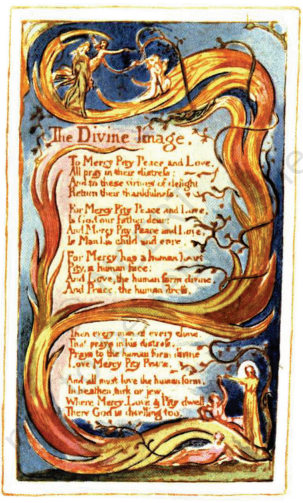
To Mercy, Pity, Peace, and Love
All pray in their distress;
And to these virtues of delight
Return their thankfulness.
For Mercy, Pity, Peace, and Love
Is God our father dear,
And Mercy, Pity, Peace, and Love
Is Man, his child and care.
Mercy has a human heart,
Pity a human face,
And Love, the human form divine,
And Peace, the human dress.
Word meanings
distress: suffering
virtues: moral qualities
mercy: compassion or forgiveness shown towards someone whom it is within one’s power to punish or harm.
pity: feel sorrow for the misfortunes of.
Explanation of the above stanza—When humans are suffering, they pray to God for his mercy, pity, peace, and love. The moral qualities like mercy, pity, peace, and love are personified, as they are the objects of prayer in suffering and should be cherished.
These moral qualities bring happiness to humans, who in return feel thankful to the god. Only God has moral qualities like mercy, pity, peace, and love, and if any man who has these qualities, he would be considered God’s child. He would be under his care. These moral qualities are first related to God and then to man, to emphasise the bond between humanity and the divine through father-son relationships. The moral values, too, are like genes passed down from God to humans. Blake describes these personified virtues separately and how they relate to other humankind. Mercy resides in one’s heart and compassion towards others, and it takes a good heart to forgive. Humans who are concerned and experience sorrow for the misfortunes of others, which could be seen in their disposition. When humans love every other human, regardless of their vices, they become the embodiment of divinity. Peace becomes a dress every human can choose to wear if they carry virtues within themselves, no matter what the situation they are in.
Stanza:
Then every man, of every clime,
That prays in his distress,
Prays to the human form divine,
Love, Mercy, Pity, Peace.
And all must love the human form,
In heathen, Turk, or jew;
Where Mercy, Love, and Pity dwell
There God is dwelling too.
Word meanings
clime: of different region
dwell: living in a specific place
heathen: a person who does not belong to a widely held religion (especially one who is not a Christian, Jew, or Muslim) as regarded by those who do.
Explanation of the above stanza— Blake argues that everyone, regardless of their religion, culture, or country, who prays in suffering is, in reality, praying to the humans, the embodiment of God. According to Blake, every human being carries within themselves the virtues of love, mercy, peace, and pity. Blake persuades humans to love every other human being as they are an embodiment of God, no matter what their religion, whether they are Heathen, Jew, or Turk. Blake feels that if virtues like peace, pity, love, and mercy reside in a human, God resides, too, within them. Here, Blake highlights discrimination of Christianity, as he feels that God resides in Heathens, Jews and Turks, too.
II
The Human Abstract
Stanza:
Pity would be no more
If we did not make somebody Poor;
And Mercy no more could be
If all were as happy as we.
And mutual fear brings peace,
Till the selfish loves increase:
Then Cruelty knits a snare,
And spreads his baits with care.
Word meanings
pity: feel sorrow for the misfortunes of.
mercy: compassion or forgiveness shown towards someone whom it is within one’s power to punish or harm.
snare: trap
baits: food placed on a trap
Underneath: situated below
knit: made by interlocking loops
Explanation of the above stanza— Blake begins the poem, The Human Abstract, by arguing about the need for the four virtues, pity, mercy, peace and love, which arise only in times of suffering. Blake argues that Christian values like pity, mercy and peace exist because of humankind’s poverty, unhappiness and insecurities. Humankind has created vices through virtues. He argues that one would feel sorrow for the misfortunes of others only when they are poor. If everyone were rich, there would be no need for pity. There would be no need for compassion or forgiveness, if everyone would be happy. Blake describes that peace exists among people when they share fears. Yet, as they become selfish, their insecurities lead to conflicts. Cruelty is personified as a sly vice, who makes the trap and spreads the food with care. It’s only through these four virtues that cruelty arises in humans. Cruelty symbolises the Cruelty of organized religion, that makes the trap and sets the bait to entrap people.
Stanza: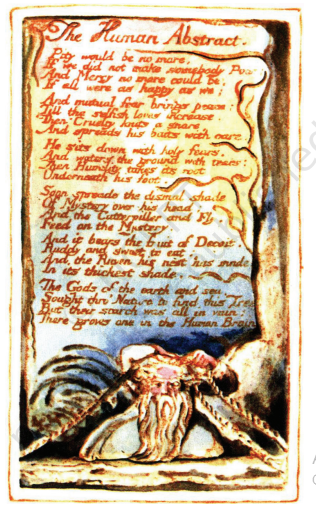
He sits down with holy fears,
And waters the ground with tears;
Then Humility takes its root
Underneath his foot.
Soon spreads the dismal shade
Of Mystery over his head;
And the Caterpillar and Fly
Feed on the Mystery.
And it bears the fruit of Deceit,
Ruddy and sweet to eat;
And the Raven his nest has made
In its thickest shade.
Word meanings
dismal: sadness
mystery: leaves
dismal: sadness
deceit: fraud
ruddy: damned fruit
humility: the quality of having a modest or low view of one’s importance.
Explanation of the above stanza— Blake here describes the tree that grows out of the seeds of Humility. Cruelty would then sit down with holy fears and water the ground with his tears, only to grow the roots of Humility under his foot. Blakes argues that these organized religions would then bring up false religious fears, water the ground with their hypocritical false religions, to sow the seed of a low view regarding humans among humankind. The four virtues give rise to two vices, cruelty of Religion and Humility among the people. As the Humility tree would grow, it would spread sadness and confusion among the people. The ‘mystery’ is the metaphor for the system of myths and rituals that are especially designed to captivate followers. The system of myths and rituals spread sadness among humankind. The Caterpillar and Fly Feed upon them. The ‘caterpillar’ and ‘fly’ are metaphors for the clergy and other religious figures, who feed off the system of religion. The “fruit” of religion, which is bright red and sweet, only appears to be healthy to humans, is “the fruit of Deceit” which is fraudulent. Blake describes the birds on the tree. Raven, a black bird with an unpleasant voice, has its nest in the thickest shade of this tree. The raven symbolizes death and the destructive nature of organized religion. The raven’s nest is in the “thickest shade”, which suggests the secrecy and obscurity of religion. Blake, here, emphasises that organized religion only brings destruction.
Stanza:
The Gods of the earth and sea
Sought thro’ Nature to find this Tree;
But their search was all in vain:
There grows one in the Human Brain.
Word meanings
sought: search for
thro’: through
vain: producing no result or useless.
Explanation of the above stanza— All the gods of sea and Earth search through nature to find this tree, but their search was futile, as it grows in the human brain. The tree is an allusion to the biblical tree of Knowledge of Good and Evil, which exists only in the human mind. Organized religion is a human construct for suffering. Good and Evil don’t exist in reality but are products of the human brain, where the tree of organized religion grows.
Note: Blake’s poetry was published in a manner most unusual in literature and art history; he manufactured each copy. The verses were not typeset but were, with the engravings that illustrated them, cut into copper plates. The pages themselves were illuminated in water colours. Thus, Blake can be called the first multi-media artist.
Poems by Blake: Poetic Devices
Alliteration
In alliteration, consonant sounds in two or more neighboring words or syllables are repeated to grasp the reader’s attention, making them focus on a particular line or section. In Blake’s poem ‘The Divine Image’, he has used alliteration in phrases like ‘Pity, Peace’, ‘their thankfulness’, ‘human heart’. In William Blake’s ‘The Human Abstract’, he has used alliteration in the phrases like ‘Soon spreads’
Repetition
Repetition in poetry is the repetition of words, phrases, lines, or stanzas. It is a poetic device that’s used to create rhythm, emphasize ideas or feelings, or create a sense of urgency. In William Blake’s ‘The Divine Image’, the repetition of ‘To Mercy, Pity, Peace, and Love’, emphasises the need for these four virtues in humankind. The Repetition of ‘human form’ emphasises God in other human beings. The repetition of ‘pray in their distress’ emphasises the need for the virtues of delight in suffering.
Oxymoron
An oxymoron is a figure of speech, usually one or two words, in which seemingly contradictory terms appear side by side. In William Blake’s ‘The Human Abstract’, “selfish love” is an oxymoron because it combines two contradictory terms, “selfish” which implies prioritizing one’s own needs, and “love” which inherently suggests putting another person’s needs first. The ‘holy fears’ is an oxymoron, as ‘holy’ means dedicated to God and ‘fears’ means to be afraid of something.
Personification
Personification is a figure of speech that is used to attribute human characteristics to something that is not human. Blake’s poem ‘The Divine Images’ has personified Mercy as ‘human heart’ as it resides in one’s heart, compassion towards others, and it takes a good heart to forgive. He has personified pity as ‘human face’ as humans who are concerned and experience sorrow for the misfortunes of others, which could be seen in their disposition. He has compared love to ‘human form divine’ as when humans love every other human, regardless of their vices, they become the embodiment of divinity. Blake has compared peace to ‘human dress’ as every human can choose to wear it if they carry virtues within themselves, no matter what the situation they are in. In William Blake’s ‘The Human Abstract’ cruelty is personified. Cruelty would then sit down with holy fears and water the ground with his tears, only to grow the roots of Humility under his foot. These organized religions would then bring up false religious fears, water the ground with their hypocritical false religions, to sow the seed of a low view of themselves among the humankind. Blake has used personification in The Human Abstract by giving Pity, Poor, Mercy, Cruelty, Humility, Mystery, Caterpillar, fly, Deceit and Raven.
Assonance
Assonance is a figure of speech that is characterised by the use of words having similar vowel sounds consecutively. In William Blake’s ‘The Divine Image’, he has used the repetition of the vowel ‘a’ in the line ‘a human face’ and the repetition of vowel ‘e’ in the lines ‘these virtues of delight’, ‘Return their thankfulness’ and ‘Then every man, of every clime’. In William Blake’s ‘The Human Abstract’, he has used the repetition of the vowel ‘e’ in the lines ‘the selfish loves increase’, the repetition of vowels ‘e’ and ‘a’ in the lines ‘the earth and sea’ and the repetition of vowel ‘e’in the line ‘Feed on the Mystery’.
Consonance
Consonance is the use of words with similar consonant sounds in a sentence or a particular context. In William Blake’s ‘The Divine Image’, the repetition of letter ‘t’ in the lines ‘Return their thankfulness’ and ‘to these virtues of delight’ and the repetition of the letter ‘r’ in the line ‘our father dear’. In William Blake’s ‘The Human Abstract’, the repetition of letter ‘t’ in the lines ‘Then Humility takes its root’, the repetition of the letter ‘s’ in the lines ‘Soon spreads the dismal shade’ and the repetition of the letter ‘t’ in the lines ‘Then Humility takes its root’.
Symbolism
Symbolism is a literary device that uses one thing to represent another. The tree symbolizes the abstract qualities of the human mind. The raven symbolizes death and the destructive nature of organized religion. The human brain is symbolized by a tree, which represents the negative abstract characteristics that grow from it. Cruelty is symbolized by a tree that takes root in the human mind and spreads a dark shadow over everything.
Imagery
Imagery is a literary device that uses figurative language to evoke a sensory experience or to paint a picture for the reader with words. In William Blake’s ‘The Human Abstract’, he has used the imagery to describe Cruelty in the lines ‘Then Cruelty knits a snare/And spreads his baits with care’. Cruelty, a vice, then makes the trap and spreads the food with care. It’s only through these four virtues that cruelty arises in humans. Cruelty would then sit down with holy fears and water the ground with his tears, only to grow the roots of Humility under his foot.
Metaphor
Metaphor is a word or phrase used to describe somebody/something else, in a way that is different from its normal use, to show that the two things have the same qualities and to make the description more powerful. The ‘caterpillar’ and ‘fly’ are metaphors for the clergy and other religious figures, who feed off the system of religion.
The raven symbolizes death and the destructive nature of organized religion. The raven’s nest is in the “thickest shade”, which suggests the secrecy and obscurity of religion. The “fruit” of religion is “the fruit of Deceit” which is fraudulent. The tree’s fruit is a metaphor for the deceptive illusions of religion. Cruelty is the metaphor for the Cruelty of organized religion. The ‘mystery’ is the metaphor for the system of myths and rituals that are especially designed to captivate followers. The tree’s “caterpillars” and “flies” are metaphors for the clergy who live off the church. The tree’s “raven” is a symbol of death and evil.
Extended Metaphor
In William Blake’s poem ‘The Human Abstract’, he has used the extended metaphor of a tree growing in the human brain to be an embodiment of an organized religion and societal structures. The tree represents religion, which Blake believed was a source of suffering, ignorance, and corruption. Cruelty sits down with holy fears and waters the ground with his tears, only to grow the roots of Humility under his foot. Blake argues that these organized religions would then bring up false religious fears, water the ground with their hypocritical false religions, to sow the seed of a low view regarding humans among humankind. The four virtues give rise to two vices, cruelty of Religion and Humility among the people. As the Humility tree would grow, it would spread sadness and confusion among the people. The ‘mystery’ is the metaphor for the system of myths and rituals that are especially designed to captivate followers. The system of myths and rituals spread sadness among humankind.
Allusion
Allusion is a figure of speech that makes a reference to someone or something by name without explaining how it relates to the given context so that the audience must realize the connection in their minds. The tree is an allusion to the biblical tree of Knowledge of Good and Evil, which exists only in the human mind. The fruit of religion is a damned fruit of fraud, which Blake caution not to eat, no matter how tempting it might be.
Conclusion:
The poems ‘The Divine Image’ and ‘The Human Abstract’ by William Blake give a profound moral lesson on virtue, vices and organized religion. Students can take help from the post to understand the lesson and also learn the difficult word meanings to get a better grasp of the poem. This lesson includes the summary of the Poems ‘The Divine Image’ and ‘The Human Abstract’ by Blake, which will help students of class 12 to get a quick recap of the poem.